Letter to the Brethren – February 14, 2005

Download PDF

Dear Brethren and Friends,

In the beginning months of this year, we have been witnessing the continuing and gathering march of events that were long ago prophesied to occur. God has left an unerring record of warning for all who would listen to Him, through His inspired Word and through the inspiration of His servants whom He has called to faithfully proclaim His gospel of hope.

The very things that we report, through the weekly updates, the StandingWatch programs, the weekly sermons and sermonettes as well as in our booklets, are those significant occurrences that parallel and actually mark fulfillment of Biblical prophecy. We stand as witnesses to the global restructuring of world powers, all of which will be used by God to usher in His Kingdom under the all-powerful direction of Jesus Christ!

Beyond carefully watching these cataclysmic changes in our generation, we need to look closely at the Church of God that Jesus Christ established, both its historical record and the very compelling prophetic statements that apply to our time!

For many of us who have been around the Church of God for several decades, we now recognize that the true faith has undergone a powerful and destructive assault from Satan. The Bible reveals that these kinds of things were prophesied to occur. Yet, the Word of God also shows that there is coming an even more intense attack from Satan against God’s people!

Here is what Jesus Christ said to His own true disciples, a statement that transcended those alive then to actually hear His words, and a warning that finds dramatic fulfillment in the closing generation of our age: ìAnd Jesus answered and said to them: “Take heed that no one deceives you” (Matthew 24:4).

How can we know if we have been deceived? For each one of us who now reads these words, is there any possibility that we have been deceived?

This is a fair and necessary question we each must weigh. We will find our answer by using the immutable standard of God’s Word along with a humble, willing and contrite heart asking for God’s help in the matter (See Isaiah 66:2). There are times when we must take the approach that David had, to make certain that we are truly serving God and fulfilling His will in our lives. You can read about David’s remarkable attitude and example in Psalm 51.

One important condition identified by Jesus that would challenge His followers is found in Matthew 24:12: “And because lawlessness will abound, the love of many will grow cold.” For abound, Lamsa translates this as, “the growth of iniquity”; the NASB translates this as, “increased”; and, the Living Bible translates the verse, “Sin will be rampant everywhere and will cool the love of many.”

Have we allowed our love to grow cold? Are we guilty of fulfilling this prophecy through the deception of withdrawing into an attitude that ONLY involves getting ourselves ready for the establishment of God’s Kingdom?

In the closing period of the very first generation of the Church of God, Paul cautioned those of his day that dramatic events were still on the future horizon before Jesus Christ would return: “Now, brethren, concerning the coming of our Lord Jesus Christ and our gathering together to Him, we ask you, not to be soon shaken in mind or troubled, either by spirit or by word or by letter, as if from us, as though the day of Christ had come” (2 Thessalonians 2:1-2).

Next, note how Paul continues his explanation: “Let no one deceive you by any means: for that Day will not come unless the falling away comes first, and the man of sin is revealed, the son of perdition, who opposes and exalts himself above all that is called God or that is worshiped, so that he sits as god in the temple of God, showing himself that he is God” (2 Thessalonians 2:3-4).

Why would some fall away?

Because their love for God’s truth would grow cold, and they would turn back to this evil world which stands in rebellion against God! Peter, also writing in the waning period of the Church of God in his lifetime, speaks in 2 Peter, chapter 2, of false prophets deceiving the people of God: “For when they speak great swelling words of emptiness, they allure through the lusts of the flesh, through lewdness, the ones who have actually escaped from those who live in error. While they promise them liberty, they themselves are slaves of corruption; for by whom a person is overcome, by him also he is brought into bondage” (verses 18-19).

Peter also records this sobering admonition: “For if, after they have escaped the pollutions of the world through the knowledge of the Lord and Savior Jesus Christ, they are again entangled in them and overcome, the latter end is worse for them than the beginning. For it would have been better for them not to have known the way of righteousness, than having known it, to turn from the holy commandment delivered to them” (2 Peter 2:20-21).

In Revelation 1, verse 20, Jesus Christ reveals that “the seven lampstands which you [John] saw are the seven churches.” What follows in chapters 2 and 3 are specific messages to these seven churches, now correctly understood as including the seven distinct eras of the Church of God from the time when He first established the Church until the time of His return.

In considering the state of the Church of God at the present time, we need to understand what Christ says to ALL of the churches. In addition, let us take particular note of the final two eras of God’s Church, Philadelphia and Laodicea.

The evidence here indicates that these two eras co-exist (remnants of other eras may have survived as well). Revelation 3:10 says: “I also will keep you from the hour of trial which shall come upon the whole world.” In verses 16 and 18, Jesus states: “I will vomit you out of My mouth… I counsel you to buy from Me gold refined in the fire”. We understand that a period of unparalleled suffering is being addressed in both passages, in the one, protection is offered, while in the other, severe correction during a time called “GREAT TRIBULATION” must be endured.

We also find explained the reasons for the different pronouncements. As in the case of all the eras, Jesus states, “I know your works” (Revelation 3:8). Continuing the message to Philadelphia in verse 8: “See, I have set before you an open door, and no one can shut it; for you have a little strength, have kept My word, and have not denied My name.”

In the message to Laodicea, Jesus makes this telling statement: “Behold, I stand at the door and knock” (Revelation 3:20). Why did THEY shut their door to Jesus? Here is the answer: “I know your works, that you are neither cold nor hot. I could wish you were cold or hot. So then, because you are LUKEWARM, and neither cold nor hot, I will vomit you out of My mouth” (Revelation 3:15-16).

Notice how the Laodiceans are self-deceived: “Because you say, ‘I am rich, have become wealthy, and have need of nothing, and DO NOT KNOW that you are wretched, miserable, poor, blind, and naked'” (Revelation 3:17). The spiritual applications for all of us are inescapable, these are spiritual issues relating to how we bear the fruits of God’s Holy Spirit as outlined in Galatians 5.

Jesus also gave a striking parable about wise and foolish virgins in Matthew 25. Note this pivotal statement in verse 5: “But while the bridegroom was delayed, they ALL SLUMBERED AND SLEPT.” Jesus gave this lesson for His followers so that they would be ready when He returns: “Watch therefore, for you know neither the day nor the hour in which the Son of Man is coming” (verse 13).

In an extraordinary prophecy encompassing the very few years just before Jesus returns to this earth, we find additional statements about God’s true people. Revelation 12, verse 13, shows that Satan persecutes the woman,the Church of God. In verse 14, note what is stated about some of God’s people: “But the woman was given two wings of a great eagle, that she might fly into the wilderness to her place, where she is nourished for a time and times and half a time (3 ½ years), from the PRESENCE of the serpent.”

Although Satan will try to use his power to destroy these Christians, he will not be successful, as shown in verses 15-16. However, another part of God’s Church will not find the same kind of protection: “And the dragon was enraged with the woman (God’s Church), and he went to MAKE WAR with the rest of her offspring, who keep the commandments of God and have the testimony of Jesus Christ.”

In the final statement to each of the seven churches of Revelation 2 and 3, Jesus Christ says: “He who has an ear, LET HIM HEAR what the Spirit says to the churches”.

That really is our challenge, today! Do we take what God is saying to us, personally? Simply having knowledge of the truth of God is not enough! We must act on it with unquenchable enthusiasm and an alert readiness as we watch for and proclaim the return of Jesus Christ! Brethren, there is a time factor for each of us to have a part in God’s Work. Jesus understood this even in the work He was sent to accomplish: “I must work the works of Him who sent Me while it is day; the night is coming when no one can work” (John 9:4).

As we continue to take to heart the warnings given to all of us who are a part of the Church of God, we can be encouraged by these words: “But you, brethren, are not in darkness, so that this Day should overtake you as a thief. You are all sons of light and sons of the day. We are not of the night nor of darkness. Therefore let us not sleep, as others do, but let us watch and be sober. For those who sleep, sleep at night, and those who get drunk are drunk at night. But let us who are of the day be sober, putting on the breastplate of faith and love and as a helmet the hope of salvation” (1 Thessalonians 5: 4-8).

Then, in verses 9-11: “For God did not appoint us to wrath, but to obtain salvation through our Lord Jesus Christ, who died for us, that whether we wake or sleep, we should live together with Him. Therefore comfort each other and edify one another, just as you also are doing.”

Since we have been given these promises from God and since we do have a living High Priest, Jesus Christ, we must hold onto what we have been given. If we can do that, we will never be deceived, not by Satan, not by this world and, importantly, not even by ourselves!

May God continue to strengthen each one of you in His marvelous calling.

In Christ’s Service,

David J. Harris

Letter to the Brethren – January 10, 2005

Download PDF

Dear Brethren and Friends:

We are indeed living in dangerous times of uncertainty and ever-increasing suffering and disaster. The most recent tragedy in Asia has shown how quickly everything can change in this world. Many thousands of people, including vacationing tourists, seemingly enjoying peace and tranquillity, were wiped out within minutes. Truly, as the Bible predicts, when man says, “we have peace and safety,” sudden destruction comes upon him (compare 1 Thessalonians 5:3). When I listened to explanations from theologians and other “experts” of this world, as to why the terrible disaster struck in Asia, little, if any, understanding was expressed. Man, being cut off from the true God, just does not comprehend that this is not God’s world. Man, under Satan’s influence, has abused this planet for about 6,000 years, and the combined efforts of the devil and man have produced misery and pain in magnifying proportions.

We, in God’s Church, must not become emotionally affected to such a degree by the trauma that is all around us, that we lose our clear focus as to why we are here. Of course, since we are living in this world, we cannot be indifferent to its trials and troubles. We grieve with those who have lost their loved ones in catastrophes and natural disasters; we share their pain, and we long for a better world to come soon. But we must not lose hope. It is human to despair and become discouraged. The Bible records that God’s servants were not immune from those feelings. At times, the Biblical giants of faith rather wished to die than have to continue to endure the misery of this life. Moses felt that way (compare Numbers 11:14-15), and so did Elijah (1 Kings 19:4, 10). Job, Jonah and Jeremiah occasionally questioned God’s actions, thinking He behaved unrighteously. Jeremiah even said to God: “Yet you have failed me in my time of need… Your help is as uncertain as a seasonal mountain brook, sometimes a flood, sometimes as dry as a bone” (Jeremiah 15:17-18, Living Bible).

In times of discouragement because of trials, when we might question why bad things happen to innocent or even to righteous people, God is there to offer us hope. He does not forsake us, as long as we don’t forsake Him. When Jeremiah argued with God, complaining about His apparent lack of help and His seeming failure of intervention or of preventing evil, He simply told him: “Stop the foolishness and talk some sense …Only if you return to trusting me will I let you continue as my spokesman. You are to influence them, not let them influence you!” (Jeremiah 15:19, Living Bible). Yes, the “wisdom” of this world CAN influence us, if we are not careful. God wants us to think as He does. Even in the midst of traumatic problems, God’s thoughts are those of hope and peace. He tells us in Jeremiah 29:11: “For I know the thoughts that I think toward you, says the LORD, thoughts of peace and not of evil, to give you a future and a hope.”

All those people in Asia who died in terrible tsunamis, caused by a huge earthquake, DO HAVE a future! God WILL bring them back to life, under better circumstances, and in a much more peaceful environment. Insofar as we are concerned, those whom God has already called in this life to qualify for His Kingdom, what an AWESOME hope and future He has prepared for us! Christ, the hope of our glory, lives in us (Colossians 1:27). Our hope is not limited to THIS life. We are looking beyond our limitations and embrace the hope of an ETERNAL, glorious life (Titus 1:2). And we can be ASSURED of that future. We can KNOW that God Who has called us will see to it THAT we qualify! Our success is guaranteed, as long as WE don’t give up.

Let us remind ourselves, in these times of terrible uncertainties, pain and suffering, of some of the unbreakable, POSITIVE promises of God. These promises leave no room for doubt. God takes it for granted that we will succeed, as long as we let Christ live His life in us. Peter confirmed this fact. In his second letter he wrote that God’s “divine power has given us all things that pertain to [eternal] life” (2 Peter 1:3). If we do our part, we will not stumble (verse 10), but God will supply to us ABUNDANTLY an entrance into His Kingdom (verse 11). Having God’s mind, and knowing His thoughts toward us, Paul could confidently say: “He who has begun a good work in you WILL COMPLETE it until the day of Jesus Christ” (Philippians 1:6). He went even further by stating: “There is therefore now no condemnation to those who are in Christ Jesus, who ‘walk’ according to the Spirit” (Romans 8:1). In Ephesians 1:11-14, Paul pointed out that we have already obtained an inheritance (verse 11), and that we are already sealed with the Holy Spirit of promise, which is a guarantee or a PROOF of our inheritance (verses 13-14).

How did God begin His work in us? How much preparation was necessary? The awe-inspiring truth is perhaps too difficult for our human minds to comprehend, and that may be the reason why one may be tempted to “interpret” the following passages in a more “humanly acceptable” way, but let us just read the inspired words of the Bible and ACCEPT, in faith, what they say. Paul told us in the eighth chapter of the letter to the Romans: “And we know that all things work together for good to those who love God, to those who are the called according to His purpose. For whom He foreknew, He also predestined to be conformed to the image of His Son, that He might be the firstborn among many brethren. Moreover whom He predestined, these He also called; whom He called, these He also justified; and whom He justified, these He also glorified” (Romans 8:28-30). Just note these tremendous statements of fact: God foreknew US. God predestined US. God called US. God justified US. God HAS GLORIFIED US. Yes, this is correct. We are ALREADY glorified. That is, in God’s eyes, it is as good as done. We read in Romans 4:17 (Living Bible) that God speaks of future events with as much certainty as though they were already past.  When Christ lives in us, and when we follow His lead, nothing can hinder or defeat us. Rather, “we come through all these things triumphantly victoriously by the power of him who loved us” (Romans 8:37, New Jerusalem Bible).

How long ago did God decide to call you and me? Paul tells us in the first chapter of the letter to the Ephesians that God chose us “before the foundation of the world”; that we have been “predestined… as sons” (Ephesians 1:4-5). We are called the “elect according to the foreknowledge of God the Father” (1 Peter 1:2). Paul told the Thessalonian church that “God from the beginning chose you for salvation through sanctification by the Spirit, and belief in the truth, to which He called you by our gospel, for the obtaining of the glory of our Lord Jesus Christ” (2 Thessalonians 2:13-14). Paul stated in 2 Timothy 1:9 that God “called US with a holy calling… according to His own purpose and grace which was given to US in Christ Jesus before time began.”

God carefully prepared both your calling and my calling to eternal life. The fact that God called YOU is not an accident. If YOU have been called today, you have been preordained to inherit eternal life and only YOU can prevent that from happening. When God calls today, He wants the person to succeed. We read in Acts 2:47 that God added to the Church those who “should be saved” (Authorized Version). The New Jerusalem Bible refers to those called ones as people “destined to be saved” In Acts 13:48, we are being told that “as many as had been appointed to eternal life believed.” Notice, the appointment to eternal life comes first, then the individual reaction of faith toward the gospel. The New Revised Standard Version states: “As many as had been destined for eternal life became believers.” The Revised English Bible translates: “Those who were marked out for eternal life became believers.” Moffat writes about all ‘who had been ordained for eternal life.’ Finally, the Menge Bible states: “And all, as long as they were ordained for eternal life, became believers.”

God has called us, in this present time, to be successful. We read Christ’s words in Matthew 25:34: “Then the King will say to those on His right hand, ‘Come, you blessed of My Father, inherit the kingdom prepared for you from the foundation of the world.í They had responded to God’s call and qualified for the Kingdom. But we read in Colossians 1:12-13 that the Father ‘HAS [already] qualified us to be partakers of the inheritance of the saints in the light. He HAS [already] delivered us from the power of darkness and conveyed us into the kingdom of the Son of His love.’ As far as God is concerned, you and I will qualify. We will be there. Christ makes this point very clear, when He states in John 5:24: “MOST ASSUREDLY, I say to you, he who hears My word and believes in Him who sent Me HAS everlasting life, and shall not come into judgment, but HAS PASSED from death into life.” He adds in John 3:36 (Revised Standard Version): “He who believes in the Son has eternal life; he who does not obey the Son shall not see life.”

Our names have been written in God’s Book of Life (compare Revelation 3:5; Philippians 4:3; Luke 10:17- 20; Hebrews 12:22-23). God has the confidence that our names stay in that Book. Only the names of those who commit the unpardonable sin will be erased from God’s Book (compare Exodus 32:33; Psalm 69:28). Paul was convinced that he would be in the Kingdom. So were Peter and John. But they were not just talking about themselves. Rather, we read in 1 John 3:1-2: “Behold, what manner of love the Father has bestowed on US, that WE should be called children of God, we know that when He is revealed, WE shall be like Him, for WE shall see Him as He is.”

In times of great personal, national or even international tragedies, we can be influenced to question the wisdom of God. We can become discouraged, frustrated, unwilling to go on. But when we consider our great purpose and our awe-inspiring future, which has been GUARANTEED to us, we can get renewed strength to continue (Isaiah 40:31). After all, the sufferings of this present time are not worthy to be compared with the glory which SHALL BE revealed in US (Romans 8:18). Paul states in Hebrews 6:18-20 (Living Bible): “Now all those who flee to him to save them can take new courage when they hear such assurance from God; now they can know without doubt that he will give them the salvation he has promised them. This certain hope of being saved is a strong and trustworthy anchor for our souls, connecting us with God himself behind the sacred curtains of heaven, where Christ has gone ahead to plead for us from his position as our High Priest, with the honor and rank of Melchizedek. With God on our side, we need never lose hope or confidence. We can know that we WILL succeed. A glorious future awaits us. God has told us so. Do we believe Him?

In Christian love,

Norbert Link

The Fall and Rise of Britain and America

Viewable PDF
Printable PDF

To Request a FREE hard copy of this booklet, please write to: contact@eternalgod.org

Foreword

This booklet is made available to the nations of Great Britain, the United States of America and other English-speaking peoples—part of the modern descendants of the ancient houses of Israel and Judah—as well as to everyone who is willing to heed God’s message of the imminent fall, and ultimate rise of, Britain and America. It is in true loving concern, but with a sense of urgency, that we seek to bring attention to the need to repent of the sin of rebellion against the great God and His way of life as revealed in the Holy Bible. Only by turning to God will ANYONE be saved from, or out of, the Great Tribulation that will strike this earth in the near future! This warning applies to God’s true Church, as well as to the modern descendants of the ancient house of Israel. The nations where these descendants are currently located are clearly identified in the Bible; therefore, this important message is being brought to the attention of these specific nations. The good news is that ultimately, most will listen to the warning; for many, however, serious lessons will first have to be learned the hard way.

Introduction – What Lies Ahead for Great Britain and the United States?

Ezekiel’s Warning

God gave Ezekiel a powerful message regarding his responsibility in warning the house of Israel in his time. He said to Ezekiel: “Son of man, I have made you a watchman for the house of Israel; therefore hear a word from My mouth, and give them warning from Me” (Ezekiel 3:17). Hosea confirms: “The watchman of Ephraim is with my God… Ephraim shall be desolate in the day of rebuke; Among the tribes of Israel I make known what is sure” (Hosea 9:8; 5:9).

According to comments made by the New Open Bible Study Edition Commentary, Ezekiel’s principal Godly-ordained mission was to speak out to the ancient Israelites, including the nation of Judah and those who were born during the days of Judah’s exile in Babylon; and to (a) tell them the reason for Judah’s destruction by a gentile nation and (b) encourage them regarding their future restoration. For although God punished them and all Israel for their national sins; He would not forever forget them because of His eternal abiding love and mercy.

It is important to understand that Ezekiel’s prophecies were dual in nature, thus they also foretell the forthcoming punishment, and rescue, of the modern houses of both Israel and Judah. Just who are these people today? What was it that Ezekiel was to warn them about, and what does it have to do with us today? Why should we be concerned about something that happened in “Old Testament times”? This booklet will address these issues and in doing so, will have cast forth the warning that God gave to Ezekiel, so that perhaps some might take heed and be saved from an otherwise certain demise.

Chapter 1 – Biblical Identity of the British Commonwealth and the United States

Overview

It is not the purpose of this booklet to give the reader ALL of the existing material available from archaeology, history and the Holy Scriptures that prove that the United States and the British Commonwealth nations belong, in fact, to the modern descendants of the ancient house of Israel. Many historians and scholars have understood this truth over the centuries and much has been written about it. The evidence is overwhelming and is readily available should one choose to pursue an in-depth study.

The focus of this booklet, instead, is to bring to the forefront the imminent downfall of the modern house of Israel, unless they turn to God and repent. At times, we will give the reader a sample of the evidence as to modern Israel’s identity, but the main intent of the booklet is to discuss what comes next in the near future for those nations.

The Modern House of Israel is Not the Present-Day Jewish Nation

We will explain later in this booklet how and why the modern house of Israel will play a major role, according to Biblical prophecy, in end-time events. It is important to note at this juncture, however, that the modern “Israelites” are not the Jewish people! As it will be explained in more detail, the Jewish people comprise just ONE tribe of the original TWELVE tribes of Israel. The present-day Jewish people are the descendants of the tribe of Judah. They, together with the tribe of Benjamin and parts of the tribe of Levi, formed the original house of Judah, which is altogether different from the house of Israel. The people of the present-day Jewish nation, known by the name of Israel, with its capital in Jerusalem, are actually descendants of the house of Judah, NOT the house of Israel. It is necessary for the reader to understand, then, that when we refer to the house of Israel in this booklet, we are not referring to the present-day nation of Israel and we include here just some of the references that substantiate this fact.

The ten tribes of the house of Israel were lost from public view by the time of Jesus. Jesus referred to them as the “lost sheep of the house of Israel” (Matthew 10:6). Today, most people still have no idea where these “lost” tribes of the house of Israel are located. As we will see, the modern nations of the United States and the British Commonwealth, mainly Great Britain, Canada, Australia, South Africa and New Zealand, have been identified as being major tribes of the house of Israel. As the Jewish Encyclopedia points out: “If the ten tribes… have not disappeared, obviously they must exist under a different name.”

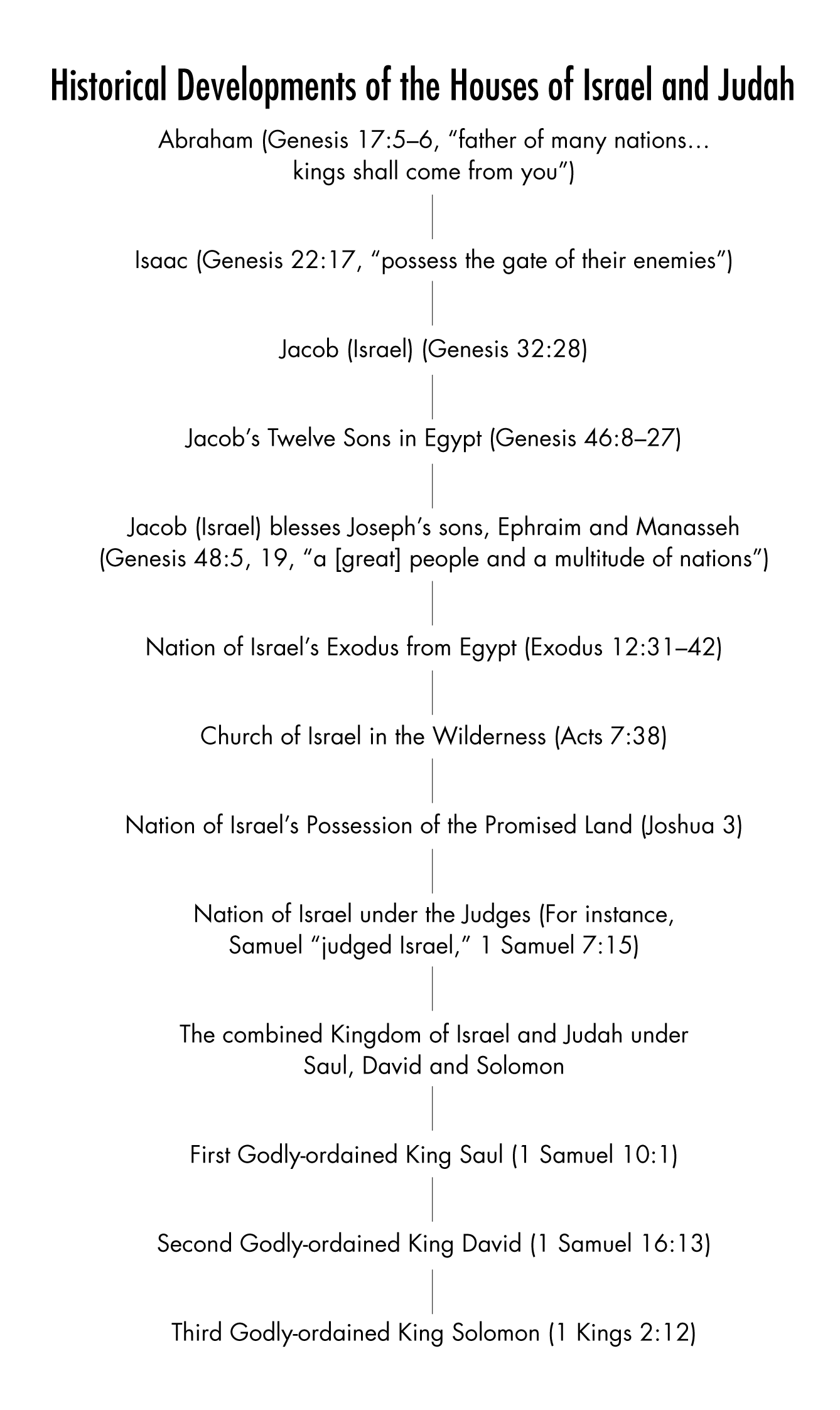
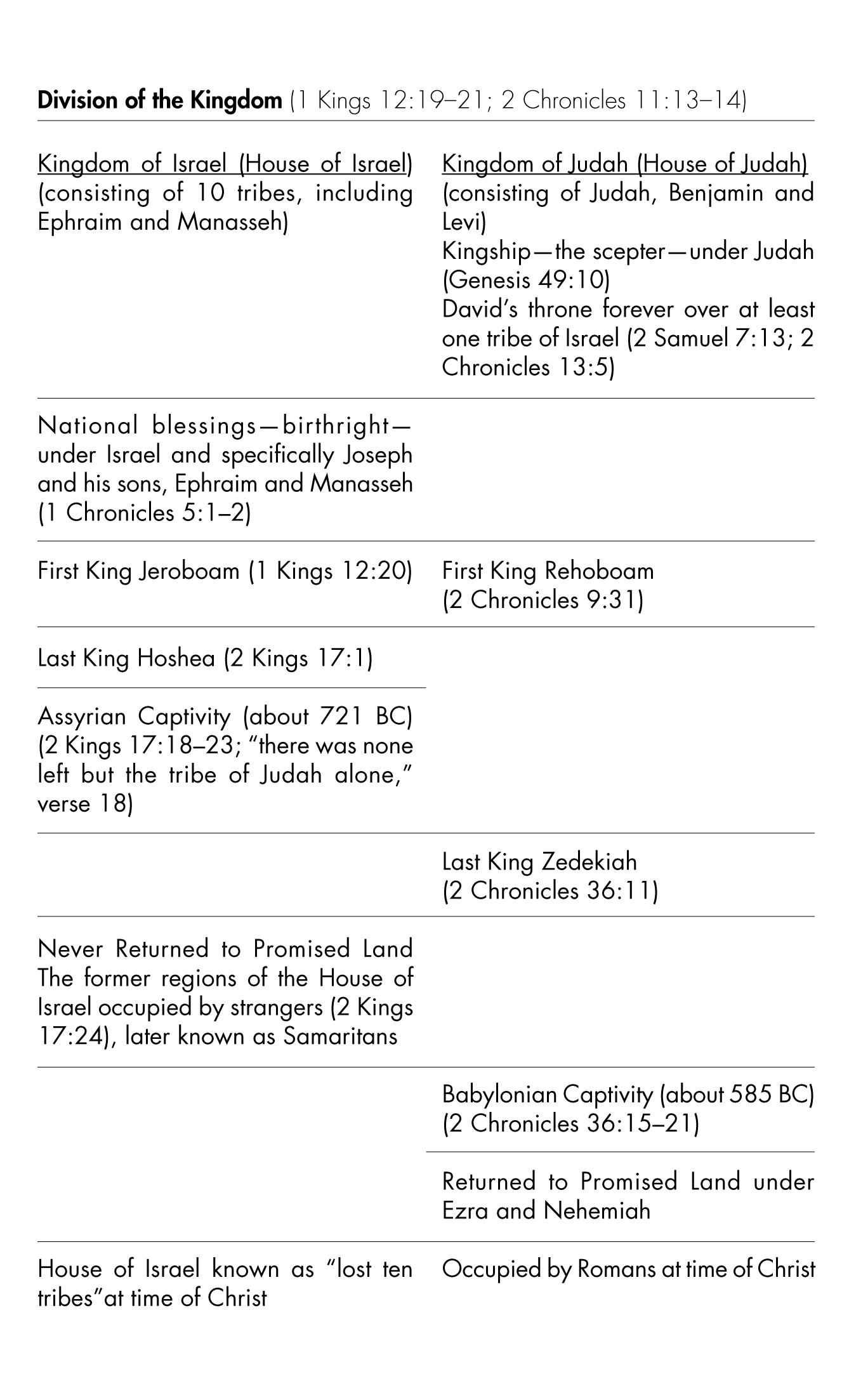
Under King David and King Solomon, the house of Israel and the house of Judah were united as one nation. It is critical to understand, however, that under King Solomon’s son, Rehoboam, the nation of Israel became divided following the death of Solomon. Two separate nations began to develop, known as the “house of Israel,” with its capital at Samaria, north of Jerusalem, and the “house of Judah,” with Jerusalem as its capital. We read in 1 Kings 12:19–20 (Authorized Version): “So Israel (being ruled by King Rehoboam, son of King Solomon) rebelled against the house of David… And it came to pass, when all Israel heard that Jeroboam (a prominent officer) was come again, that they sent and called him unto the congregation, and made him king over all Israel: there was none that followed the house of David, but the tribe of Judah only.”

King Rehoboam of Judah tried to reunite the two kingdoms—the house of Israel and the house of Judah—by force, but God prevented him from doing so. We read in 1 Kings 12:21, 24: “And when Rehoboam came to Jerusalem, he assembled all the house of Judah with the tribe of Benjamin, one hundred and eighty thousand chosen men who were warriors, to fight against the house of Israel, that he might restore the kingdom to Rehoboam the son of Solomon… ‘Thus says the LORD: “You shall not go up nor fight against your brethren the children of Israel. Let every man return to his house, for this thing is from Me.”’ Therefore they obeyed the word of the LORD, and turned back, according to the word of the LORD.”

The two houses or kingdoms did not unite again throughout their history. They remained as two separate kingdoms. The “house of Israel” comprised the ten northern tribes and the “house of Judah” comprised the southern tribes of Judah. The house of Judah was later joined by the tribes of Benjamin and part of the tribe of Levi (compare 1 Kings 12:21).

We read also in 2 Kings 16:5–8 about a war between Israel and Judah. Later the northern ten tribes, led by the descendants of Ephraim and Manasseh, the sons of Joseph, became “lost” from public view. These two tribes can be found today mainly in English-speaking nations around the world, a provable fact that is not widely perceived around the world.

To reiterate, many people believe that the Jews are identical with the modern house of Israel, but this is simply not true. Christ spoke of the “LOST sheep (tribes) of the house of Israel” (Matthew 10:6). Note that the tribe of Judah was never “lost” from sight. James referred to all of Israel and Judah as “the twelve tribes which are scattered abroad” (James 1:1; compare Revelation 7:4–8). Note also that the tribe of Joseph, one of Jacob’s twelve sons, consists of Joseph’s sons, Ephraim and Manasseh. We read that at some point in the near FUTURE, the houses of Israel AND Judah will be reunified in the Promised Land. Note, once again, that this will be after they come out of the prophesied future captivity (Jeremiah 30:3, 33:7).

The ancient house of Israel went into captivity in 721–718 BC by the hand of the Assyrians (2 Kings 17:5–6, 23). The house of Judah did not go into captivity until about 120 years later by the hand of the Babylonians under King Nebuchadnezzar (2 Kings 25:1–10) for the same reason the northern tribes were deported; i.e., because of their persistent practice of disobeying God.

But the ancient house of Israel did not return to the Promised Land. Josephus wrote in about 100 AD: “The entire body of the people of Israel remained in that country, wherefore there are but two tribes in Asia and Europe subject to the Romans, while the ten tribes are beyond the Euphrates till now and are an immense multitude, and not to be estimated by numbers.” So we see that the ten tribes of the house of Israel did not return to the Promised Land after their captivity; only the house of Judah subsequently returned.

The Jewish Quarterly Review, vol. 1, p. 15, added: “The captives of Israel exiled beyond the Euphrates did not return as a whole to Palestine along with their brethren the captives of Judah; at least there is no mention made of this event in the documents at our disposal.”

And the Jewish Chronicle wrote: “The Ten Tribes are certainly in existence. All that has to be done is to discover which people represent them.”

Historical records show without doubt that after they were freed from their captivity by the ancient Assyrians, the ancient ten tribes of the house of Israel migrated to Western Europe and to the British Isles, where mainly the tribes of Ephraim and Manasseh settled. Note from the Old Testament that Ephraim and Manasseh were two of the sons of Joseph. In time, the tribe of Manasseh migrated to the “New World,” which eventually became known as the United States, while the tribe of Ephraim stayed in the British Isles and, from there, colonized other countries, such as Canada, Australia, South Africa and New Zealand. The Bible shows that while Manasseh was to become one great nation, Ephraim was to become a company of nations (compare Genesis 48:19).

Notice carefully what happened in Genesis 32:28: Following his all-night wrestling match with the God of the Old Testament—the One who became Jesus Christ; the One who spoke with the prophets—Jacob’s name was changed to “Israel” by that same divine being: “Your name shall no longer be called Jacob, but Israel; for you struggled with God and with men, and have prevailed.”

Birthright Blessings of Abraham Were Passed On

Israel (Jacob) had 12 sons, among whom were Joseph and Benjamin, the sons of Rachel (Genesis 35:22–26). In time, Joseph took his sons Manasseh and Ephraim to see their grandfather Jacob. Joseph had been told that Jacob was sick. When Joseph presented his sons to their grandfather, Jacob or Israel strengthened himself and sat up on the bed. Then Jacob told his son Joseph in Genesis 48:5: “And now your two sons, Ephraim and Manasseh, who were born to you in the land of Egypt… are mine; as Reuben and Simeon, they shall be mine” [i.e., Jacob adopted the two lads.].

The account shows that Joseph, facing Jacob, took them both, Ephraim with his right hand toward Jacob’s left hand, and Manasseh (the firstborn) with his left hand toward Jacob’s right hand, and brought them near him. Then Israel, crossing his hands over the lads, stretched out his right hand and laid it on Ephraim’s head (who was the younger) and his left hand on Manasseh’s head, guiding his hands knowingly, for Manasseh was the first-born. This is notable because normally the first-born is given the greater blessing. So Jacob blessed Joseph and said: “Let my name [Israel] be named upon them” (verse 16). Now when Joseph saw that his father had laid his right hand on the head of Ephraim [his second-born], it displeased him; so he took hold of his father’s hand to remove it from Ephraim’s head and to lay it on Manasseh’s head. And Joseph said to his father: “‘Not so, my father, for this one [Manasseh] is the first-born; put your right hand on his head.’ But his father refused and said, ‘I know, my son, I know. He also shall become a people, and he also shall be great; but truly his younger brother shall be greater than he, and his descendants shall become a multitude [or a company or a “Commonwealth”] of nations’” (compare Genesis 48:17–19).

So the birthright of Abraham was passed to Ephraim and Manasseh, the sons of Joseph. Manasseh was to become a single great nation, known today as the United States. Ephraim was to become a multitude or a company of nations, which we know as the Commonwealth nations of the British Empire. The birthright was indeed Joseph’s and was passed on to his two sons. Notice: “Now the sons of Reuben the firstborn of Israel [Jacob]—he was indeed the firstborn, but because he defiled his father’s bed, his birthright was given to the sons of Joseph, the son of Israel, so that the genealogy (in this case) is not listed according to the birthright… the birthright was Joseph’s” (1 Chronicles 5:1–2).

We also read in Genesis 27:28–29 that the blessings of the birthright to Jacob and his descendants (i.e., Joseph and his sons, Ephraim and Manasseh) included the following: “Therefore may God give you Of the dew of heaven, Of the fatness of the earth, And plenty of grain and wine. Let peoples serve you, And nations bow down to you. Be master over your brethren, And let your mother’s sons bow down to you. Cursed be everyone who curses you, And blessed be those who bless you!”

Blessings Withheld for Disobedience

It should be noted that because of their sins, the immediate descendants of Joseph did not receive the full blessings of the fabulous wealth and power of the birthright through Abraham. The kingdom of the house of Israel was taken captive by the Assyrian Empire as a result of God’s anger with them. “Therefore the LORD was very angry with Israel, and removed them from His sight; there was none left but the [southern] tribe of Judah alone” (2 Kings 17:18; emphasis added throughout Biblical quotations).

How long were the blessings of the birthright to be withheld from Ephraim and Manasseh (Great Britain and the United States) because of their disobedience of the laws of God?

The Bible teaches that because of ancient Israel’s continued disobedience, the blessings that God originally promised unconditionally to Abraham’s descendants (compare Genesis 17:5; 21:3; 22:17) would be withheld for a certain period of time, after they would first have to be punished by having to go into Assyrian captivity (in 721–718 BC). A principle of the withholding of a blessing because of sin can be found in Numbers 14:34 when ancient Israel was not allowed to enter the Promised Land for forty years after the spies had explored the Promised Land for forty days: “According to the numbers of the days… forty days, for each day you shall bear your guilt one year, namely forty years, and you shall know my rejection.”

Beginning with the Assyrian captivity (compare 2 Kings 17:23), God would withhold the birthright blessings for seven times (Leviticus 26:18), or seven years (the Hebrew words for “times” and “years” are used interchangeably). A year consists of 360 days, according to the  Hebrew calendar. God’s blessing would be withheld for seven times 360 days, but since this is a prophecy, it would be withheld for seven times 360 years, or 2,520 years. In prophecy, a day represents a year. Compare Ezekiel 4:4-6: “I have laid on you a day for a year.” This principle of a day for a year, and vice versa, can be seen throughout the Bible. We read, for instance, that the restored Roman Empire would rule for 42 months (compare Revelation 13:5). Since a month has 30 days, the restored Roman Empire was prophesied to rule for 1,260 prophetic days or years, which it did from 554 AD under Justinian until 1814 AD when the fall of Napoleon I occurred. (For more information, please read our free booklet, “Europe in Prophecy.”)

God pronounced that Israel’s blessing to become a world-ruling power would be withheld for “seven times.” The 2,520 prophetic days, or literal years after the Assyrian captivity of the house of Israel, brings us to the beginning of the 1800’s. It is no coincidence that at that time, Great Britain, and then the United States, became world powers. Great Britain began her rise to tremendous wealth and power as the worldwide British Empire. At the same time, the United States more than doubled in size in 1803 through the Louisiana Purchase from France. Eventually the United States began to take over leadership of the birthright during World War II, which has continued even to this day.

Once God had fulfilled His promises that He had given to Abraham, He was no longer bound to continue to bless Israel, if they should continue to sin. Note that both Great Britain and the United States are now in a state of continuous decline, a decline that they can owe to their own persistent sins of disobedience to God; sins that they have literally “heaped up” against themselves. The United States, though still all-powerful from a military standpoint, has lost a great deal of prestige, especially in recent years. Many nations no longer have confidence in the United States because of its involvement in the conflicts of Korea, Vietnam, and more recently, Afghanistan and Iraq. Americans and Britons have also steadily reneged on their God-given responsibilities to observe God’s Commandments. They have progressively forgotten God as their leader, their provider and their protector.

As former American President Abraham Lincoln once said: “We have been the recipients of the choicest bounties of heaven. We have been preserved these many years in peace and prosperity. We have grown in numbers, wealth and power as no other nation has ever grown. But we have forgotten God. We have forgotten the gracious Hand which preserved us in peace, and multiplied and enriched and strengthened us, and we have vainly imagined, in the deceitfulness of our hearts, that all these blessings were produced by some superior wisdom and virtue of our own. Intoxicated with unbroken success, we have become too self-sufficient to feel the necessity of redeeming and preserving grace; too proud to pray to the God that made us.”

Throne of David to Continue Until the Return of Christ

In addition to the birthright blessings, God promised that the kingly rule would not depart from Judah (Genesis 49:10), and that a descendant of the house of David (David was a descendant of Judah) would always rule over at least one tribe of Israel (2 Samuel 7:13; 2 Chronicles 13:5). When Nebuchadnezzar conquered the house of Judah and dethroned Zedekiah, a descendant of David, and killed all of his sons, it seemed like God’s promise failed. But the opposite is true.

Let us carefully notice what happened. God had promised King David: “… your house (dynasty) and your kingdom shall be established forever before you. Your throne shall be established forever” (2 Samuel 7:16). This promise was unconditional: “…I will set up your seed after you, who will come from your body, and I will establish his kingdom… If he commits iniquity, I will chasten him with the rod of men and with the blows of the sons of men. But My mercy shall not depart from him, as I took it from Saul, whom I removed from before you” (2 Samuel 7:12, 14–15). God spoke to King David about his son Solomon in 1 Chronicles 22:10: “He shall build a house for My name, and he shall be My son, and I will be his Father, and I will establish the throne of his kingdom over Israel forever.”

This promise to King Solomon was conditional: “Only may the LORD give you [Solomon] wisdom and understanding, and give you charge concerning Israel, that you may keep the law of the LORD your God. Then you will prosper, if you take care to fulfill the statutes and judgments with which the LORD charged Moses concerning Israel…” (1 Chronicles 22:12–13).

King Solomon, however, broke his Coronation Oath. God later said to King Solomon: “Because you have done this [gone after other gods], and have not kept My covenant and My statutes, which I have commanded you, I will surely tear the kingdom away from you and give it to your servant” (1 Kings 11:11).

Although Solomon’s son remained king over the house of Judah, Solomon’s servant Jeroboam became king over the house of Israel. Also, we find that Mary, mother of Jesus, did not descend from Solomon, but from David’s son Nathan (compare Luke 3:31, explaining that Mary, the mother of Jesus, was a descendant of “Mattathah, the son of Nathan, the son of David, the son of Jesse…”).

Even in the very last generation, at the time of Christ’s return, there would still be a king sitting on the throne of David. God says, through the prophet Jeremiah: “‘Behold, I will fill all the inhabitants of this land—even the kings who sit on David’s throne, the priests, the prophets, and all the inhabitants of Jerusalem—with drunkenness! And I will dash them one against another, even the fathers and the sons together’, says the LORD. ‘I will not pity nor spare nor have mercy, but I will destroy them’… Say to the king and to the queen mother, ‘Humble yourselves; Sit down, For your rule shall collapse, the crown of your glory’” (Jeremiah 13:13–14, 18).

And again: “Hear the word of the LORD, O King of Judah, you who sit on the throne of David, you and your servants and your people who enter these gates! Thus says the LORD: ‘Execute judgment and righteousness… But if you will not hear these words, I swear by Myself,’ says the LORD, ‘that this house shall become a desolation’…[Why?] “Because they have forsaken the covenant of the LORD their God, and worshipped other gods and served them” (Jeremiah 22:2–3, 5, 9).

The Coronation Oath, the condition by which King Solomon ruled in Israel, has been God’s measuring stick for the kings of the dynasty of David as to whether they are to be beaten with the rod of men: “Behold, I am setting a plumb line In the midst of My people Israel; I will not pass by them anymore” (Amos 7:8). Note that God’s people were expected to be true to His standards, but, as the New International Version Commentary put it, were completely “out of plumb” [not straight] when tested. “The high places (of pagan worship) of Isaac (Jacob’s father, and by extension, Jacob himself, i.e., Israel) shall be desolate, And the sanctuaries of Israel shall be laid waste. I will rise with the sword against the house of Jeroboam” (Amos 7:9).

The prophet Amos continues: “On that day [alluding to a future restoration in the Millennium] I will raise up the tabernacle of David, which has fallen down, And repair its damages; I will raise up its ruins” (Amos 9:11). The word “fallen” in Hebrew means to cease, to perish or to become fugitives, according to Strong’s #5307. The word “ruin” in Hebrew means “demolished, destroyed, thrown down utterly” (Strong’s #2034, 2040). The final king of the house of David, prior to Christ’s return, may cease to rule for a very short period of time: “At dawn the king of Israel Shall be cut off utterly” (Hosea 10:15).

But this does not mean that the throne of David will ever cease to exist, as clearly explained in Scripture: “For thus says the LORD: ‘David shall never lack a man [a descendant or a person] to sit on the throne of the house of Israel’” (Jeremiah 33:17). God had promised David that a descendant of David would always occupy his throne. And this has been the case from the dynasty of David to the present dynasty of Queen Elizabeth II.

God promised David that a descendant of his line would rule over Israel from the time he put David on the throne until the actual return of Jesus Christ. This promise has seen fulfillment in the line of David ruling over at least one tribe from all the tribes of Israel, either, as was the case until the Babylonian captivity over the house of Judah, or has been the case thereafter, over the house of Israel.

David’s Throne Overturned?

The Bible foretells that the throne of David would be overthrown or transferred three times (compare Ezekiel 21:27). And so it happened. As we will discuss now, it was transferred from Jerusalem to Ireland, then from Ireland to Scotland, and finally from Scotland to England. Today, it is in ENGLAND, from where the Queen rules, sitting on the throne of David, over one of the tribes of Israel (i.e., Ephraim).

Ezekiel tells us: “And Thou, profane wicked prince of Israel, whose day is come, when iniquity shall have an end, Thus saith the Lord GOD; Remove the diadem, and take off the crown; this shall not be the same; exalt him that is low, and abase him that is high. I will overturn, overturn, overturn, it; and it shall be no more, until he come whose right it is; and I will give it [to] him” (Ezekiel 21:25–27, Authorized Version).

The Hebrew word for “overturn” means to be overthrown for committing iniquity leading to ruin (Strong’s #5762). This happened three times to David’s dynasty from the time Ezekiel wrote this prophecy. The first “overturn” involved King Zedekiah, the last king of David’s dynasty in Jerusalem, who became exalted, but was to be made low. Nebuchadnezzar, King of Babylon, and all of his army came against Jerusalem and besieged it. King Zedekiah fled out of the city but was captured by the Babylonians. The King of Babylon killed the sons of Zedekiah before his eyes in Riblah, as well as all the nobles of Judah. Moreover, he put out Zedekiah’s eyes and carried him off to Babylon (Jeremiah 39:1, 4–5, 6–7). “But Johanan (a warrior) took…the king’s daughters (of Zedekiah)…and Jeremiah the prophet and Baruch the son of Neriah [and] they went to the land of Egypt” (Jeremiah 43:5–7).

God stated that “none …shall return [from Egypt] except those who escape” (Jeremiah 44:14). Subsequently Jeremiah, Baruch and the king’s two daughters [known in history as Tea and Scota] did escape from Egypt. They were taken to Ireland.

It was Jeremiah’s commission to uproot and to plant (Jeremiah 1:10). He had to uproot the kingship of Zedekiah over Judah, and he had to plant the kingship of Zedekiah’s daughters over another tribe or tribes of Israel. According to Irish records, shortly after the time of Jerusalem’s fall in 600 B.C., two princesses arrived in Ireland from Egypt with two wise men. We are even told that the one princess, identified as Tea or Tea-Tephi, married the Irish king, Eochaidh, while Scota married into a noble family, perhaps giving her name to Scotland. Irish scholars maintain that the later kings of Ireland knew that they were descendants of King David. Both princesses feature in many Irish poems, songs and legends.

Thus David’s line continued the new dynasty in Ireland. This dynasty was later moved to Scotland, which, in accordance with prophecy, was the second time the crown was “overturned.” Ultimately, it was moved to England, thus fulfilling the prophetic third time it was “overturned,” when the Stewart line of David came to England in 1603 in the person of James I. Two monarchs of this line, Mary, Queen of Scots, and James II both tried to re-impose the Catholic religion on England, contrary to God’s plan. Satan also tried to thwart the blessings of the promised birthright of Abraham that were to be given to Great Britain and the United States of America in the course of time. But Satan could not prevent God from fulfilling His promise to bless Abraham’s descendants in due time. With regard to America, this did happen in 1803 with the Louisiana Purchase from France, greatly expanding the nation—after 2,520 years of the promised blessings being withheld because of Israel’s sins. The blessings were, indeed, finally given to modern Ephraim and Manasseh, not that they were righteous or deserving of these special blessings, but only because God had unconditionally promised Abraham that He would bless his descendants in due time.

But it doesn’t end there. Remember, this is a dual prophecy and the line of David was prophesied to continue ruling over the house of Israel up until the return of Jesus Christ, Who will then take over this same throne. God has this to say about this future event: “Your eyes will see the King in His beauty” (Isaiah 33:17).

Are the “Lost” Ten Tribes Really Lost?

Biblical prophecies tell us clearly where the ancient house of Israel would settle after their Assyrian captivity, and where the throne of David would be: “For surely I will command, And will sift the house of Israel among all nations, As grain is sifted in a sieve; Yet not the smallest grain shall fall to the ground” (Amos 9:9). Notice that this prophecy is talking about the house of Israel, not just the Jewish people. The house of Judah would be sifted among many nations as well, and we still find today many Jews outside the borders of the state of Israel, but the prophecy in Amos specifically addresses the modern descendants of the house of Israel, actually, the “lost” ten tribes.

How Do We Identify Today Where These “Lost” Ten Tribes Are?

The tribes of the house of Israel went to a new land. In prophetic context, God said to King David: “…I will appoint a place for My people Israel, and will plant them, that they may dwell in a place of their own and move no more; nor shall the sons of wickedness oppress them anymore, as previously…” (2 Samuel 7:10). When David wrote these words, ancient Israel had already taken possession of the Promised Land. But God inspired David to write that God would, in the future, appoint a place for the house of Israel from which they would no longer have to move. Where was this place to be located? “Listen, O isles (Ephraim)…Behold, these [tribes] shall come from far: and, lo, these from the north and from the west…” (Isaiah 49:1, 12, Authorized Version).

Keep in mind that geographical references are always to be judged from the location of Jerusalem. That is, when we read that someone appears “from the north,” we understand that the meaning is “north of Jerusalem.”

The appointed place was northwest of Jerusalem in the “isles of the sea;” that is, the British Isles (compare Isaiah 24:15 in the Authorized Version).

God prophesied that He would uproot the house of Israel from the Promised Land and “scatter them beyond the [Euphrates] River” (1 Kings 14:15). But they would not stay there. Rather, God’s Word was to be proclaimed in these last days to God’s people “toward the north” (Jeremiah 3:11–12). They would come back to the Promised Land, in the future, “from the north and the west” (Isaiah 49:12). That is, from an area “northwest” of Jerusalem. We are also told that Israel would have migrated to the west: “Ephraim… pursues [or follows] the east wind” (Hosea 12:1), the wind that comes from the east and blows west. David was also inspired to write that his throne would be established “over the sea” (Psalm 89:20, 25).

Also, Jeremiah 31:8 (Authorized Version) states that God would, in the future, gather modern Israel from “the north country, and gather them from the coasts of the earth,” and that He wants His word proclaimed in “the isles afar off” (verse 10). Isaiah 41:1 addresses modern Israel (compare verse 8) in saying: “Keep silence before me, O islands (Authorized Version).”

If we were to take a world map and draw a line from Jerusalem in a northwest direction, it leads us to the British Isles, where the throne would be located. But we are also told that once some of the ten tribes of the house of Israel, especially Ephraim and Manasseh, had reached the British Isles, they would continue to colonize other countries, to possess land and sea gates—strategically important ports and passages—controlling crucial military and trade routes, such as Gibraltar, the Suez and Panama canals (compare Genesis 22:17). And so we see that the modern tribe of Manasseh settled in the United States of America, while those from the modern tribe of Ephraim migrated to Australia, New Zealand, Canada, South Africa and other nations. Yair Davidy wrote in his book, “The Tribes: The Israelite Origins of Western People”: “In the course of time they [some of the tribes of Israel] reached the British Isles and north-west Europe.”

Even Christ told His early apostles to go to the lost sheep of the house of Israel (compare Matthew 10:6). It is interesting that historical records prove that the apostles Peter, Simon the Zelot, and James actually preached the gospel in Britain.

For instance, Caves wrote in Antiquitates Apostlicae that Peter stayed for a long time in Britain; that Simon the Zelot preached in Britain; and that James reached England and Ireland. Eusebius reports in Evangelical Demonstrations that some of the apostles preached the gospel in the British Isles. Jesus most certainly knew where the lost ten tribes were located, and so did the early apostles. James wrote his letter “to the twelve tribes which are scattered abroad” (James 1:1). He undoubtedly knew where they were and felt confident that his letter would reach them.

So we can actually trace the migration of ancient Israel—under the names of Celts, Scythians and Anglo-Saxons—from Assyria (northeast of Jerusalem in what is now Iraq), passing northwest through Europe, and centuries later, to the British Isles. Ultimately, part of ancient Israel would then migrate to the United States of America. So the “lost” ten tribes are not lost at all. They are identifiable if one follows the records of history and the Biblical accounts.

In this chapter we have given you a brief overview of the roots of the peoples of Britain and the United States. This understanding provides the backdrop for the rest of this booklet, which is to show how the prophecies are unfolding for present-day Britain and its associated Commonwealth countries, as well as for the United States.

We still have available a full color, 66-page booklet, explaining in detail the identity of the nations of ancient Israel in today’s world. The booklet is titled, “America and Britain in Prophecy.” We are offering a copy of the same for distribution, free of charge, on a first come-first serve basis.

Chapter 2 – The Soon-Coming World War III

A Call to Repentance

This booklet is a call to repentance to the nations of the British Commonwealth and the United States, as well as to everyone who is willing to listen and understand the gravity of the world scene. A call to repentance from what? As we will show, repentance from national AND personal sins that have been committed against the great God and Creator of all things visible and invisible. Why? So as to avoid total destruction, the inevitable penalty for sin. Sin is defined by God Himself in His Holy Word as “lawlessness” or “transgression of the law” (1 John 3:4, Authorized Version).

Romans 6:23 tells us that “…the wages of sin is death, but the gift of God is eternal life in Christ Jesus our Lord.” As Solomon tells us, “There is a way that seems right to a man, But its end is the way of death” (Proverb 14:12). God’s prophet Isaiah called for repentance: “Seek the LORD while He may be found, Call upon Him while He is near. Let the wicked forsake his way, And the unrighteous man his thoughts; Let him return to the LORD, And He will have mercy on him… ‘For My thoughts are not your thoughts, Nor are your ways My ways’”, says the LORD. “‘For as the heavens are higher than the earth, So are My ways higher than your ways, And My thoughts than your thoughts’” (Isaiah 55:6–9).

If modern Israel and other nations REFUSE to repent, rejecting God’s way of life in favor of doing whatever they want to do, then they WILL BE DESTROYED by the prophesied rising superpower in Europe (the last and final resurrection of the ancient Roman Empire). The surviving peoples of the modern house of Israel will be scattered—actually enslaved by other nations. Ultimately, only one-tenth of the population will remain alive. Hard to believe? The Bible is unequivocal and does not lie. Israel’s sins will result in this disastrous punishment if they do not repent.

In the context of the commission God gave His prophet Isaiah to declare what is to come upon ancient AND modern Judah, as well as the nations of the house of Israel, Isaiah questioned God as to how long he must warn the people. God’s reply to him was: “Until the cities are laid waste and without inhabitant, The houses are without a man, The land is utterly desolate” (Isaiah 6:11). God said in Isaiah 6:12 and 13: “The LORD has removed men far away, And the forsaken places are many in the midst of the land. But yet a tenth will be in it, And will return…”

The New International Version completes verse 13: “it will again be laid waste.” These prophecies are dual. They pertained to ancient Israel, but they also pertain to the modern nations of Israel, including Judah, thus the reference “will again be laid waste.” This remnant will only be saved from death by the return of Jesus Christ to this earth as King of kings to take over rulership of the earth, along with His saints, following 3½ years of GLOBAL destruction!

Understanding the Prophecies of Ezekiel

In a Church of God member letter dated November 19, 1976, Herbert W. Armstrong (1892–1986), former human leader of the Worldwide Church of God, explained how he came to the vital understanding of the meaning of the prophecies of Ezekiel in the early years of his conversion and ministry:

 “In those early days I was especially interested in the book of Ezekiel. A special reason was that I saw Ezekiel was first given God’s message in PROPHECY, while he was a Jewish slave, by the River Chebar in the land of Babylon. Now this was close to 120 years after the House of Israel had been taken captive to Assyria. My astonishment was aroused when I saw that his message was to be taken to the House of Israel. Now Ezekiel was a slave among the House of Judah—not Israel. By this time many of the ‘lost sheep of the House of Israel’ had migrated north and west from Assyria. They were, by Ezekiel’s time, in Britain and Western Europe.

“The first message, or instruction from God, comes, beginning [with] the second chapter [of the book of Ezekiel, AV], ‘And He said unto me, son of man, I send thee to the children of Israel, to a rebellious nation… [and they shall know] that there hath been a prophet among them’ (Ezekiel 2:3, 5. In Chapter 3:1 God says,’…GO speak unto the House of Israel.’ Again in verse 4, ‘Son of man, GO, get thee unto the House of Israel, and speak with My words unto them.’ NOWHERE in the Bible are JEWS called ‘the House of Israel.’ This term applies ONLY to the TEN-tribe Kingdom of Israel taken into Assyrian captivity more than a hundred years before Ezekiel and the Jews of the House of JUDAH. Nowhere in the book does Ezekiel record his journey from where he was in Babylon to those of the House of Israel who were then in Britain and Western Europe. Nowhere does he record his giving of the message to them. He merely RECEIVED the message. He merely RECORDED IT IN WRITING. There is no reason to think his message was ever delivered to the House of Israel in Ezekiel’s time. The message in fact is dual and is for us at this end-time—and contained a WARNING of things to happen to Britain, America and the other Israelite nations including parts of western Europe NOW in OUR DAY.”

What we should notice very carefully from the foregoing is that Ezekiel, a young Jew, was in captivity in Babylon when he received messages from God to be delivered to the house of Israel and other nations, including the ancient Ammonites (Ezekiel 25:2), Moabites (Ezekiel 25:8), Edomites (Ezekiel 25:12), the Philistines (Ezekiel 25:15), and the people of Tyre (Ezekiel 26:2–3) and Egypt (Ezekiel 29:2)—all a great distance from his location in Babylon. Note, too, that Ezekiel saw visions of impending destruction upon Israel “in the fifth day of the month,” which was the fifth year of king Jehoiachin’s captivity” (Ezekiel 1:1–3). Jehoiachin went into captivity in 596 B.C. The fifth year brings us to about 592 B.C—over 125 years AFTER the removal and captivity of the house of Israel in 721–718 B.C.! Ezekiel, then, was given a future prophetic message for the modern house of ISRAEL, including a message about their future punishment and slavery. This message had been given AFTER the removal and captivity of the ancient house of ISRAEL. The ancient house of Israel had already been punished and gone into captivity. Ezekiel’s prophetic message was never delivered to the ancient house of Israel.

As explained in our free booklet, “The Great Tribulation and the Day of the Lord,” the modern tribes of Ephraim and Manasseh are comprised of mainly the English-speaking nations in the world, including the United States of America, Great Britain, Canada, Australia, South Africa and New Zealand. God has given His end-time Church the commission to proclaim the “Ezekiel warning message” in Ezekiel 3:16–21 to those very peoples! This is a charge that we in God’s Church MUST take seriously! It is part of the gospel message of the Kingdom of God that must be preached before the wonderful world tomorrow can be ushered in (Matthew 24:14). The Great Tribulation and the Day of the Lord, which will be a time of terrible trouble for the modern nations of the houses of Israel AND Judah, as well as the entire world, must first be fulfilled. Notice what Paul told Timothy, “…know this that in the last days perilous times will come” (2 Timothy 3:1).

In Ezekiel 2:3–5 we find this commission from God to His prophet Ezekiel: “…Son of man, I am sending you to the children of Israel, to a rebellious nation that has rebelled against Me; they and their fathers have transgressed against Me to this very day. For they are impudent and stubborn children. I am sending you to them and you shall say to them, ‘Thus says the Lord God.’ As for them, whether they hear or whether they refuse—for they are a rebellious house—yet they will know that a prophet has been among them.”

This warning from God, through Ezekiel, was written for OUR day! It MUST BE PROCLAIMED to the people whom God designated. The responsibility to proclaim the message has been passed along to the true Church of God, which is still in existence today. You are reading that message in this booklet.

Watchman for the House of Israel

The prophet Ezekiel is referred to as a “watchman” (Ezekiel 3:17). And since this prophecy is for OUR time, it is, therefore, God’s end-time Church that is to function as “a watchman” or “watchmen.” Notice, for example, Ezekiel 33:7, “So you, son of man, I have made you a WATCHMAN for the HOUSE OF ISRAEL; therefore you shall hear a word from My mouth and warn them for Me.”

Additionally, consider these Scriptures that explain the job of a watchman: “I have set WATCHMEN on your walls, O Jerusalem; THEY shall never hold THEIR peace day or night. You [plural in Hebrew] who make mention of the LORD, do not keep silent” (Isaiah 62:6).

“Yes, proclaim against Jerusalem, that WATCHERS come from a far country. And raise THEIR voice against the cities of Judah” (Jeremiah 4:16).

“Thus says the LORD: ‘Stand in the ways and see, and ask for the old paths, where the good way is, and walk in it; then you will find rest for your souls.’ But they said, ‘We will not walk in it.’ Also, I set WATCHMEN over you, saying, ‘Listen to the sound of the trumpet!’ But they said, ‘We will not listen.’ Therefore hear, you NATIONS, and know, O congregation, what is among them. Hear, O EARTH! Behold, I will certainly bring calamity on this people, even the fruit of their thoughts, because they have not heeded My words nor My law, but rejected it’” (Jeremiah 6:16–19).

God’s Church, then, is to WATCH current events all around us (Matthew 24:42), discerning the times in order to be effective WATCHMEN in God’s service (compare Amos 3:7), warning others of what will surely come to pass. Notice Hosea 5:9: “Ephraim [modern Great Britain] shall be DESOLATE in the day of rebuke; among the TRIBES OF ISRAEL I make known what is sure.” Hosea 7:12 adds, “I will CHASTISE THEM [the people of Ephraim] according to what their congregation HAS HEARD.”

Ezekiel 33:2–6 explains to us WHY God’s Church is to proclaim His warning message: “When I bring the sword upon the land, and the people of the land take a man from their territory and make him their WATCHMAN, when he sees the sword coming upon the land, if he blows the trumpet and warns the people, then whoever hears the sound of the trumpet… [and] takes the warning will save his life. But if the WATCHMAN sees the sword coming and does not blow the trumpet, and the people are not warned, and the sword comes and takes any person from among them, he is taken away in his iniquity; but his blood I will require at the WATCHMAN’S hands.”

God instructs His Church to teach that God’s Kingdom will be established here on this earth, one element of the true Gospel message. (For more information on this subject, please read our free booklet, “The Gospel of the Kingdom of God.”) This assignment includes “blowing the trumpet” and warning of impending disaster. Some will listen and change their ways so that they, too, may ultimately enter the Kingdom. Many others, however, will not heed the message. Still, if God’s Church shrinks back from its God-given responsibility, God will have no pleasure in it (Hebrews 10:37–39).

World War III

God is completely fair in His dealings with men. He will give them time to repent of their sins and false way of life and turn to Him and the true way of life that yields blessings. Failure to heed His warnings and repent will eventually bring on the most destructive time in all of human history—World War III. It will be a time of GLOBAL DESTRUCTION and it is ominously near at hand! As Christ warned: “For then there will be great tribulation, such as has not been since the beginning of the world until this time, no, nor ever shall be [again]. And unless those days were shortened, no flesh would be saved [alive], but for the elects’ sake those days will be shortened” (Matthew 24:21–22).

Who are the “elect”? Those whom God has called, chosen and sanctified to be His “firstfruits” (compare Romans 8:23). They will be part of the Kingdom of God, ruling under Christ on this earth (not in heaven) following Christ’s return (Revelation 5:10; 20:6).

A prophesied World War will occur just prior to the return of Jesus Christ. As the prophet Ezekiel warned, “…prophesy against the land of Israel; and say to [them], ‘Thus says the Lord: “Behold, I am against you, and I will draw My sword out of its sheath and cut off both righteous and wicked from you… You therefore, son of man, prophesy, And strike your hands together (a sign of grief). The third time let the sword do double damage (in punishment)… I have set the point of the sword against all their gates, That the heart may melt and many may stumble…’” (Ezekiel 21:2–3, 14–15). God’s warnings are not mere words! They have great force!

God’s servants, His true ministers, must “Cry aloud, spare not; Lift up your voice like a trumpet; Tell My people their transgression, And the house of Jacob [Israel—as noted, Jacob’s name was changed by God to Israel] their sins” (Isaiah 58:1). This is what they are to tell the people: “‘Cast away from you all the transgressions which you have committed, and get yourselves a new heart and a new spirit. For why should you die, O house of Israel? For I have no pleasure in the death of one who dies,’ says the LORD God. ‘Therefore turn and live!’” (Ezekiel 18:31–32).

Why? Because God yearns for the modern houses of both Israel and Judah to turn to Him and repent. Speaking of the house of Judah, the house of Israel, and, in fact, all nations, God says through the prophet Jeremiah: “It may be that the house of Judah will hear all the adversities which I purpose to bring upon them, that everyone may turn from his evil way, that I may forgive their iniquity and their sin… It may be that they will present their supplication before the LORD, and everyone will turn from his evil way. For great is the anger and fury [a reference to the seven last plagues in the book of Revelation, compare Revelation 15:1] that the LORD has pronounced against this people” (Jeremiah 36:3, 7).


Satan Deceives the Whole World

The cherub Lucifer, now called Satan the devil (“Satan” meaning “adversary”), started today’s evil way of rebellion against God. This created spirit being is described in Scripture in this way: “You were the seal of perfection, Full of wisdom and perfect in beauty. You were in Eden, the garden of God; Every precious stone was your covering…[They were] prepared for you on the day you were created. You were the anointed cherub who covers [over- shadowing and protecting the world prior to the creation of man]; I established you; You were on the holy mountain of God… You were perfect in your ways from the day you were created Till iniquity was found in you…You became filled with violence within, And you sinned; Therefore I cast you as a profane thing Out of the mountain of God…Your heart was lifted up because of your beauty; You corrupted your wisdom for the sake of your splendor; I cast you to the ground…” (Ezekiel 28:12-17).

The prophet Isaiah confirms: “How you are fallen from heaven, O Lucifer, son of the morning!… For you have said in your heart: ‘I will ascend into heaven…’ Yet you shall be brought down to Sheol” (Isaiah 14:12-13, 15).

The Scriptures also report about another spiritual war to occur in the end-time, just prior to Christ’s return: “And war broke out in heaven…and the dragon and his angels fought, but they did not prevail… So the great dragon was cast out, that serpent of old, called the Devil and

Satan, who deceives the whole world; he was cast to the earth, and his angels [demons] were cast out with him” (Revelation 12:7-9).

How does Satan deceive the whole world? Paul, one of Christ’s apostles, gives us the answer when addressing the former lifestyles of those who had become converted: “…you once walked according to the course of this world, according to the prince of the power of the air, the spirit who now works in the sons of disobedience” (Ephesians 2:2).

But Paul continued: “…God… made us alive together with Christ (by grace you have been saved)” (verses 4-5).

Satan deceives and influences all of mankind by his spirit of disobedience toward God. Those being called are told to “[r]epent, and let every one of you be baptized in the name of Jesus Christ for the remission of sins; and you shall re- ceive the gift of the Holy Spirit”— the Spirit of understanding spiritual matters (Acts 2:38). Satan is still on his earthly throne and the true people of God (those called and sanctified by the Holy Spirit) can and must resist him at all times through the help of the Holy Spirit: “Therefore submit to God. Resist the devil and he will flee from you” (James 4:7; compare 1 Peter 5:8-9). All of mankind is continually faced with fighting against the wiles of Satan, and in this modern world of loathsome sins, he is manifesting his power of persuasion! But not for much longer!


Blessings and Cursings

Today the birthright blessings that God bestowed on modern Israel because of Abraham’s obedience are being gradually removed from Great Britain and the United States and the other Israelite “birthright” nations of Canada, Australia, New Zealand and South Africa. There is a reason for this. In the context of blessings for obedience and cursings for disobedience, God told the ancient Israelites, and He is likewise telling the modern-day Israelites: “The LORD will send on you cursing, confusion, and rebuke in all that you set your hand to do, until you are destroyed and until you perish quickly, because of the wickedness of your doings in which you have forsaken Me” (Deuteronomy 28:20).

We cannot avoid noticing the burgeoning tide of wars, sexual perversion, crimes, abortions, hedonistic and homosexual lifestyles, and idolatry. These various forms of evil fill our theaters and TV screens and news reports. God promised vast blessings upon the nation of Israel IF they obeyed Him, and contrasted these blessings with curses for disobedience (compare chapter 28 of the book of Deuteronomy). We are now witnessing the blessings being removed and, as a result, inevitable cursings.

Notice also Leviticus 26:14–20 where God warned the Israelites following their release from slavery in Egypt, giving them specific instructions on how to worship Him. He also told them—as He is telling modern Israel and Judah today—that if they disobeyed Him, they would suffer certain penalties: “But if you do not obey Me, and do not observe all [My] commandments, and if you despise My statutes, or if your soul abhors My judgments, so that you do not perform all My commandments, but break My covenant, I also will do this to you: I will even appoint terror over you, wasting disease and fever which shall consume the eyes and cause sorrow of heart. And you shall sow your seed in vain, for your enemies shall eat it. I will set My face against you, and you shall be defeated by your enemies. Those who hate you shall reign over you, and you shall flee when no one pursues you. And after all this, if you do not obey Me, then I will punish you seven times more for your sins. I will break the pride of your power; I will make your heavens like iron (hot and without rain) and your earth like bronze. And your strength shall be spent in vain, for your land shall not yield its produce, nor shall the trees of the land yield their fruit.”

God states in 2 Chronicles 7:14: “… if My people who are called by My name will humble themselves, and pray and seek My face, and turn from their wicked ways, then I will hear from heaven, and will forgive their sins and heal their land.” But to the United States and Great Britain, as well as modern Judah, He says: “For Israel has forgotten his Maker, And has built temples; Judah also has multiplied fortified cities; But I will send fire upon his cities, And it shall devour his palaces… Ephraim provoked Him to anger most bitterly; Therefore his Lord will leave the guilt of his bloodguilt upon him, And return his reproach upon him” (Hosea 8:14; 12:14).

God has been preparing for the prophesied end-time events, “…that he may do his work, his strange work; and bring to pass his act, his strange act…for I have heard from the Lord GOD of hosts a consumption [destruction], even determined upon the whole earth” (Isaiah 28:21–22, Authorized Version). The United States and Great Britain, as well as the rest of the world, will not escape, unless they repent of their sins.

On the international level, and being mindful that Biblical prophecy is quite frequently dual in nature, an ancient fulfillment and a modern end-time fulfillment become evident by historic events: “Look among the nations and watch—Be utterly astounded! For I will work a work in your days Which you would not believe, though it were told you. For indeed I am raising up the Chaldeans [originally referring to ancient Babylon, but in modern times, it is referring to the descendants of the Babylonians, which can be found today in Europe], A bitter and hasty nation Which marches through the breadth of the earth, To possess dwelling places that are not theirs. They are terrible and dreadful…” (Habakkuk 1:5–7).

The end result of this is explained in Hosea 8:8–10: “Israel is swallowed up; Now they are among the Gentiles… For they have gone up to Assyria [prophetically alluding to modern Germany and other German-speaking nations], Like a wild donkey alone by itself; Ephraim has hired lovers. Yes…they have hired among the nations…” This might be a prophetic reference to the temporary present-day relationship between Ephraim—the United Kingdom—and the developing European Union.

We also read that “… the Assyrian shall be his [captor] king, Because they [Israel] refused to repent” (Hosea 11:5). A descendant of ancient Assyria—a modern German-speaking leader—will conquer and rule over Great Britain and the United States. Judah also will fall to them. “Therefore Israel [mainly Manasseh—the United States] and Ephraim [Great Britain] stumble in their iniquity; Judah also stumbles with them” (Hosea 5:5).

On the national level, in the northern ancient kingdom of Israel, prior to their captivity, the people settled into spiritual demise and a state of apostasy, riddled with sin and idolatry. God spoke to them through His prophet Hosea: “…I will be like a lion to Ephraim [the major tribe of the house of Israel at that time, but since this is a dual prophecy, it refers today to Great Britain], And like a young lion to the house of Judah [the southern kingdom of the house of Judah, today the modern Jewish nation]. I, even I, will tear them and go away; I will take them away, and no one shall rescue” (Hosea 5:14). Prophetically national destruction will likewise come upon the modern houses of Israel and Judah in the days ahead if they do not repent of their sins.

On the personal level, God is testing every individual. “Go over what is left of Israel’s vineyard, scan her as a gardener scans twig after twig; is there a man whom I can warn…?” (Jeremiah 6:9–10, Moffatt translation). A twig represents an individual person, as Ezekiel 17:22 explains: “I (the LORD) will crop off from the topmost of its young twigs a tender one, and will plant it on a high and prominent mountain.”

From these passages we see that God is greatly concerned and occupied with carrying out His master plan. The modern houses of Israel and Judah will most likely reject God’s warning messages, if we judge based on the experience of history, although, if they were to repent, God’s terrible punishment would not have to be carried out. Notice Jeremiah 18:7–8: “The instant I speak concerning a nation and concerning a kingdom, to pluck up, to pull down, and to destroy it, if that nation against whom I have spoken turns from its evil, I will relent of the disaster that I thought to bring upon it.”

But looking at history, God warned ancient Judah by the prophet Jeremiah over a period of 40 years of their many sins: “…I set watchmen over you, saying, ‘Listen to the sound of the trumpet!’ But they said, ‘We will not listen’” (Jeremiah 6:17). The same warning, and likely response, applies to the houses of Judah and Israel today.

The question for you, the reader, is this: Will you personally reject these warnings given by a loving God? Notice Solomon’s blunt assessment: “… he who hates correction is stupid” (Proverb 12:1). God says in Hosea 7:8–11: “Ephraim [Great Britain and the former Commonwealth nations] has mixed himself among the peoples; Ephraim is a cake unturned [a metaphor describing unwise policies, as the NIV commentary points out]. Aliens have devoured his strength, But he does not know it; Yes, gray hairs are here and there on him, Yet he does not know it. And the pride of Israel testifies to his face, But they do not return to the LORD their God, Nor seek Him for all this. Ephraim also is like a silly dove, without sense—They call to Egypt, They go to Assyria.”

In the context of political idolatry, God says in Hosea 8:9: “Ephraim has hired lovers.” Hosea 7:12 adds: “Wherever they go, I will spread My net on them; I will bring them down like birds of the air; I will chastise them According to what their congregation has heard.”

The only solution for the nations of Israel and Judah; for the entire world; and for individuals—whatever their heritage, ethnic background, color, race, or religion—is to sincerely and fully repent for their transgressions of God’s way of life. This must include rejection of the customs and norms of this world, if they are in contradiction to God’s standards. The Bible refers to this process of repentance as change or RETURN. We are called upon to RETURN to God whom we have forsaken. If this world repents, then there is hope. If it refuses to repent and to return to God, destruction and desolation WILL come. The Bible leaves no doubt about that.

Chapter 3 – Impending Downfall of Great Britain, the United States and Other English-Speaking Nations

At this point, you might be wondering why God would be so angry with the modern houses of Israel—including Great Britain and the United States—and Judah; that He would ultimately bring them to their knees, literally.

Listen to this indictment from God: “Hear the word of the LORD, You children of Israel, For the LORD brings a charge against the inhabitants of the land: There is no truth or mercy Or knowledge of God in the land. By swearing and lying, Killing and stealing and committing adultery, They break all restraint, With bloodshed upon bloodshed. Therefore the land will mourn; And everyone who dwells there will waste away With the beasts of the field And the birds of the air; Even the fish of the sea will be taken away. Now let no man contend, or rebuke another; For your people are like those who contend [strive] with the priest. Therefore you shall stumble in the day; The prophet also shall stumble with you in the night; And I will destroy your mother [the whole nation of the modern house of Israel]. My people are destroyed for lack of knowledge. Because you have rejected knowledge, I also will reject you from being priest for Me; Because you have forgotten the law of your God, I also will forget your children” (Hosea 4:1–6).

Note what the prophet Isaiah said when he spoke of the house of Israel, both ancient and modern: “Behold, the LORD’s hand is not shortened, That it cannot save; Nor His ear heavy, That it cannot hear. But your [Israel’s] iniquities have separated you from your God; And your sins have hidden His face from you, So that He will not hear. For your hands are defiled with blood, And your fingers with iniquity; Your lips have spoken lies; Your tongue has muttered perversity. No one calls for justice, Nor does any plead for truth. They trust in empty words and speak lies; They conceive evil and bring forth iniquity” (Isaiah 59:1–4).

Penalty for Sins

Those in ancient Israel who contended with the priest were sentenced to death. We read in Deuteronomy 17:12: “Now the man who acts presumptuously and will not heed the priest [today God’s true ministers who rightly teach God’s Law and teach the people to obey God] who stands to minister there before the LORD your God, or the judge, that man shall die. So you shall put away the evil from Israel.” This sentence of death was, and still is, upon the modern houses of Israel and Judah. It even applies to God’s true end-time Church. In Revelation 3:16, Christ condemns those among His Church who are complacent. He says to them: “…because you are lukewarm…, I will vomit you out of My mouth.”

How will God’s awesome sentence of death be carried out upon the modern nations of Israel? This is revealed in Ezekiel 5:2 and 6:6: “You [God, compare Ezekiel 5:8] shall burn with fire one-third in the midst of the city, when the days of the siege are finished; then you shall take one-third and strike around it with the sword, and one-third you shall scatter to the wind: I will draw out a sword after them… In all your dwelling places the cities shall be laid waste, and the high places shall be desolate, so that your altars may be laid waste and made desolate, your idols may be broken and made to cease, your incense altars may be cut down, and your works may be abolished.”

Notice Ezekiel 5:12 and 13: “One-third of you shall die of the pestilence, and be consumed with famine in your midst; and one-third shall fall by the sword all around you; and I will scatter another third to all the winds, and I will draw out a sword after them. Thus shall My anger be spent, and I will cause My fury to rest upon them, and I will be avenged; and they shall know that I, the LORD, have spoken it in My zeal, when I have spent My fury [God’s seven last plagues mentioned in the book of Revelation] upon them.”

This great siege is described prophetically in Deuteronomy 28:47–48, 52: “Because you did not serve the LORD your God with joy and gladness of heart, for the abundance of everything, therefore you shall serve your enemies, whom the LORD will send against you, in hunger, in thirst, in nakedness, and in need of everything; and He will put a yoke of iron on your neck until He has destroyed you… They shall besiege you at all your gates until your high and fortified walls, in which you trust, come down throughout all your land; and they shall besiege you at all your gates throughout all your land which the LORD your God has given you.”

Notice the very graphic horror spoken of in verse 53: “You shall eat the fruit of your own body, the flesh of your sons and your daughters whom the LORD your God has given you, in the siege and desperate straits in which your enemy shall distress you.” Can you believe that the world will come to such devastation that people will actually be eating their own children in order to stay alive? God says it WILL happen!

About 60 million people live in the British Isles. How can one-third, as Ezekiel 5:12 said, that is, about 20 million die within a short period of time? In addition to famine and disease, Psalm 91:3 refers to modern Israel’s eventual deliverance from “the noisome pestilence” (Authorized Version). Strong’s Concordance (Hebrew #1942) defines the Hebrew word for “noisome” as “rushing, falling, ruin, calamity and very wickedness.” It seems to refer to a disaster from the sky, conceivably from rockets, missiles and bombs, and would most likely include chemical and biological substances. By this means around 20 million—one-third of the nation of Ephraim—will die, in addition to the proportionate deaths of those of the other tribes of the houses of Israel and Judah. Such a horrendous punishment is certainly difficult to contemplate!

Now consider these staggering figures: About 296,530,000 people live in the United States; about 32,508,000 live in Canada; about 19,913,000 live in Australia; almost 4,000,000 live in New Zealand; and almost 43,000,000 people live in South Africa. According to
Biblical prophecy, one third of all of those will die within a short period of time.

But wait, that’s not all!

The next one-third of the people will be struck with the sword [weapons of war], thus another 20 million of the people of the British nation, and also one-third of the United States, Canada, Australia, New Zealand and South Africa will die, presumably by hydrogen or atomic bombs or other weapons exploding onto the modern cities of the United States, Great Britain and other English-speaking nations in the world. So now, we can envisage a very extreme scenario with a full two-thirds of the people DEAD! What happens next?

The final third will be sold as slaves around the world. The Scriptures tell us that “…the LORD will scatter you [the modern houses of Israel and Judah] among all peoples, from one end of the earth to the other, and…you shall find no rest…Your life shall hang in doubt before you; you shall fear day and night, and have no assurance of life” (Deuteronomy 28:64–66).

Why will God bring on such terrible punishment? Because of SINS—personal and national sins! Let’s take a look at what some of those specific sins are.

Idolatry

One of the sins about which God is very angry is the sin of idolatry—denying God by replacing the true God with idols, and worshipping the work of our own hands. We commonly tend to think of idolatry as having a statue of some sort and kneeling before it in worship. Although certainly included, idolatry manifests itself in many additional different forms. Idolatry is placing your trust in, or having your mind set on, anything or anyone other than God. It takes the form of worshipping almost anything that we have created. But God told ancient Israel: “Thus says the LORD: ‘…because they (Israel) have forsaken Me and burned incense [succumbed to idolatry] to other gods, that they might provoke Me to anger with all the works of their hands. Therefore My wrath shall be aroused against this place and shall not be quenched’”
(2 Kings 22:16–17). The message is the same for us today, because God is the same yesterday, today and forever. He does not change.

Sabbath-breaking

Breaking the Sabbath is also a sin! God tells us very clearly in Isaiah 58:13–14: “If you turn away your foot from the Sabbath, From doing your pleasure on My holy day, And call the Sabbath a delight, The holy day of the LORD honorable, And shall honor Him, not doing your own ways, Nor finding your own pleasure, Nor speaking your own words, Then you shall delight yourself in the LORD; And I will cause you to ride on the high hills of the earth, And feed you with the heritage of Jacob your father. The mouth of the LORD has spoken.”

Notice that the true Sabbath [the time from Friday sunset to Saturday sunset] is equated with the seventh day of the week, Saturday, not with the first day, Sunday (compare Genesis 2:2–3; Ezekiel 20:12–13, 16, 19–20; Mark 2:27–28). Christ NEVER observed Sunday as the true Sabbath. Recognition of Sunday as “the Lord’s Day” has caused mainstream Christianity to SIN! How? By working and/or engaging in pleasure on the true Sabbath day—Saturday, the seventh day—thus BREAKING the Fourth Commandment! By extension, orthodox Christianity has also abolished God’s annual Holy Days, which are also called “Sabbaths” in the Bible, and has replaced them with holidays that are totally rooted in paganism, days which God says we are not to keep! Please read, for more information, our free booklets, “God’s Commanded Holy Days,” and “Don’t Keep Christmas.”

Killing

Another sin that God is very angry about, is killing in all of its gruesome forms including killing in war, murder in times of peace and abortions! God tells us in Exodus 20:13 that we are not to murder; that is, we are not to take human life. Only God, the One Who gave us life has the right to take it. This is especially true for the killing of innocent children, born or unborn. Notice 2 Kings 24:3–4: “Surely at the commandment of the LORD this came upon Judah, to remove them from His sight because of the sins of Manasseh [an evil King of Judah], according to all that he had done, and also because of the innocent blood that he had shed; for he had filled Jerusalem with innocent blood, which the LORD would not forgive.”

Punishment for the spilling of innocent blood of unborn children—a viable human being at conception—will be required of our nations. Notice what King David confirms in Psalm 139:16: “Your eyes saw my substance, being yet unformed.” God is fully aware of the formation of a human life form from the very moment of conception! Notice also Matthew 1:20, where the angel of the Lord said to Joseph: “…do not be afraid to take to you Mary your wife, for that which is conceived in her is of the Holy Spirit.” The Bible clearly teaches that a conceived baby is a human being. In this case it was Jesus Christ Himself, following a miraculous conception. Why would God, by using the power of His Holy Spirit, create a non-viable human being? Life begins at the moment of conception; therefore, abortion at any stage of gestational development breaks the Sixth Commandment. A woman’s purported right to do as she pleases with an embryo or a fetus does not negate the sin of murder, whether we agree with that or not! It is God who has put down the law—for our good—so that we can know right from wrong. He hasn’t kept it a secret, but He does give us the choice. We had better be sure that we CHOOSE to do the right thing, from God’s point of view.

There were 181,600 abortions in the United Kingdom in 2003, 80% of which were funded by the NHS (National Health Service), thus directly implicating the government! About 46 million abortions were performed worldwide between the years 1973 and 2000, and about 20 million of these were carried out in “backroom” clinics. In the United States, in the year 2000 alone, there were 1.31 million abortions! In January of 2005 in the United Kingdom, academics were calling for a scrapping of the 24-week limit on legalized abortions. The Pro-Choice Forum argued that this idea was “little short of legalized infanticide,” with babies aborted for CONVENIENCE. How gruesomely true! God instructed Jeremiah to proclaim to Judah: “Behold, I will bring such a catastrophe on this place, that whoever hears of it, his ears will tingle… [for having] filled this place with the blood of the innocents…” (Jeremiah 19:3–4). Are not abortionists guilty of the blood of innocent children? Indeed they are! But, of course, so are those who kill in war; especially when we consider the “casualties” of war, a “nice” description for totally innocent civilians being slaughtered by friend or foe. And included in the innocent tally are the murder victims of such a rampant trend of senseless killings, including genocide, in our generation. For an additional discussion on the subject of killing and abortion, please read our free booklets, “Are You Already Born Again?”, and “Should You Fight in War?”

Sexual Perversion

God hates ALL forms of sexual perversion, including prostitution, sodomy, pedophilia and homosexuality. Notice carefully God’s words: “There shall be no whore of the daughters of Israel, nor a sodomite of the sons of Israel” (Deuteronomy 23:17, Authorized Version). God states emphatically: “You shall not lie with a male as with a woman. It is an ABOMINATION” (Leviticus 18:22). Contrary to what God has to say about sexual perversion, it is sadly tolerated or even promoted in our present day societies. In fact, those who do condemn the acts of homosexuality are labeled as “homophobic.” Would they dare label God Almighty likewise? The nations of Manasseh and Ephraim have, in effect, sanctioned the “gay” life style, and in a growing number of cases, even within their churches! The education authorities in the United Kingdom recently promoted, and financed, lessons for young students on the gay lifestyle.

But, for a moment, let’s go back to the beginning to get our bearings on the subject. Notice in Genesis 1:27–28: “…God created man in His own image; in the image of God He created him; male and female He created them. Then God blessed them, and God said to them, ‘Be fruitful and multiply…’” Two men or two women cannot be fruitful and reproduce in the same manner that a man and a woman can reproduce. Further to that, physical marriage is a figurative pattern—a type—of the spiritual marriage between Christ and His Church. And it is by the means of physical marriage and reproduction that we can understand that God will ultimately add to His own spiritual Family. It is the potential of man to become—through a future resurrection at the return of Christ—a spirit being, a member of the God Family, provided that humans repent of their sins so that they can be forgiven through the sacrifice of Jesus Christ. Does this amaze you? This is precisely why God is so concerned, and so angry, with those nations who promote and succumb to such sexual practices which He labels as “ABOMINABLE!”

Adultery and Fornication

God is also very angry about the sins of adultery and fornication. God commands us in Exodus 20:14: “You shall not commit adultery.” Yet the act of adultery in this modern age is rife—it is prevalent everywhere! Christ expanded the definition of adultery in His Sermon on the Mount. Notice: “You have heard that it was said…‘You shall not commit adultery.’ But I say to you that whoever looks at a woman to lust for her has already committed adultery with her in his heart” (Matthew 5:27–28). And in verse 32, Christ tells us: “…whoever divorces his wife for any reason except sexual immorality causes her to commit adultery; and whoever marries a woman who is divorced commits adultery.” Notice James 1:14–15, “…each one is tempted when he is drawn away by his own desires and enticed. Then, when desire has conceived, it gives birth to sin; and sin, when it is full-grown, brings forth death (Compare Romans 6:23: “For the wages of sin is death…”).”

A related sin is that of fornication. While adultery includes at least one married person, fornication involves two unmarried partners. But the principles and consequences apply equally. Paul tells us very clearly: “Flee fornication” (1 Corinthians 6:18).

Sometimes, perhaps far too many times, adultery and fornication can result in either of the people involved contracting a case of HIV and AIDS or other sexually transmissible diseases. Paul tells us in Hebrews 13:4: “Marriage is honorable among all, and the bed undefiled; but fornicators and adulterers God will judge.” Adultery within marriage hurts both partners, their children (if any), and their immediate families. Fornication hurts the future marriage. Notice in Exodus 34:7 God’s warning of the continuing consequences of such “iniquity of the fathers [including sexually transmissible diseases] upon the children and the children’s children to the third and the fourth generation.” This is no idle warning! The God-ordained institution of marriage is holy; so much so that, as noted previously, it is used in God’s Word to typify the spiritual relationship between Christ and His Church (Ephesians 5:22–33). [For more information, please read our free booklet, “The Keys to Happy Marriages and Families.”]

Man’s whole way of life must change and conform to God’s way of life, such that God left an instruction book for us to understand how to do that. The Ten Commandments are the basis of those instructions. God has not kept it a secret from man. When man deviates or turns his back on God’s instructions, God will punish those involved. In the very near future, Great Britain, the United States, Canada, Australia, South Africa and New Zealand, as well as the whole world, will eventually be confronted with the need to repent of their evil ways by having experienced a period of 3½ years of utter turmoil, initially brought on by Satan’s wrath. God will allow this to occur to bring about His purpose, but He will ultimately intervene so that they will come to know who He is.

Warning to Judah

God specifically warns modern Judah in no uncertain terms. He says in Hosea 5:10: “The princes of Judah are like those who remove a landmark [or boundary]; I will pour out wrath on them like water.”

Hosea 5:13 tells us: “When Ephraim saw his sickness, And Judah saw his wound [apparently inflicted in a war yet to come], Then Ephraim went to Assyria [inferring the modern German-speaking people] and sent to King Jareb [the future king or leader over the German-speaking people and the United States of Europe]; Yet he cannot cure you nor heal you of your wound.”

The word “Jareb” in Hebrew connotes a fighter, one who is quarrelsome or one who will contend, and he certainly will do just that! This prophecy seems to indicate that Ephraim and Judah are on good terms initially with modern Assyria [German-speaking people]. They even ask them for help, but it won’t come to pass. Soon thereafter, any friendly relationship will soon dissipate, to the utter surprise of many. Today continental Europe enjoys a fairly good relationship with Great Britain and the United States, although recently there has been a degree of political animosity, particularly over the invasion of Iraq and EU farm subsidies. But this semi-cozy relationship will not last, and the whole world will be astonished at the change that will occur!

In view of Judah’s sins, God’s instructions to Judah are these: “O Jerusalem, wash your heart from wickedness, That you may be saved. How long shall your evil thoughts lodge within you? For a voice declares from Dan [Southern Ireland or Denmark] And proclaims affliction from Mount Ephraim [Great Britain]” (Jeremiah 4:14–15).

God said of ancient Judah through the prophet Jeremiah: “…do not pray for this people, nor lift up a cry or prayer for them, nor make intercession to Me, for I will not hear you” (Jeremiah 7:16). Also: “So do not pray for this people… I will not hear them” (Jeremiah 11:14). But this was not just an instruction for ancient Judah. The time will come, just prior to the Great Tribulation, when God will utter the same warning for modern Judah: “Do not pray for this people… I will consume them by the sword, by the famine, and by the pestilence” (Jeremiah 14:11–12). But note that this time spoken of has not arrived yet, so we are still to pray for modern Judah. God said to Jeremiah in Lamentations 1:9, which is also a prophecy for our times: “…her (Jerusalem’s) collapse was awesome.”

As Ezekiel 23:4–5 says in a parable about two sisters, again in both an historical and a prophetically future sense: “Their names: Oholah the elder and Oholibah her sister; They were Mine, And they bore sons and daughters. As for their names, Samaria [capital of ancient Israel] is Oholah, and Jerusalem [Judah] is Oholibah. Oholah played the harlot even though she was Mine; And she lusted for her lovers, the neighbouring Assyrians.”

Verses 11, 12, 22 and 25 continue: “…although her sister Oholibah saw this, she became more corrupt in her lust [inordinate love] than she, and in her harlotry more corrupt than her sister’s harlotry. She lusted for the neighbouring Assyrians, Captains and rulers, Clothed most gorgeously, Horsemen riding on horses, All of them desirable young men… Therefore, Oholibah, thus says the LORD God: ‘Behold I will stir up your lovers against you, From whom you have alienated yourself, And I will bring them against you from every side… I will set My jealousy against you, And they shall deal furiously with you; They shall remove your nose and your ears, And your remnant shall fall by the sword; They shall take your sons and your daughters, And your remnant shall be devoured by fire.’”

The Coming European Superpower

The United States, Great Britain and the State of Israel in the Middle East will suffer at the hands of the rising superpower which is now developing in Europe. Scripture identifies the superpower as the prophesied seventh and last revival of the Holy Roman Empire in the form of ten nations or groups of nations. Europe will be led by an Assyrian king (“King Jareb”), that is, by a powerful German-speaking leader. God will use Europe and especially the modern Assyrian “king” to punish modern Israel and Judah for their spiritual treachery toward Him. Hosea 6:7 states: “… they (Ephraim and the modern house of Israel, as well as modern Judah, compare verse 4) transgressed the covenant…they dealt treacherously with Me.” Notice, too, Hosea 8:7: “They sow the wind, And reap the whirlwind.”

God prophesies through Hosea: “As for Ephraim, their glory shall fly away like a bird…Though they bring up their children, yet will I bereave them, that there shall not be a man left…when I depart from them!” (Hosea 9:11–12, Authorized Version). As Hosea 9:17 prophesies: “My God will cast them away, because they did not hearken unto him: and they [modern Ephraim, verse 16] shall be wanderers among the nations” (Authorized Version).

As if to emphasize God’s wrath for the sins of modern Israel and Judah, let us prayerfully and soberly consider what will happen to Israel’s lands and cities. God warned His prophet Jeremiah that for ancient Israel’s sins their lands and cities would be “waste”: “…His cities are burned, without inhabitant” (Jeremiah 2:15). Again God warned Judah that they are “wasted and desolate” (Jeremiah 44:6). And this will happen again to modern Israel and Judah. Note God’s anger against Jerusalem: “…In the day of the LORD’S anger There was no refugee or survivor,” or as the Authorized Version reads, “… none escaped nor remained [in the land]” (Lamentations 2:22).

In light of Manasseh’s (America’s) current superpower status and their close relationship with Ephraim (UK), will there be any retaliation against the rising end-time European superpower by the United States and Great Britain? The answer is, No. Modern Israel won’t be in a position to retaliate. In the context of the ancient Babylonian conquest of Israel, God gave Ezekiel a vision for the future—for our days: “…the vision [of what is to happen] concerns the whole multitude, And it shall not turn back; No one will strengthen himself Who lives in iniquity. They have blown the trumpet [for war] and made everyone ready [for war], But no one goes to battle; For My wrath is on all their [Israel’s] multitude” (Ezekiel 7:13–14). God will thwart any attempts of the modern house of Israel to retaliate.

The end result for those who proclaim God’s warnings will make it all worthwhile since God WILL accomplish His purpose: “How beautiful upon the mountains Are the feet of him who brings good news, Who proclaims peace, Who brings glad tidings of good things, Who proclaims salvation, Who says to Zion, ‘Your God reigns!’” (Isaiah 52:7).

Modern Ezekiel

Who is charged by God to proclaim this message of warning and the physical and spiritual salvation to come, including deliverance from a future physical captivity? God’s true Church—the modern Ezekiel—is prophesied to bring, and NOW IS bringing this vital message directly to you, the reader. God says of His Church in Revelation 3:8, 11: “I know your works. See, I have set before you an open door, and no one can shut it; for you… have kept My word and have not denied My name… Hold fast what you have, that no one may take your crown.”

Hosea 9:8 (NIV) adds the following thoughts about the end-time Work of God’s Church: “The prophet, along with my God, is the WATCHMAN over Ephraim, yet snares await him on all his paths, and hostility in the house of his God.”

In this context, it should be noted that the true Church of God, to which, in part, these warnings are addressed, is a spiritual organism, comprised of all baptized members who have been sanctified by the Holy Spirit, after genuine repentance and faith in Christ and His Sacrifice, through the laying on of hands by a true minister of God (compare Romans 8:9).

Take note that those of God’s true servants who do this work of warning the nations won’t have an easy job. Both those who proclaim the kingdom of God and those who diligently support them in this task, will encounter snares and hostility, even in “the house of God”—the Church. We are also told that God’s true disciples will be protected at a place of safety during the 3½ years of the Great Tribulation. For God says: “Because you have kept My command to persevere, I will also keep you from the hour of trial which shall come upon the whole world, to test those who dwell on the earth” (Revelation 3:10). And again: “But the woman [the Church of God] was given two wings of a great eagle, that she might fly into the wilderness to her place, where she is nourished for a time and times and half a time [3½ years], from the presence of the serpent [Satan]” (Revelation 12:14).

Chapter 4 – The Return of Jesus Christ to this Earth to Save All of Israel

God Extends His Mercy When Israel Repents

We read in Hebrews 12:7: “If you endure chastening, God deals with you as with sons; for what son is there whom a father does not chasten?” Ultimately, those few of the modern nations of Israel and Judah who survive the terrible punishment of God (first by allowing Satan to torment them, and then through God directly) will repent and change! In this context, note God’s promise to restore to Israel the blessings and the birthright. God’s servant Hosea prophesied for modern Israel: “Ephraim shall say, ‘What have I to do anymore with idols?’” (Hosea 14:8)

He also wrote that repentant Israel will say in the future: “…Nor will we say anymore to the work of our hands, ‘You are our gods…’ [And God will answer:] ‘I will heal their (Israel’s) backsliding, I will love them freely, For My anger has turned away from him’” (Hosea 14:3–4).

At that time, the way of salvation will be opened and the blessings of Israel’s birthright will be restored. As Scripture says: “His [Israel’s, including Ephraim’s] branches shall spread; His beauty shall be like an olive tree, And his fragrance like Lebanon. Those who dwell under his shadow shall return; They shall be revived like grain, And grow like the vine…” (Hosea 14:6–7).

The Scriptures promise that the modern house of Israel will say: “For the LORD is our Judge, The LORD is our Lawgiver, The LORD is our King; He will save us” (Isaiah 33:22). And again: “For thus says the LORD: ‘Sing with gladness for Jacob, And shout among the chief of the nations; Proclaim, give praise, and say, “O LORD, save Your people, The remnant of Israel!” Behold, I will bring them from the North country [north and northwest of Jerusalem where they are going to be held captive], And gather them from the ends of the earth…For I am a Father to Israel, And Ephraim is My firstborn’” (Jeremiah 31:7–9).

Once the modern nations of Israel and Judah repent of their whole wrong way of life, as the great city of Nineveh did at the preaching of Jonah, they will be saved out of the awful punishment that will come upon them, the worst punishment in all of human history! Note the story of Nineveh: “…Jonah began to enter the city…Then he cried out and said, ‘Yet forty days, and Nineveh shall be overthrown!’ So the people of Nineveh believed God…from the greatest to the least of them…Then God saw their works, that they turned from their evil way; and God relented from the disaster that He had said He would bring upon them, and He did not do it” (Jonah 3:4–5, 10). God is a merciful God, but to receive that mercy, Israel needs genuinely to repent of their sins.

God does not change. God said to the nations of ancient Israel, and He is saying the same thing to us today: “For I am the LORD, I do not change…” (Malachi 3:6). God will bless the modern-day Israelite nations when they sincerely repent. Sadly, though, it appears they will repent only after they have first been severely punished by God. God says: “I will strengthen the house of Judah, And I will save the house of Joseph [the father of the birthright tribes of Israel]…” (Zechariah 10:6). Although it is highly unlikely that these nations will repent prior to their great punishment—beginning with the Great Tribulation—you, as an individual, can and should repent prior to that terrible time. Once they are in captivity, they will repent, and God has promised that He will eventually bring modern Israel and Judah back into the Promised Land, extending His great mercy to them. Verse 6 continues: “… They shall be as though I had not cast them aside; For I am the LORD their God, And I will hear them.”

God will do this for His great name’s sake. In the context of Israel returning to the LORD, we read in the book of Ezekiel: “Therefore say to the house of Israel, Thus says the Lord GOD: ‘I do not do this for your sake, O house of Israel, but for My holy name’s sake, which you have profaned among the nations wherever you went. And I will sanctify My great name, which has been profaned among the nations, which you have profaned in their midst; and the nations shall know that I am the LORD,’ says the Lord GOD, ‘when I am hallowed in you before their eyes… Then you will remember your evil ways and your deeds that were not good; and you will loathe yourselves in your own sight, for your iniquities and your abominations’” (Ezekiel 36:22–23, 31).

Those from the modern houses of Israel and Judah shall say in their state of desolation and slavery: “Come, and let us return to the LORD; For He has torn, but He will heal us; He has stricken, but He will bind us up. After two days He will revive us; On the third day He will raise us up, That we may live in His sight. Let us know, Let us pursue the knowledge of the LORD. His going forth is established as the morning; He will come to us like the rain, Like the latter and former rain to the earth” (Hosea 6:1–3).

Jeremiah, once again, prophesies in a letter to Israelite exiles, pointing out that God will say to the nations and peoples of the modern houses of Israel and Judah: “…I know the thoughts that I think toward you, says the LORD, thoughts of peace and not of evil, to give you a future and a hope. Then you will call upon Me and go and pray to Me, and I will listen to you. And you will seek Me and find Me, when you search for Me with all your heart. I will be found by you, says the LORD, and I will bring you back from your captivity; I will gather you from all the nations and from all the places where I have driven you, says the LORD, and I will bring you to the place from which I cause you to be carried away captive” (Jeremiah 29:11–14).

Here is yet another prophecy by Jeremiah for Israel’s future: “… I will bring them back to this place (the Holy Land)… And I will make an everlasting covenant with them… I will put fear in their hearts SO THAT they will not depart from Me” (Jeremiah 32:37, 40).

Isaiah 54:10: “‘For the mountains shall depart and the hills be removed, But My kindness shall not depart from you (Israel), nor shall My covenant of peace be removed,’ says the LORD, who has mercy on you.’”

On this great day of Israel’s restoration, Zechariah prophesied: “Behold, the day of the LORD is coming…And in that day His (Christ’s) feet will stand on the Mount of Olives, Which faces Jerusalem on the east. And the Mount of Olives shall be split in two…And the LORD shall be King over all the earth…The people shall dwell in it; And no longer shall there be utter destruction, But Jerusalem shall be safely inhabited” (Zechariah 14:1, 4, 9, 11).

Of Ephraim God passionately asks the question: “Is Ephraim My dear son? Is he a pleasant child? For though I spoke against him, I earnestly remember him still; Therefore, My heart yearns for him; I will surely have mercy on him, says the LORD” (Jeremiah 31:20).


Restoration and Rulership in the Millennium

When Christ returns to this earth in a few years from now, He will not only free modern Israel and Judah from captivity and bring them back into the Promised Land, but He will also give possession of this earth and rulership over this earth to those who qualified in this life for such a tremendous task. Notice the following examples from Scripture:

Psalm 37:9–11: “For evildoers shall be cut off; But those who wait on the LORD, They shall inherit the earth. For yet a little while and the wicked shall be no more… But the meek [who are of a humble, obedient nature] shall inherit the earth, And shall delight themselves in the abundance of peace” (Compare Matthew 5:5).

Revelation 5:9–10: “For You [Christ] were slain, And have redeemed us to God by Your blood Out of every tribe and tongue and people and nation, And have made us kings and priests to our God; And we shall reign on the earth.”

Daniel 7:27: “Then the kingdom and dominion, And the greatness of the kingdoms under the whole heaven, shall be given to the people, the saints of the Most High. His kingdom is an everlasting kingdom, And all dominions shall serve and obey Him.”

Revelation 20:4–5: “… then I saw the souls of those who had been beheaded for their witness to Jesus and for the word of God… And they lived and reigned with Christ for a thousand years… This is the first resurrection…”

When Christ’s rule over this earth begins at His Second Coming, and those who have qualified in this life to rule with and under Him, modern Israel and Judah, as well as all nations, will want to learn God’s Way and live under His government:

Isaiah 2:2–4: “Now it shall come to pass in the latter days That the mountain [government] of the LORD’S house Shall be established on top of the mountains [above all governments], And shall be exalted above the hills; And all nations shall flow to it. Many people shall come and say, ‘Come, and let us go up to the mountain of the LORD, To the house of the God of Jacob; He will teach us His ways, And we shall walk in His paths.’ For out of Zion shall go forth the law, And the word of the LORD from Jerusalem. He shall judge between the nations, And shall rebuke many people; They shall beat their swords into plowshares, And their spears into pruning hooks; Nation shall not lift up sword against nation, Neither shall they learn war anymore.”

Following the initial 1,000-year time period of Christ’s rule on this earth, a new Jerusalem will ultimately become the universal headquarters of God the Father and Jesus Christ (Revelation 21:1–6). Notice verse 4 in particular: “And God will wipe away every tear from their eyes; there shall be no more death, nor sorrow, nor crying. There shall be no more pain, for the former things have

passed away.” What a joyful thought! These blessings are for the righteous—those who repent of their sins and overcome them, and those who joyfully obey God and apply His way of life. In contrast, note carefully Revelation 21:8: “But the cowardly, unbelieving, abominable, murderers, sexually immoral, sorcerers, idolaters, and all liars shall have their part in the lake which burns with fire and brimstone, which is the second death.” These people will be dead permanently—forever—without consciousness, not burning consciously forever in a hell fire. They will have ceased to exist, never again to be resurrected! Think about it! Is that where you want to end up?

To the righteous God says: “… he who is righteous, let him be righteous still; he who is holy, let him be holy still… Blessed are those who do His commandments, that they may have the right to the tree of life, and may enter through the gates into the city” (Revelation 22:11, 14).


And again by the prophet Hosea, God says: “How can I give you up, Ephraim? How can I hand you over, Israel? …My heart churns within Me; My sympathy is stirred… I will not again destroy Ephraim… They shall walk after the LORD…” (Hosea 11:8–10).

Notice the following Scriptures that give hope for the future of Israel and the whole world after the Great Tribulation and the Day of the Lord, when Jesus Christ returns to restore a very devastated earth and disheartened peoples.

Jeremiah 46:27–28: “‘But do not fear, O My servant Jacob, And do not be dismayed, O Israel! For behold, I will save you from afar, And your offspring from the land of their captivity; Jacob shall return, have rest and be at ease; No one shall make him afraid. Do not fear, O Jacob My servant,’ says the LORD. ‘For I am with you; For I will make a complete end of all the nations To which I have driven you… I will rightly correct you, For I will not leave you wholly unpunished.’”

Jeremiah 50:6, 20: “‘My people have been lost sheep. Their shepherds have led them astray; They have turned them away on the mountains. They have gone from mountain to hill; They have forgotten their resting place… In those days and in that time,’ says the LORD, ‘The iniquity of Israel shall be sought, but there shall be none; And the sins of Judah, but they shall not be found, For I will pardon those whom I preserve.’”

Jeremiah 33:7–9, 14: “‘And I will cause the captives of Judah and the captives of Israel to return, and will rebuild those places as at the first. I will cleanse them from all their iniquity by which they have sinned against Me, and I will pardon all their iniquities by which they have sinned and by which they have transgressed against Me. Then it shall be to Me a name of joy, a praise, and an honor before all nations of the earth, who shall hear of all the good I do to them; they shall fear and tremble for all the goodness and all the prosperity that I provide for it… Behold, the days are coming,’ says the Lord, ‘that I will perform that good thing which I have promised to the house of Israel and to the house of Judah.”

Joel 3:20: “…Judah shall abide forever, and Jerusalem from generation to generation.”

You have now read how Biblical prophecies have manifested themselves through the pages of history. Therefore, no valid reason exists to doubt that the end-times prophecies pertaining to the years just ahead of us, will also be fulfilled, exactly as foretold in Scripture.

Jesus Christ will return to earth and rescue the house of Israel and the house of Judah, as well as all mankind, from an otherwise complete annihilation. Christ said that if He were not to return, no flesh would be saved alive (Matthew 24:22). But just before His return, God will protect 144,000 of the tribes of the children of Israel from His wrath (compare Revelation 6:17; 7:1-8). This is the beginning of the promise that God made to Israel through Paul, an apostle of Jesus Christ. Right now, the modern nations of Israel and Judah, have “not attained to the law of righteousness” (Romans 9:31). They are described today as “a disobedient and contrary people” (Romans 10:21). But Paul tells us that “God has not cast away His people whom He foreknew” (Romans 11:2). “For God has committed them all to disobedience, that He might have mercy on all” (verse 32). “And so all Israel will be saved, as it is written: ‘The Deliverer will come out of Zion, And He will turn away the ungodliness from Jacob; For this is My covenant with them, When I take away their sins’” (verses 26–27).

God forgives upon repentance. As a nation, Israel will not repent, it seems, until they have been severely punished. But these things don’t have to happen to you. With so much encouragement to repent of sins, can you afford to ignore these warnings?

God asks: “Can two walk together, unless they are agreed?” (Amos 3:3). Can the nations of Israel—can the world itself—walk with God if they do not agree with God’s ways? Christ tells us in Luke 21:36: “WATCH therefore, and pray always that you may be counted worthy to escape all these things that will come to pass, and to stand before the Son of Man.”

God tells us what to watch. We are to watch events, which are surely coming to pass. But notice: “Surely the Lord GOD does nothing, Unless He reveals His secret to His servants the prophets… The LORD GOD has spoken! Who [of God’s true servants] can but prophesy?” (Amos 3:7–8).

For further vital information on this subject, please request our free booklets, “Europe in Prophecy” and “The Great Tribulation and the Day of the Lord.”

You, the reader, have been warned! You are called upon to DO something with this warning! We urge you to CHOOSE to do the right thing—to turn to God and repent.

Letter to the Brethren – December 13, 2004

Download PDF

Dear Brethren and Friends,

We have come once again to that time of year when we hear those most familiar words, “Peace on earth, good will toward men.” Leaders of the free world continually speak of this ideal of peace between nations. And yet, it seems whatever course these well meaning leaders take in this regard, peace continues to elude them.

As we examine the conditions in the world, between men and between nations, we find conflict, we find turmoil, and we find a world devoid of the peace which is so keenly desired. But why is that? Why does peace continually elude the nations of the world; with so much effort being put forth in the form of negotiations between nations, and with the religious leaders in much of the world speaking continually of peace? Why is the reality so far removed from the ideal?

This particular time of year (the time of Christmas, which is a time when many who do not understand its origins use this occasion to exchange gifts among themselves), the idea of peace seems to be even more prevalent in the minds of men. And yet, this season always seems to be one of the most chaotic, especially in the homes of many who participate in this annual event.

Of course, this quote from the Authorized Version of the Holy Bible states that there was …a multitude of the ‘heavenly’ host praising God, and saying, “Glory to God in the highest, and on earth peace, good will toward men” (Luke 2:13-14). This Scripture has long been the concept upon which this festival is purportedly kept, but historically, this event did not take place anywhere near December 25. And yet, so many of the practices of this festival are in direct conflict with the concept of peace, as is taught in the Holy Scriptures!

For a more complete understanding of what is wrong with the keeping of this festival, and why God reveals in His Holy Word we are not to participate in such activities, be sure to read our free booklet, “Don’t Keep Christmas.” The Biblical revelation of why God tells us to avoid such observances is thoroughly explained in the booklet. But what, then, is this heavenly host proclaiming to these shepherds, as they were tending their flocks on that very eventful, autumn night some two thousand years ago?

The Amplified Bible more correctly translates this Scripture (Luke 2:14), as follows: “Glory to God in the highest [heaven], and on earth peace among men with whom He is well- pleased, men of good will, of His favor.”

The Living Bible quotes the Scripture in a similar fashion: “Glory to God in the highest heaven …and peace on earth for all those pleasing him.”

The Ryrie Study Bible notes that this phrase, “good will toward men,” would more accurately be translated, “among men with whom He is pleased.” Ryrie goes further to say that “The peace promised is not given universally to men who possess good will toward God but individually to men who are the recipients of His favor and grace.”

Adam Clark’s “Commentary on the holy bible” states, in reference to this passage which reads “Peace, good will toward men,” that “Men are in a state of hostility with Heaven and with each other. The carnal mind is enmity against God. He who sins wars against his Maker. When men become reconciled to God, through the death of His Son, they love one another. They have peace with God, peace in their own consciences, and peace with their neighbors; good will dwells among them, speaks in them, and works by them.”

In fact, while the world proclaims Christmas, a pagan holiday observed in defiance of Almighty God, as a time of peace, we have come to understand that the observance of this holiday brings with that observance hostility, and promotes concepts which are many times totally contrary to the way of peace. Jesus Christ, the One Whom this holiday purports to honor in the name of peace, states in the book of Matthew, “Do not think that I came to bring peace on the earth. I did not come to bring peace but a sword. For I have come to set a man against his father, a daughter against her mother, and a daughter-inlaw against her mother-in-law; and a man’s enemies will be those of his own household” (Matthew 10:34- 36). At the time of Christ’s First Coming, He did not bring universal peace to this world. One of the purposes for His coming was to establish His Church, calling some out of this world to acquire and develop a different mindset. Christ predicted that this would cause conflict with those not called by God. But how does one receive favor and grace from Almighty God? One must learn the way to peace! Notice, from the book of Isaiah: “Their feet run to evil, And they make haste to shed innocent blood; Their thoughts are thoughts of iniquity; Wasting and destruction are in their paths. The way of peace they have not known, And there is no justice in their ways; They have made themselves crooked paths; Whoever takes that way shall not know peace” (Isaiah 59:7-8).

And from the book of Jeremiah: “Because from the least of them even to the greatest of them, Everyone is given to covetousness; And from the prophet even to the priest, Everyone deals falsely. They have also healed the hurt of My people slightly, Saying, “Peace, peace!” When there is no peace” (Jeremiah 6:13-14). Ezekiel prophesies for the end-time: “Destruction comes; They will seek peace, but there shall be none” (Ezekiel 7:25). But why is this? God tells us that man does not know the way to peace. The reason is, of course, they reject the Way of God. This festival of Christmas is an example. While men keep these pagan festivals in direct rebellion to the command of God, they also refuse to keep His Festivals, which He requires. (For more information as to what Festivals to keep, please read our free booklet, “God’s Commanded Holy Days.”) They observe Sunday worship, but refuse to keep God’s Sabbath. They are selective as to which of God’s commands they will keep and how they will attempt to obey Him in their own selective ways.

David asks the question in Psalm 34: ìWho is the man who desires life, And loves many days, that he may see good? Keep your tongue from evil, And your lips from speaking deceit. Depart from evil and do good; Seek peace and pursue itî (Psalm 34:12-14).

David continues in Psalm 37: “For evildoers shall be cut off; But those who wait on the LORD, They shall inherit the earth. For yet a little while and the wicked shall be no more; Indeed, you will look carefully for his place, But it shall be no more. But the meek shall inherit the earth, And shall delight themselves in the abundance of peace” (Psalm 37:9-11). And, again, David states in Psalm 119:165: “Great peace have those who love Your law, And nothing causes them to stumble.” As God’s law continues to come into David’s mind, he states: “LORD, I hope for Your salvation, And I do Your commandments. My soul keeps Your testimonies, And I love them exceedingly. I keep Your precepts and Your testimonies, For all my ways are before You” (Psalm 119:166-168).

Of course we see in these words why God referred to David as a man after His own heart (Acts 13:22). The Scripture tells us in Proverbs 14: “There is a way that seems right to a man, But its end is the way of death” (Proverbs 14:12). This way which the world has accepted and followed is Satan’s way and this is presently Satan’s world; but the ways of Satan must be rejected!

Such action, of course, requires God’s intervention, with the individual life as well as with this world. For the world to come in line with God’s Way He will have to intervene powerfully to end Satan’s hold on the earth. But the good news is that God intends to do just that! In fact, if He did not intervene at just the right time, all life would cease on the earth.

Note Christ’s words in Matthew 24: “For then there will be great tribulation, such as has not been since the beginning of the world until this time, no, nor ever shall be. And unless those days were shortened, no flesh would be saved; but for the elect’s sake those days will be shortened” (Matthew 24:21-22).

Christ did not come to this earth two thousand years ago to bring peace on the earth. He came in the flesh to live a perfect life for our example; He came to defeat the ruler of this world, Satan the devil; and He came to qualify as our Savior! But when He returns, He will come as King of kings and Lord of lords (Revelation 19:16), and He will establish perfect rulership on the earth, which will embrace God’s Way of life, with perfect peace forevermore! (Compare Micah 4:3-5).

In Christian love,

J. Edwin Pope

Tithing – Today?

Viewable PDF
Printable PDF

To Request a FREE hard copy of this booklet, please write to: contact@eternalgod.org

Introduction

MONEY—a sensitive subject for many people. Those who have money, don’t want to part with it. Those who don’t have it, long for it. Yet from the time of man’s creation on this earth, God has given instructions on tithing—paying ten percent of our income to God who gave it in the first place.

But what about today? Is tithing important? Does it make a difference to God whether we tithe or not? If so, where do we send our tithes? In this booklet we will explore the Biblical teaching on tithing in order to fully understand what relevance it has for us today.

What Is Tithing?

Tithing—the practice of giving or paying ten percent to God—is an ancient concept that is well-known to both pagans and worshippers of the true God. The Encyclopedia Britannica, 1959, Vol. 22, points out, on page 252: “Tithes, a form of tribute consisting of a tenth of a man’s property or produce, connected politically with taxation, and religiously with the offering of first fruits to deity. This custom was almost universal in the ancient world, and can be traced in Babylonia, Persia, Arabia, Egypt, Greece, Rome and even in China.”

The Encyclopedia of Religion and Ethics, edited by James Hastings, 1921, Vol. 12, elaborates on page 350: “Many nations and tribes, if not nearly all, have had the custom of setting apart a portion of their goods for the gods; and when, as was sometimes the case, the king or chief was a sort of god, he took his share by compulsion… The Pelasgians are said by Stephanus to have offered the tithe, which in later days they dedicated at Delphi.”

The same work explains on page 347: “Tithes are connected… religiously with offerings of firstfruits… In Babylon… its use is found in the time of Nebuchadnezzar II…”

Tithing has also been taught, of course, throughout the Bible. Although no Biblical scholar questions that tithing is Biblical, many claim that the tithing LAW was only instituted at the time of Moses, and that it was abolished at the time of Christ.

Is this true?

Many people who have learned that tithing is still valid for us today, and who have begun to tithe, have noticed inexplicable financial, physical and spiritual blessings in their lives. This is because God promises physical and spiritual blessings if one is obedient to Him, and that includes obedience to His command to tithe. Why, then, would God deprive man of this BLESSING by abolishing the tithing law with Christ’s death? After all, Christ did say that He came so that man could live even more abundantly (compare John 10:10).

It is reported of John D. Rockefeller that he began to tithe at the age of eight. Mr. Colgate, who produced and distributed Colgate toothpaste, also began to tithe as a little boy. We are not saying, of course, that everyone who tithes will become a multimillionaire, but we are reporting the fact that these multimillionaires began to tithe at a very early age.

Again, we ask—Why would God do away with tithing, if it is a law that is meant to bless man?

Tithing Before Moses

Biblical scholars recognize that righteous men practiced tithing long before Moses. Many so-called scholars claim, however, that those men individually and independently came up with the idea of tithing on their own as a means of worshipping God, or that they did it voluntarily, without being under any obligation from God to do so. This, however, distorts and stretches the Biblical account.

One of the ancients who honored God with tithing was righteous Abraham. We are told that Abraham gave a tithe of his income to the high priest, Melchizedek. We read in Genesis 14:20 that Abraham gave him “a tithe [or one-tenth] of all.” In the book of Hebrews, it is again mentioned that Abraham gave Melchizedek “a tenth of the spoils” (Hebrews 7:4).

In passing, some teach today that tithing only relates to agricultural products and farm produce of livestock, while excluding all other forms of income; i.e., wages, income from a business or investments. Through- out the pages of this booklet we will refute this concept. We may also state that such a teaching can have the result of doing away with tith- ing in most cases. We may want to ask the question: WHY would some- one want to teach this? What is their motive?

In any event, we read that Abraham gave Melchizedek a tithe of “all” and a tenth of the “spoils.” Notice that the spoils included “all the goods of Sodom and Gomorrah, and all of their provisions” (Genesis 14:11). Abraham said later that those goods even included “a thread to a sandal strap” (verse 23). Clearly, the tithe of these goods was not limited to just agricultural and farm produce.

So then, why did Abraham give the high priest the tithe? Had Abraham done it before, or was this the first time? And if it was the first time, how did this thought enter his mind?

The context of both passages in Genesis 14 and Hebrews 7 shows that Abraham practiced tithing as a way of life. We read that Abraham kept God’s “charge.” We also find this statement from God Himself regarding Abraham, that “Abraham obeyed My voice and kept My charge, My commandments, My statutes, and My laws” (Genesis 26:5). In other words, Abraham was OBEDIENT TO GOD IN EVERYTHING, and that included tithing in accordance with God’s instructions.

We also read of the patriarch, Jacob, who became obedient to God’s instructions on tithing, as well. When he fled for his life from his brother Esau, God appeared to him in a dream. When Jacob awoke, he made a vow, stating, “… of all that You give me I will surely give a tenth [or tithe] to You” (Genesis 28:22).

Note that Jacob did not limit God’s tithe to just agricultural or farm produce. Rather, he said: “… of ALL that You give me I will give a tenth to You.” The principle should be clear—God’s tithe refers to ALL the increase.

Again, how did Jacob know that God required this of him? The obvious answer is that Abraham, his grandfather, and Isaac, his father, had taught him. However, Jacob had not yet begun to tithe, because he had not yet accepted God as his God. Rather, he said, “If God will be with me, and keep me in this way that I am going, and give me bread to eat and clothing to put on, so that I come back to my father’s house in peace, THEN the Lord shall be my God” (Genesis 28:20–21).

It has been said that Jacob’s vow was not conditional, but that he made a commitment in Bethel to faithfully depend on God. This is, however, not the meaning of the Scripture. The Hebrew is very clear that Jacob wanted PROOF first that God would be with him, BEFORE he was willing to commit to Him and to tithe to Him. Jacob said: “IF God is with me…” He did not say: “Since God is with me,” or, “Because God is with me…” The Interlinear Bible renders verses 20–22 in this way: “‘If God is with me… and I return in peace to the house of my father, THEN Jehovah SHALL BECOME my God… and all which You shall give me, I will tithe the tenth to You.’”

Jacob did what so many people do today. Rather than tithing and reaping the benefits that flow from it, he wanted the benefits first! He wanted PROOF that God would bless him BEFORE he made a com- mitment! But God says, in effect, in Malachi 3:8–10, you tithe to Me, as you should, and THEN will I open for you the windows of heaven.

Jacob had to serve his deceitful uncle Laban for fourteen years, amidst fraud and suffering, before he became wealthy. If he had diligently obeyed God earlier in his life, perhaps things would have worked out better for him.

Tithing Since Moses

Most Bible students know the tithing law, as codified in writing at the time of Moses. But, as we saw, this does not mean that it came into existence at that time; rather, at the time of Moses, it was reduced to the written word. We also find that God gave, at that time, the administration of the tithe to the Levites. Prior to Moses, the tithe was apparently given to the high priest Melchizedek. But God made it clear throughout that the tithe BELONGED to Him, not the Levites. To not tithe always meant—and still means—to WITHHOLD FROM GOD WHAT IS RIGHTFULLY HIS!

God says in Leviticus 27:30, 32: “And all the tithe of the land, whether of the seed of the land or of the fruit of the tree, is the LORD’S. It is holy to the LORD… And concerning the tithe of the herd or the flock, of whatever passes under the rod, the tenth one shall be holy to the LORD.”

The Levites received the tithe as compensation for their work for God, but they themselves had to tithe from their reward. Numbers 18:21, 24, 26, 28, 30–31 explains: “Behold, I have given the children of Levi all the tithes in Israel as an inheritance in return for the work which they perform, the work of the tabernacle of meeting… For the tithes of the children of Israel, which they offer up as a heave offering to the LORD, I have given to the Levites as an inheritance… Speak thus to the Levites, and say to them: ‘When you take from the children of Israel the tithes which I have given you from them as your inheritance, then you shall offer up a heave offering of it to the LORD, a tenth of the tithe… Thus you shall also offer a heave offering to the LORD from all your tithes which you receive from the children of Israel…’ Therefore you shall say to them: ‘When you have lifted up the best of it, then the rest shall be accounted to the Levites as the produce of the threshing floor and as the produce of the winepress. You may eat it in any place, you and your households, for it is your reward [margin, wages] for your work in the tabernacle of meeting.’”

God’s tithing law was to be obeyed by the Israelites throughout their generations, but in time, they refused to obey it, just as they refused to obey many of God’s other laws. In due time, the nations of Israel and Judah were defeated by their enemies and were taken into slavery. Many from the house of Judah returned to Jerusalem under Ezra and Nehemiah. They knew WHY God had allowed them to be sold into slavery, and so they made a covenant with God to pledge their obedience.

Nehemiah records this in chapter 10, verse 35–39: “And we made ordinances to bring the firstfruits of our ground and the firstfruits of all fruit of all trees, year by year, to the house of the LORD; to bring the firstborn of our sons [note again, this is not limiting God’s tithe to agricultural or farm produce] and our cattle, as it is written in the Law, and the firstborn of our herds and our flocks, to the house of our God, to the priests who minister in the house of our God; to bring the firstfruits of our dough, our offerings, the fruit from all kinds of trees, the new wine and oil, to the priests, to the storerooms of the house of our God; and to bring the tithes of our land to the Levites, for the Levites should receive the tithes in all our farming communities. And the priest, the descendant of Aaron, shall be with the Levites when the Levites receive tithes; and the Levites shall bring up a tenth of the tithes to the house of our God, to the rooms of the storehouse. For the children of Israel and the children of Levi shall bring the offering of the grain, of the new wine and the oil, to the storerooms where the articles of the sanctuary are, where the priests who minister and the gatekeepers and the singers are; and we will not neglect the house of our God.”

We read in Nehemiah 13:12 that Judah obeyed the tithing law, which had also been made a part of their covenant with God: “Then all Judah brought the tithe of the grain and the new wine and the oil to the storehouse.”

The Tithing Law—Still in Effect Today!

The nation of Judah had come to realize that their violation of God’s command to tithe was part of the reason why they had gone into slavery. They had been WARNED by God’s prophets not to violate God’s commandments, but they had not listened! Even after their return, they had become lax and indifferent regarding God’s commandments, including the instruction to faithfully tithe.

Malachi, a prophet who was active around that time, told them that they were CURSED for disobeying God in that respect! God inspired him to record His stirring warning in Malachi 3:8–10: “Will a man rob God? Yet you have robbed Me! But you say, ‘In what way have we robbed You?’ In tithes and offerings. You are cursed with a curse, For you have robbed Me, Even this whole nation. Bring all the tithes into the storehouse, That there may be food in My house, And try Me now in this,’ Says the LORD of hosts, ‘If I will not open for you the windows of heaven And pour out for you such blessing That there will not be room enough to receive it.’”

The Jews understood, coming out of Babylonian captivity, that they had to obey God’s tithing law. But God’s warning in the book of Malachi was not written just to ancient Judah. It is a challenge for us today! Although recorded in the Old Testament, the statement refers equally, if not more so, to God’s New Testament Church, as well as to all of mankind just prior to Christ’s return. This is made clear, for example, in 1 Corinthians 10:11: “Now all these things happened to them as examples, and they were written for our admonition, upon whom the ends of the ages have come.”The entire context of the book of Malachi has to do with OUR immediate future!

For instance, we read in Malachi 4:1–4: “‘For behold, the day is coming, Burning like an oven, And all the proud, yes, all who do wickedly will be stubble. And the day which is coming shall burn them up,’ Says the LORD of hosts, ‘That will leave them neither root nor branch. But to you who fear My name The Sun of Righteousness shall arise With healing in His wings; And you shall go out And grow fat like stall-fed calves. You shall trample the wicked, For they shall be ashes under the soles of your feet On the day that I do this,’ Says the LORD of hosts. ‘Remember the Law of Moses, My servant, Which I commanded him in Horeb for all Israel, With the statutes and judgments.’”

This is a challenge God extends to us today! Malachi’s prophecies apply to us today AND to our immediate future! The Law of Moses—with its statutes and judgments—includes God’s law to tithe. God says to remember this and to cease from robbing Him—cease neglecting to tithe to Him His HOLY tithe! To those who obey Him, God says in Malachi 3:17: “‘They shall be Mine,’ says the LORD of hosts, ‘On the day that I make them My jewels. And I will spare them As a man spares his own son who serves him.’ Then you shall again discern Between the righteous and the wicked, Between the one who serves God And one who does not serve Him.’”

Jesus Christ confirmed that the tithing law was still in effect at the time of His first coming. While emphasizing that tithing is not an end in itself, He nevertheless endorsed its validity: “Woe to you, scribes and Pharisees, hypocrites! For you pay tithe of mint and anise and cummin, and have neglected the weightier matters of the law: justice and mercy and faith. These you ought to have done, without leaving the others undone” (Matthew 23:23).

Note that Christ talked about “paying” tithes, even confirming that this OUGHT TO BE DONE! Some say that Christ did away with the law of tithing when He died. They support their claim by referring to the seventh chapter of the book of Hebrews. They misunderstand, however, what this passage tells us.

Let’s read Hebrews 7:5 and understand what it says: “And indeed those who are of the sons of Levi, who receive the priesthood, have a commandment to receive tithes from the people according to the law.”

The law referred to here is the law of the Levites—that portion of the laws of God that regulates the collection of tithes through the Levites. Note how that portion of God’s laws is referred to in Nehemiah 12:44: “And at the same time some were appointed over the rooms of the storehouse for the offerings, the firstfruits, and the tithes, to gather into them from the fields of the cities the portions specified by the Law for the priests and Levites.” The Levites had been given the right, from God, to collect the tithes. God had issued a specific law to grant them such responsibility.

But, some might ask: Wasn’t there a change in the law?

Back in Hebrews 7, let’s continue in verses 11–12: “Therefore, if perfection were through the Levitical priesthood (for under it the people received the law), what further need was there that another priest should rise according to the order of Melchizedek, and not be called according to the order of Aaron? For the priesthood being changed, of necessity there is also a change in the law.”

The law that was changed had to do with the Levitical priesthood. It is referred to as “the law of a fleshly commandment” (Hebrews 7:16), as the Levites were human beings—flesh and blood. That portion of the entirety of God’s laws giving authority to the Levites to collect tithes was “annulled,” as we read in verse 18, “because of its weakness and unprofitableness.” The Levites were weak by reason of human nature. The law that gave them the right to collect tithes “made nothing perfect” (verse 19). But the “change of that law for the Levites” did not do away with the commandment to pay tithes—it had only to do with who has the right and responsibility today to collect tithes from God’s people.

The tithing law was, in fact, in existence long before the law was given to the Levites to collect those tithes. Notice Hebrews 7:9–10: “Even Levi, who receives tithes, paid tithes through Abraham, so to speak, for he was still in the loins of his father when Melchizedek met him.” We read about this incident in Genesis 14:20, where Abraham gave Melchizedek “a tithe of all.” Remember that Abraham did not pay tithe only from agricultural or farm produce.

God’s people, we see, paid a tithe of their income long before there were Levites to collect the tithes. And today, it is no longer the Levites who have the responsibility to collect God’s tithes. This right has now been given to “another priest” who arose “according to the order of Melchizedek”—Jesus Christ.

He is the everlasting High Priest who collects the tithes today, just as He did prior to the Levites. We read in Hebrews 7:4–8: “Now consider how great this man was, to whom even the patriarch Abraham gave a tenth of the spoils. And indeed, those who are of the sons of Levi, who receive the priesthood, have a commandment to receive tithes from the people according to the law, that is, from their brethren, though they have come from the loins of Abraham; but he whose genealogy is not derived from them received tithes from Abraham and blessed him who had the promises. Now beyond all contradiction the lesser is blessed by the better. Here mortal men receive tithes, but there he receives them, of whom it is witnessed that he lives.”

Notice, too, Hebrews 7:28: “For the law [regulating the collection of tithes through the Levites] appoints as high priests men who have weaknesses, but the word of the oath, which came after the law [pertaining to the Levites], appoints the Son who has been perfected forever.”

Christ, who is a priest forever according to the order of Melchizedek” (verse 17), was none other than Melchizedek Himself. Melchizedek is described as the “‘king of peace,’ without father, without mother, without genealogy, having neither beginning of days nor end of life, but made like the Son of God, remain[ing] a priest continually” (verses 2–3). It is said about Melchizedek that he “receives them [tithes], of whom it is witnessed that he LIVES” (verse 8).

The ONLY human who has been resurrected from death to ETERNAL LIFE is Jesus Christ. We read that David is still dead and buried and that he did not go to heaven (Acts 2:29, 34; 13:36). None of the righteous have received the promise of eternal life (compare Hebrews 11:39–40). They are still dead, waiting for the resurrection from the dead at the time of Christ’s return (1 Corinthians 15:50–55; 1 Thessalonians 4:13–18). Note, too, that Paul shows the greatness of Melchizedek, or Christ, as being ALIVE, by comparing Him with the mortal Levites, who are dead (Hebrews 7:8).

This means, then, that Melchizedek and Jesus Christ are one and the same person! We read that Melchizedek was without beginning—and so was Christ, the Eternal One, about whom we read: “In the beginning was the WORD [the Spokesman], and the Word was with God, and the Word was God” (John 1:1). Christ IS the Beginning or the Beginner (Revelation 1:8). There was never a time when He did not exist! We also read that Melchizedek LIVES—and so does Christ. We read Christ’s own words in Revelation 1:18: “I am He who lives.”

Before God gave His holy tithe to the Levites, to be collected by them, He Himself, through the person of Melchizedek or Jesus Christ, the Son of God, collected the tithe (for instance, from Abraham). We are told, in the book of Hebrews, that with Christ’s death and resurrection, a change in the ADMINISTRATION of the tithing obligation occurred. As it was prior to Moses, so it is today: God’s tithe, holy to Him, is to be paid directly to Christ. But how can we do it? Since Christ is in heaven, how are we to pay HIM, DIRECTLY, God’s tithe?

To Whom Do We Pay God’s Tithe?

The answer is made clear by the Scriptures. Christ is ALIVE IN HIS BODY, the Church. We read that Christ is the “head of the body, the church” (Colossians 1:18). Again, Paul said that he was suffering “for the sake of His [Christ’s] body, which is the church” (Colossians 1:24).

We read in Ephesians 4:11–16 that Christ gave Himself for the body, His Church, and that He gave to His body the ministry. The ministry is to teach, guide and direct, so that ultimately “we should no longer be children, tossed to and fro and carried about with every wind of doctrine, by the trickery of men, in the cunning craftiness of deceitful plotting, but, speaking the truth in love, may grow up in all things into Him who is the head—Christ—from whom the whole body, joined and knit together by what every joint supplies, according to the effective working by which every part does its share, causes growth of the body for the edifying of itself in love” (verses 14–16).

Today, God’s true ministers who are upholding and forcefully and boldly teaching God’s LAW, are in the same position that the Levites were, in Old Testament times, and these ministers, as spiritual Levites, are to be “rewarded” (compare Numbers 18:31) through tithes and offerings. Notice 1 Corinthians 9:13–14: “Do you not know that those who minister the holy things eat of the things of the temple, and those who serve at the altar partake of the offerings of the altar? Even so the Lord has commanded that those who preach the gospel should live from the gospel.”

Paul’s words are very clear: Financial support for the preaching of the gospel is an actual command of Christ Himself! Christ minced no words when He sent out His disciples to proclaim the gospel. He instructed them in Luke 10:3–9: “Go your way; behold, I send you out as lambs among wolves. Carry neither money bag, knapsack, nor sandals… But whatever house you enter, first say, ‘Peace to this house.’ And if a son of peace is there, your peace will rest on it; if not, it will return to you. And remain in the same house, eating and drinking such things as they give, FOR THE LABORER IS WORTHY OF HIS WAGES… Whatever city you enter, and they receive you, eat such things as are set before you. And heal the sick there, and say to them, ‘The kingdom of God has come near to you.’”

Support of God’s true and faithful ministry—through tithes and offerings—is an ongoing and binding command, and those who claim to follow Christ must do what He tells them to do (compare Luke 6:46; Matthew 7:21–23).

Paul said very clearly in 1 Timothy 5:17–18 (Living Bible): “Pastors who do their work well should be paid well and should be highly appreciated, especially those who work hard at both preaching and teaching. For the Scriptures say, ‘Never tie up the mouth of an ox when it is treading out the grain—let him eat as he goes along!’ And in another place, ‘Those who work deserve their pay!’”

And once we have paid God’s tithe, our duty in that regard ceases! It is not up to us to determine whether the donated money is to be used in exactly the way that we would use it. If God’s ministers make a wrong judgment call, they will have to give account for it to God, as it is His tithe. God’s true ministers would, of course, never defraud people or misuse contributions in a way that would constitute inappropriate or even criminal conduct.

Yes, we are still duty-bound today to pay tithes; otherwise, we are robbing God and are under a curse. And since it is God’s tithe, and since we OWE it to God, we must pay it, even if we are also indebted to others. God must always come first in our lives! And one way we show that to God is by faithfully tithing to Him. This requires faith—faith that we can do what God requires of us. With God, all things are possible, and without faith, we cannot even please God (compare Hebrews 11:6). At the same time, “he who comes to God must believe that He is, and that He is a rewarder of those who diligently seek Him” (same verse).

Today, it is no longer the Levites who are to collect the tithes. That part of the law was changed, but the tithing LAW was not abolished! It is now Christ—through His Church—who has the responsibility of collecting God’s tithes.

We don’t want to be found guilty of robbing God, do we? The priest Eli once asked a very poignant question that we can apply to our ongoing duty of paying God’s tithe to Him. Eli warned his sons to cease eating those portions of the offerings that were to be given to God (compare 1 Samuel 2:12–17). We read in 1 Samuel 2:25: “If one man sins against another, God will judge him. But if a man sins against the LORD, who will intercede for him?”

So we see that our tithing obligation is not a light matter in God’s eyes. God thunders at us: “You are cursed with a curse, For you have robbed Me”!


God’s Tithes Belong to Him!

We are all aware that April 15 in the United States is income tax day. It is time to settle with Uncle Sam for another year. Of course, it is relatively painless for the majority of taxpayers with the establishment of the current withholding system to collect taxes at the time a person gets paid, thus transferring a good part of the burden of the collection effort to the employers in this country.

God also has a system for the collection of funds due to Him to be used in carrying out His work on the earth. He calls that system tithing. The big difference in the two systems is that God focuses on the honor of the individual, thus allowing the person to individually pay the funds due Him.

What many do not consider is that the obligation to pay God’s tithes is just as binding under God’s system, if not more so, as the obligation to pay the government for taxes due. Most people today are not even aware that they are duty-bound to such an obligation. But those called of God have been apprised of the truth in this matter. Still, many have begun looking for any, and every, reason not to pay God’s tithes. This is a serious error!

Christ tells us in Luke 20:25 to “Render therefore to Caesar the things that are Caesar’s, and to God the things that are God’s.”

God told Adam, in the Garden of Eden, that he was not to eat of the tree of the knowledge of good and evil, lest he die (Genesis 2:16–17). He and his wife chose to go contrary to that command and established a pattern, leading to death for all of mankind.

Today, God raises the question in Malachi 3:8: “Will a man rob God? Yet you have robbed Me.” When asked the question, “In what way have we robbed You?”, the answer comes back: “In tithes and offerings. You are cursed with a curse, For you have robbed Me, even this whole nation” (verse 9).


To Whom Do We Tithe—Exactly?

The tithe belongs to God. But it is clear that we cannot go to heaven to place God’s tithe in front of His heavenly altar. God has decreed that in the time period prior to Christ’s return, His tithe is to be paid to His Church, for the dual purposes of proclaiming the gospel in all the world as a witness, and of feeding or taking care of the flock, the members. God’s Church is a spiritual organism, consisting of all those Church members in whom God’s Holy Spirit dwells. However, in order to be able to properly fulfill its commission and responsibilities in this world and in this age, the Church needs to be humanly organized. It must be able to work through humans in an organized manner.

Not every human organization is part of the true Church—the spiritual body of Christ—regardless of their claim to be so. This means, then, that God’s tithe is not to be paid to organizations that falsely claim to be part of the Church of God. God has decreed that His tithe is to be paid to HIS Church today, not to an impostor!

Christ told us that by their fruits we can determine whether or not ministers are of God (compare Matthew 7:15–20). The same can be said about human organizations, entities or corporations, which claim that they belong to, or even comprise the entirety of, the Church of God.

God’s true Church today will still bear the correct name (“Church of God,” or a name in which the words “Church of God” appear), as in early New Testament times, but that alone is not a sufficient basis to determine the true identity of the particular organization(s). It is equally important to evaluate the doctrines and teachings of the church organization(s).

God’s true ministers will teach the ongoing validity of God’s commandments, statutes and judgments. They will teach the difference between right and wrong, holy and profane (Ezekiel 22:26; 44:23–24). They will teach, for example: the necessity to keep HOLY the weekly Sabbath and the annual Holy Days; to uphold God’s dietary laws; and to tithe faithfully, because these are things that are holy to God. At the same time, God’s Church will not compromise with the true worship of God by introducing or incorporating pagan festivals and holidays. This means that the true Church of God will not celebrate Sunday as the weekly day of worship, nor will it observe such holidays as Christmas, Easter, Halloween and Valentine’s Day, as those are all clearly derived from paganism. The Church of God will also teach against participation in war, as this constitutes a violation of God’s commandment against murder. How many churches in this world do you know that actually teach ALL of these things?

Further, God’s true Church will teach the correct understanding of the nature of God the Father AND Jesus Christ—two separate beings—explaining how the Holy Spirit is not a third personage at all, but is the power emanating from both the Father and the Son! God’s Church teaches that it is only through Jesus Christ that one can be saved, and that baptism, as an adult, is a necessary prerequisite.

There are also other important teachings that you will hear from the true Church of God. Our Statement of Beliefs gives additional information regarding those critical AND salvational issues. For instance, since God’s Holy Spirit is a spirit of prophecy (compare Revelation 19:10), God’s true Church will have a good understanding as to what is going to happen in the near future, as revealed in the Bible and through God’s Holy Spirit working through the Church (compare John 16:13). It will reject unfounded speculations and human imaginations! And most importantly, God’s true Church will be active in proclaiming the true gospel of the Kingdom of God in all the world as a witness (presently facilitated by the invention of the printing press and the technology of the Internet). The true Church will also take care of those whom God has added to the fold, by counseling and correctly explaining God’s Word, thereby encouraging God’s people to be faithful to the truth by applying it in their personal lives as they move forward in their conversion, with the ultimate goal of being in the Kingdom of God.

This nation is cursed because, among other things, it has failed God in the payment of His tithes and free-will offerings. But even more critical, many in God’s Church today, are suffering from this same curse, because of disobedience. Let us not be guilty of committing this sin against our Creator!

Again, we ask: How many organizations do you know that meet ALL of these requirements?

But, one might say: Although this disqualifies many organizations that keep Sunday and Christmas and other holidays instead of the weekly Sabbath and the annual Holy Days, there are still many organizations out there that seem to meet all of the requirements that we list in this booklet. It is therefore immaterial as to which of those many organizations we send God’s tithe, as long as we do tithe, right?

Not really!

Of course, it is true that we need to go “somewhere,” and that we must pay God’s tithe to “someone.” You are not to “pay” God’s tithe to yourself; nor to store it away.

At the time of Christ, the situation was not that much different. Although the Jews kept, or at least believed in—more or less—the Old Testament laws, we still find the following interesting statement about Christ recorded in Matthew 9:36: “But when He saw the multitudes, He was moved with compassion for them, because they were weary and scattered, like sheep having no shepherd.”

Some at the time of Christ were “scattered.” They did not seek out Christ’s true disciples in order to associate with them and receive the benefits from doing so. Sadly, this is still true today, perhaps even more so. Some who formerly understood the truth still claim to be a part of the Church of God, despite the fact that they have decided to stay at home and have their own private services, without the presence of a faithful ordained minister! They have also decided that they can just keep God’s tithe to themselves, placing it in a bank account to wait for “better days.” In doing so, they ignore the unapparent danger in this approach! God tells us that we must pay His tithe, not store it away!

Some have pointed to the parable in Luke 19:11–27 to support the idea that we can place God’s tithe in a bank account, rather than paying it to the Church. After all, didn’t the master in the parable—representing Jesus Christ—ask the unprofitable servant, “Why then did you not put my money in the bank, that at my coming I might have collected it with interest?”

However, it is dishonest to use this parable as justification for not paying God’s tithe to God’s Church. We must first of all realize that the Scripture in question is a parable, to show certain principles—not, to deduce from it an entire way of life. For instance, Christ used other parables to stress certain principles of life. In one parable, He referred to a king going to war (Luke 14:31). Christ did not intend to teach in that parable that it is acceptable to fight in the wars of today’s world, as He told Peter to put his sword away, “for all who take the sword will perish by the sword” (Matthew 26:52).

In the parable in Luke 19:11–17, Christ compared money with individual talents or abilities, as well as with the measure of God’s Holy Spirit given to a Christian. The master expected that his servants would use those abilities to overcome their weaknesses. The “money” was not to be hidden, and even the unprofitable servant was supposed to do something with the “money”—at least, he could have put it in the bank, to receive interest for the master. Even if we were to look at this parable in a literal way—as distinguished from the intended spiritual meaning—then it could still not be applied to tithing. Please note that the profitable servants were allowed to keep all the money, including what they gained (compare verse 24). If we were to apply this to tithing, Christ would have done away here with the entire concept of tithing. Other Scriptures show, however, that tithing is still a law to be obeyed today. Also, note that the profitable servants did not put the money in the bank—only the unprofitable servant should at least have done that. The money was given to the servants to be used by them. The parable speaks, in its literal application, about money as a business loan, which the servants received to trade with. It does not address the concept of tithing, as God’s tithe is not to be used by the individual servants, but it is to be paid to the Church.

There are reasons why God instructed that His tithe be paid to His Church. Paul tells us, in Ephesians 4:11–16, that Christ gave ministers to His Church to feed and edify the flock, so that “we should no longer be children, tossed to and fro and carried about with every wind of doctrine…” (verse 14).

Brethren need Christ’s ministers! Romans 10:14 tells us that we cannot hear “without a preacher.” We are also told, however, that God must send the “preacher” (verse 15). We are encouraged to “test the spirits, whether they are of God; because many false prophets [or preachers] have gone into the world” (1 John 4:1).

So then, we need to go “somewhere.” We need to send God’s tithe to “someone.” The questions remain: Where to go? Where to pay God’s tithe?

The fact that somebody claims he believes and preaches certain doctrines does not necessarily mean that this is so. Again, you shall know them by their fruits.

Some may decide to follow ministers who seem to uphold the truth, just as it had been taught earlier in God’s Church. Some ministers, however, went off-track, claiming that they would never change or alter anything within their teaching. This claim proved to be incorrect in many cases when reviewing their doctrines and practices. However, to even make such a claim neglects the fact that we are to “grow in the …knowledge of…Jesus Christ” (2 Peter 3:18; compare Ephesians 4:13). When the BIBLE proves to us that we may have to alter a certain teaching or understanding in order to follow God more perfectly, we must do so! Otherwise, we are placing tradition ahead of God, which we must never do!

On the other hand, it must be the BIBLE—God’s Word—that convinces us of the need to GROW in the knowledge of Christ. Far too often, ministers and brethren change their understanding of God’s truth because of certain pet ideas they have developed in their own minds, based on their own research of historical and other worldly records.

The understanding of prophecy is a key example. Some are proposing alternate prophetic concepts, calling them speculation but teaching them, nevertheless, as truth and new understanding. In virtually every case, their understanding is based on human reasoning and on a limited view of present circumstances and world conditions, not on the clear prophetic word of the Bible (compare 2 Peter 1:19–21). God’s Word tells us: “Bind up the testimony, Seal the law among my disciples… To the law and to the TESTIMONY! If they do not speak according to this word, it is because there is no light in them” (Isaiah 8:16, 20). Revelation 19:10 states that the “TESTIMONY of Jesus is the spirit of prophecy.” We are also told in Jeremiah 6:16–17: “Thus says the LORD: ‘Stand in the ways and see, And ask for the old paths, where the good way is, And walk in it; Then you will find rest for your souls. But they said, “We will not walk in it.” Also, I set watchmen over you, saying, “Listen to the sound of the trumpet!” But they said, “We will not listen.”’”

The questions still remain: “Where do we go? Where do we pay God’s tithe?”

Some have started a campaign, asking the members of their group to reach out to a number of “our former brethren” and encourage them to return to the truth, that is, supposedly, to their particular group. We in the Church of the Eternal God and our affiliated corporate organizations will not engage in such conduct, although we will happily communicate with everyone who wants us to. We are certainly praying to God that He will cause “the light of the gospel of the glory of Christ, who is the image of God, [to] shine on them” (2 Corinthians 4:4). We are reminded, however, in the same passage, that we “do not preach ourselves, but Christ Jesus the Lord, and ourselves your bondservants for Jesus’ sake. For it is the God who commanded light to shine out of darkness, who has shone in our hearts to give the light of the knowledge of the glory of God in the face of Jesus Christ” (verses 5–6).

We in the ministry of the Church of the Eternal God and its affiliates are not here to commend ourselves (2 Corinthians 10:17–18: “But ‘he who glories, let him glory in the LORD.’ For not he who commends himself is approved, but whom the Lord commends”). We are here to help, and we are happy to answer truthfully any questions, which might arise. We will not directly contact our “former” or our “future” brethren, however, trying to proselytize and to “convince” them to join with us. Our literature and sermon material are both freely available to everyone, via our Webpage or upon request. However, we feel we need to leave it to God to inspire anyone to make personal contact with us, including those who may have left the truth and may want to return to it. It is God who has allowed the sheep to be scattered by their shepherds, and it is God who will gather them together again (Jeremiah 23:1–4). In keeping with this, if we should become aware of a “lost sheep” that seeks to return to the fold, we would most certainly work with such a person. But this would be a different matter.

We believe that God must call a person, and we believe that God will lead His people to the place where He wants them to be—whatever and wherever that place might be. Christ said, “Most assuredly, I say to you, he who does not enter the sheepfold by the door, but climbs up some other way, the same is a thief and a robber [This would also apply to some self-appointed “leaders” who write books and disseminate their false teachings, although they were never Biblically ordained to the ministry.] But he who enters by the door is the shepherd of the sheep. To him the doorkeeper opens, and the sheep hear his voice; and he calls his own sheep by name and leads them out. And when he brings out his own sheep, he goes before them; and the sheep follow him, for they know his voice. Yet they will by no means follow a stranger, but will flee from him, for they do not know the voice of strangers” (John 10:1–5).

So, “where to go?” To answer this, we each need to look at ourselves. Where are we now, personally? We need to examine ourselves whether we are in, or moving toward, the faith (2 Corinthians 13:5). If we find ourselves lacking, we need to become zealous for the truth and repent (Revelation 3:19; compare, too, Revelation 2:4–5; 2:14–16; 2:20–21; 3:1–3). At the same time, we need to pray to God that HE points out where to go, and where to send His tithe. Also, in light of Matthew 7:20, we truly believe that God will make it clear, if one really wants to know. Remember, too, that it is God and only God Who calls anyone into His truth (compare Matthew 16:17). If God is calling you, then you must look to God for your ultimate answers. Ask Him in heart-rendering prayer and fasting how to recognize where His truth is flourishing, and ask Him to open your mind to understand CLEARLY what you should do. Psalm 119 offers us deep insight in this regard. The central aspect of this Psalm is that understanding comes through obedience—that is how we can truly GROW in our relationship with God and Jesus Christ!


Does God Require Tithes and Offerings Today?

With the apostasy that came upon the Church of God, many of God’s people have turned to false teachings, as Paul clearly stated would happen, in 2 Timothy 4:3–4. Many have changed their whole approach in dealing with God’s Truths, which they had learned AND had been practicing, including those relative to their own financial obligations to God and His Church. They have become “very sensitive” when it comes to the subject of “giving” to God’s Church.

Yet, there are numerous examples in Scripture where God shows He requires tithes and offerings from His people. We see such an example in Exodus 25, where God required offerings from the children of Israel for the building of the Tabernacle of God. Note God’s instructions to Moses, the one who was responsible for conveying to God’s people what God required relative to this offering.

God’s requirement was and is, “… that they bring Me an offering. From everyone who gives it willingly with his heart you shall take My offering” (Exodus 25:2). Two things should be noted here:

First of all, God REQUIRED an offering. Although the person giving the offering can determine the particular amount of the offering, based on Biblical guidelines, the offering itself does not belong to the person who gives it. Simply put, it is not his! The offering belongs to God! That is true, even before the offering is given.

Secondly, God accepts the offering under a specific condition. That is, it is only an acceptable offering to God if it is from one who gives it WILLINGLY, as the Scripture points out: “From everyone who gives it willingly with his heart you shall take My offering.” Paul, one of Christ’s apostles, also boldly proclaims this same principle in 2 Corinthians 9:7, where he states, “…for God loves a cheerful giver.”

There is concern that the contribution of free-will offerings may be one area where many in the Church of God today have let down in their relationship with God. It is true, that God owns all wealth. He can see to it that the finances needed by the Church are provided, whatever the need may be. However, He chooses the method of financing His end-time Work. It is, for each of us, our responsibility—individually and collectively—to be faithful in our financial obligations so that the commission of preaching and publishing the gospel of the soon-coming Kingdom to the world as a witness, as well as the feeding of God’s sheep, will be accomplished.

This requirement by God is a “test” command for all of God’s people, including those in positions of leadership—the appointed ministers of God. Notice this clear admonition found in Malachi 3:10: “‘Bring all the tithes into the storehouse, That there may be food in My house, And try Me now in this,’ Says the Lord of hosts, ‘If I will not open for you the windows of heaven And pour out for you such blessing That there will not be room enough to receive it.’”

Moses, by the way, did not hesitate to convey the exhortation of God to willingly bring offerings in Exodus 35:5, 29.

There are a number of such financial requirements that God has placed on His people and has administered through those He put in positions of service to those He is calling.

In addition to free-will offerings, God requires the payment of His tithe. While the particular amount of voluntary offerings is at the discretion of the individual, the specific amount of the tithe has been determined by God as being ten percent of one’s income. The tithe has always belonged to God (Leviticus 27:30)! It is HOLY to Him! He did give the tithe, for a period of time, to the sons of Levi “…as an inheritance in return for the work which they perform[ed], the work of the tabernacle of meeting” (Numbers 18:21).

Yet, we see in Hebrews 7:9 that the law of tithing existed long before God made an agreement with the sons of Levi, which agreement gave them the right and responsibility to collect tithes for a certain time. We can see in verses 15–28 of Hebrews 7 that this right to receive tithes later reverted back to Jesus Christ, whose right it was from the beginning! Today, Christ collects tithes through His Body—the Church—to be used to carry out the end-time Work of God.

Christ showed that this system of financing the Work of God is definitely applicable today (Matthew 23:23, Luke 11:42, Luke 18:12). And, of course, God shows in Malachi 3:8–9 that one thing He is angry about at the time of the end is that His people are failing Him in this requirement!

So much confusion exists today, especially since the apostasy set in, indicating that many of God’s people do not know what to do. There must be a clear voice in this end-time that is willing to speak out and teach the correct way, or else we will all be held accountable for the error that exists in the Church.

We are told in Isaiah 58:1: “Cry aloud, spare not; Lift up your voice like a trumpet; Tell My people their transgression, And the house of Jacob their sins.” We must not be fearful in doing this! We here point out these truths as a reminder to those God has called and given understanding, and yet now appear to be holding back because they are uncertain where God’s Work is being done. They must not continue to hold back, but must come to the realization that they have an obligation to determine where that Work is being done, based upon the clear evidence they see and the clear word they hear. Once having proven this, they have a responsibility to carry out God’s command and to support His Work where they see it being faithfully carried out, just as the people of Israel, willingly and with a joyful heart, contributed to the construction of the Tabernacle.

The tithe belongs to God! It is His! To withhold His tithe, God says, is stealing from Him! God requires that His tithe be paid, so that His Work will be done (Malachi 3:10).


How to Calculate God’s Tithe

How much exactly should we pay? Should we pay from the gross or from the net? Do we have to pay from gifts and inheritance? Are we allowed to first deduct our expenses, before calculating the tithe?

In this booklet, we will not attempt to answer each and every question that may arise regarding the correct calculation of God’s tithe. Rather, we will set forth some general guidelines. If you have specific questions, we recommend contacting one of our ministers for advice, counsel and guidance.

How much?

The question has been asked many times whether we are to pay tithe from the gross (before taxes are deducted from our paychecks) or from the net (after deduction of taxes). It has been the long-standing policy of the Church to advise that there is no duty to tithe on the gross, as this would be impossible in certain countries, where taxes are so high. At the same time, the Church has always emphasized that it is up to the individual whether he or she wants to tithe from the gross or the net. Many tithe from the gross, following the principle as expressed in Luke 17:10, but this is a personal decision, based on personal circumstances. God looks at the heart of a person. If one chooses to tithe from the net, he would then be obligated, of course, to pay tithe on any tax refunds he might receive in the next year.

Some have asked the question whether we can calculate our titheable income by first deducting “stealth taxes,” “value added taxes,” “sales taxes” or “use taxes.” These are all taxes, which are added or related to the goods that we normally buy for our personal use. Some countries have also introduced “sin taxes,” such as duty on alcohol, cigarettes and high-profile environmental taxes. However, all of these are taxes, which we pay, when we buy goods or services [Of course, we should not buy cigarettes in the first place, as smoking is detrimental to our health]. These taxes have nothing to do with our income or increase—what we receive for our work. Therefore, these kinds of taxes should clearly not be deducted from our titheable income. On the other hand, if certain goods were bought for the operation of a business, they—including the “use tax” on those purchases—would be part of business expenses, which could be deducted by a sole proprietor in arriving at his or her titheable income (see next paragraph).


Not Just One Tithe?

God has instituted THREE different types of tithes—commonly referred to as the first, second and third tithe.

Some teach that the Bible never instructed second and third tithes. However, this conclusion is clearly false. Historical records do show that ancient Israel practiced a tithing system of three tithes.

The apocryphal book of Tobit, which was apparently written about 250 BC (compare Encyclopedia Britannica, Vol. 22, p. 264, copyright 1959, under “Tobit”), confirms the practice in ancient Judah of a three-tithe system. Although apocryphal, the book of Tobit is useful from a strictly historical standpoint to show that the Jews of that day were knowledgeable of, and practiced, the same tithing commands as revealed through Moses. Tobit 1:6–8 (New Revised Standard Version) states the following:

“But I alone went often to Jerusalem for the festivals, as it is prescribed for all Israel by an everlasting decree. I would hurry off to Jerusalem with the first fruits of the crops and the firstlings of the flock, the tithes of the cattle, and the first shearings of the sheep [describing the FIRST tithe]. I would give these to the priests, the sons of Aaron, at the altar; likewise the tenth of the grain, wine, olive oil, pomegranates, figs, and the rest of the fruits to the sons of Levi who ministered at Jerusalem. Also… I would save up a SECOND tenth in money and go and distribute it [use or spend it] in Jerusalem. A THIRD tenth I would give to the orphans and widows and to the converts who had attached themselves to Israel. I would bring it and give it to them in the THIRD year, and we would eat it according to the ordinance decreed concerning it in the law of Moses and according to the instructions of Deborah, the mother of my father Tobiel, for my father had died and left me an orphan.”

Our Statement of Beliefs discusses the FIRST tithe as follows: “We believe in the Godly institution of tithing to enable the Church to carry out its commission of preaching the gospel and feeding the flock.”

The first tithe is the first ten percent of one’s “increase” (compare Proverbs 3:9), referring to his or her job earnings and/or other income (such as proceeds from rental, interest, gains from stocks, etc.). The Church of God made the administrative decision in 1982, that in certain countries, such as Scandinavia and the United Kingdom, because of the extremely high income tax rates and the inability to deduct most or all contributions from individual tax returns, “increase” is defined as the amount of earnings after the deduction of the income tax. The Church of the Eternal God and its corporate affiliates are following this teaching and practice. On the other hand, each individual is responsible before God to determine the amount of his or her “increase” in his or her individual circumstances.

The first tithe is to be sent to the Church on a regular basis (compare the principle in Exodus 22:29–30), to be used by the Church for preaching the gospel and feeding the flock. Since the Church has to rely on such regular contributions to be able to meet its expenses, it is important, of course, that those contributions are generally received on at least a monthly basis. It is also important for the contributor to recognize that the first ten per cent of his or her earnings or increase belong to God (Leviticus 27:30, 32), and that we honor God best if we give Him what is due to Him first.

An interesting example of the reinforcement of the tithing command in ancient Judah can be found in 2 Chronicles 31:4–12. As the people had become slack in paying God’s tithe, Hezekiah, the king, “commanded the people who dwelt in Jerusalem to contribute support for the priests and the Levites, that they might devote themselves to the Law of the LORD” (verse 4). The Scripture continues, in verses 5–6: “As soon as the commandment was circulated, the children of Israel brought in abundance the firstfruits of grain and wine, oil and honey, and of all the produce of the field; AND they brought in abundantly the tithe of EVERYTHING [not just from the produce of the field]. And the children of Israel and Judah, who dwelt in the cities of Judah, brought the tithe of oxen and sheep; ALSO the tithe of HOLY THINGS which were consecrated to the LORD their God they laid in heaps [again, showing that God’s tithe was not limited to agricultural products].” Verse 12 explains that they “faithfully brought in the offerings, the tithes, and the dedicated things.”

The SECOND tithe (or a second ten percent of one’s earnings or other income) is an additional tithe of one’s “increase” (Deuteronomy 14:22–26). Soncino confirms that Deuteronomy 14:23 discusses the “second tithe.” They state, “This refers to the second tithe, because the first tithe was to be given to the Levites who were allowed to eat it anywhere (cf. Num. xviii. 26, 31).” The Ryrie Study Bible has a similar comment pertaining to Deuteronomy 14:22–27, confirming the existence of a “second tithe.” So does “The New Bible Commentary: Revised,” copyright 1970, on page 220: “This is the so-called ‘second tithe,’ as contrasted with that tithe of the produce given to maintain the Levites (see Nu. 18:26–28).”

The individual saves the second tithe each year for use in observing God’s annual Holy Days, mainly the Feast of Tabernacles (FOT), as members are commanded to travel for the FOT to one of God’s designated feast sites. (For more information, please read our free booklet, “God’s Commanded Holy Days.”) This tithe is to be saved for use by the individual. Only “excess second tithe”—the portion of the second tithe exceeding necessary individual use—should be sent to the Church. The Church will distribute such amount to members who were unable to save sufficient second tithe for the Holy Days, and it might use remaining funds for necessary Church-related Feast expenses (such as hall rentals).

In addition, God instituted a THIRD tithe system for the purpose of assisting and helping “Levites, widows and orphans.” The third tithe is an additional tithe of one’s “produce” or “increase” and is described in passages such as Deuteronomy 14:28–29 and Deuteronomy 26:12–15. (The third tithe was paid on the third and sixth year out of a cycle of seven years. On the seventh year, no third tithe was to be paid, as the land rested during the seventh year, Leviticus 25:4.)”

Soncino confirms this understanding. They comment on Deuteronomy 26:12: “[The term] in the third year [refers to] the tithe of the produce of the third year…the year of tithing, i.e. the third in the cycle of seven years in which a special tithe was to be given to the poor.”

The principle of paying third tithe on the third and sixth year out of a cycle of seven years still applies today. Many members begin counting their third tithe years from the annual festival nearest the date of their baptism. Others decide to begin from the date that they first began tithing. It is the responsibility of each member to decide when he or she should begin the cycle, and the observance of that cycle should be carefully maintained.

Our Statement of Beliefs addresses the third-tithe system as follows, “We believe that needy members are to be helped and taken care of, through the tithing system described in the Bible, by other members of the Church (Luke 3:11; 1Timothy 5:8; James 2:15–16).”

Traditionally, God’s Church had previously taught for over 25 years that the Church can use third tithe income for first tithe expenses, if the Church has enough third tithe funds and is able to provide adequately for those of its members who need third tithe assistance. Conversely, it has been understood that if the Church does not have enough third tithe to help its needy members, it can use first tithe income for this purpose. The Church of the Eternal God and its corporate affiliates are following this teaching and practice.

It should also be mentioned that “third tithe” is FOR the poor and needy, not BY the poor and needy. It is, therefore, not necessary for a “poor” person to pay third tithe. Someone who receives assistance from the government does not have to pay third tithe. It would also be following a wrong principle to take out a loan in order to be able to pay third tithe. Based on this principle, God’s Church made the administrative decision in the late 70’s and early 80’s to excuse Church members in certain countries, such as the United Kingdom, from paying third tithe because of the high rate of taxation and mandatory social security payments in those countries. In addition, much of social security benefits constitutes, to an extent, the equivalent of third tithe payments in those countries. The Church of the Eternal God and its corporate international affiliates are following this teaching and practice. However, each individual is responsible before God to determine whether he or she is “poor” or “needy” and therefore excused from paying third tithe.

God expects us to obey His tithing commands faithfully. God is the Giver of all things, but He wants to know how much we appreciate His blessings. One way we show Him our thankfulness is by obeying Him cheerfully and willingly in tithing.


Deduction of Expenses

God requires that we pay tithe from our increase. This would include everything that we have acquired through our own labor or our own money (such as salaries and profits from our business, as well as profits from capital investments, interest from savings accounts, or money from renting out property). We are permitted to deduct from our titheable income the amount we need to use in order to achieve the increase. For instance, if we own a business, we are permitted to deduct all the costs we spend to run the business. We are only required to pay tithe from the actual increase or profit. But a word of caution is in order here.

As was the case with the Levites, so ministers today are obligated to tithe from their salaries, even if they are full-time employees of the Church. Some ministers in certain fellowships treat their parsonage allowance, which is a portion of their salary that is excused from tax, as non-titheable income. They pay no tithe on that. That is defrauding God, pure and simple! Others have created for themselves a very big expense account. They deduct those “expenses” from their titheable income until there is nothing left to tithe from. Likewise, some members who earn good salaries erroneously “justify” deducting from their salaries all their monthly living expenses, including bills for power, gas, water, gasoline, food, rent, mortgage, car and house repair costs, etc., so that they end up having acquired no “increase” at all. (Obviously, such expenses are not to be deducted from the amount on which to tithe). This is simply playing games with God! Again, God looks at the heart. So we would caution you to be very careful, especially if you are self-employed, what expenses you deduct before you tithe to God. You might be able to deceive yourself and other people, but you will not be able to deceive God.

Show God that your heart is in the right place by being generous. I would like to interject here a very brief personal comment. As long as I have been a member of the Church of God, which is now over 30 years, I have never sent a check to the Church in the amount of, let’s say, 34 dollars and 89 cents. I rounded it up to 35 dollars, at least. We are not to develop the attitude of the Pharisees, wanting to make sure that we don’t pay God one cent more than what He is entitled to, so to speak. The Pharisees were very diligent in counting exactly the amount of produce to be tithed on, to make sure that they paid God exactly the “right” amount—not too little, and certainly not too much!

How Often to Pay

This depends on the circumstances. If we are employed and are paid on a regular basis, we should pay God’s tithe every time we receive a paycheck. Again, the principle is clear: God should come first in our lives. It is not advisable, for our own spiritual growth and our relationship with God, to retain the tithe for a considerable period of time before paying it.

In order to develop a habit of obeying God fully and promptly, without delay, we strongly advise to pay God’s tithe at least once a month, even if it is not much. One may think: Why should I pay $10.00 when I can wait until I have saved $50.00. No, pay the $10.00. The Church will certainly not fail if you don’t, but it will help you to develop the habit of obeying God promptly. The first ten percent of our increase belongs to God, so even before paying other debts, we need to pay our debt to God first. We owe it to God to pay Him His tithe because it is, in fact, His, not ours!

If you are self-employed, you should make it a habit to pay God’s tithe as soon as possible, at least on a monthly basis. Make it a point to at least look at your own affairs once a month; determine what your increase has been during that month, and pay God’s tithe.

Tithing on Inheritance, Pension, Unemployment, Social Security and Gifts?

God requires that we tithe from our increase—what we ourselves produce through our efforts or investment. Gifts or inheritances are not acquired through our own labor and don’t have to be tithed on. The same is true for money given to us in the form of unemployment benefits, pensions or social security. However, it would be advisable, at least in some of those cases, to consider whether a generous special offering would be appropriate. If in doubt, it is always better to err on the side of generosity, again, showing God where our heart is.

Giving—A Way of Life

There is another fundamentally important reason why God insists that we pay Him His holy tithe, and that we be generous in free-will offerings. God wants us to learn to share what we have, thus exhibiting a way of life that helps others. There are only two ways by which people live, easily summarized as the way of GET, and the way of GIVE. God is LOVE, and love is outgoing concern for the welfare and benefit of others. LOVE shares and gives, while greed and lust are products of the way of get—a way that is only interested in self, rather than others.

God GIVES. He GAVE His only-begotten Son so that the world could be saved. God wants us to develop the kind of character that He has—essentially, His nature! He wants us to become LOVING, SHARING and HELPING individuals who practice His way of giving as a WAY OF LIFE!

For us humans, it can be very difficult to part with money, and if we are not careful, money can become our idol—our “god.” Christ told the rich young man that he had to give up his wealth and follow Christ (compare Matthew 19:16–22). Christ knew that his riches were preventing this young man from living the way of give. Sadly, the young ruler refused to do what Christ told him. He loved his riches too much. Christ pointed out to His disciples that those who trust in riches (compare Mark 10:24) will have a very hard time entering the Kingdom of God.

Paying God His tithe and giving free-will offerings is one way of showing where our heart truly is. It is not as if God needs our money. He owns everything. He owns all the riches of the universe. In fact, He owns you and me! If God would not keep us alive by giving us—every second—the air needed for breathing, we would die!

There have been examples where people who followed God’s command to tithe and give free-will offerings, came to realize that they had only given a small portion back to God that had come out of God’s hands to begin with. David understood this. He gave a moving prayer in 1 Chronicles 29:13–14: “Now, therefore, our God, We thank you And praise Your glorious name… For all things come from You, And of Your own we have given You.”

God has decreed that His Work be financed through the tithing system. It is not a matter of deciding whether or not it is right for us to tithe, it is only a matter of choosing whether or not we want to obey God. God has told us what He expects of us, and He has said that, even though we may claim that we are faithful and obedient Christians, we are, in fact, no better than ordinary thieves and robbers if we refuse to pay Him His holy tithe. This is true for ministers and members alike, and even for those who are not yet members of the Church of God. All people are ordered by God to pay Him His tithe. God says that the entire nation is cursed for flagrantly disobeying His command regarding tithing and free-will offerings!

More Blessed to Give Than to Receive

God WANTS to bless us! And when we accept God’s love in our lives, we WILL be blessed! It might be difficult for the carnal human mind to understand that God promises His blessings when we give to others, but that is exactly what is revealed to us in God’s holy Word, and with a spiritual mindset, it is not all that difficult to understand how God’s way of give works in practice.

We are told, in Acts 20:35, that it is more blessed to give than to receive. How can this be true? Why—and in what way—are we more blessed when we give? Is it really more blessed to give someone a gift, than to win a $5 million mansion in the lottery?

Scripture reveals how it really works!

Christ told us in Matthew 5:10 that we are blessed when we are persecuted for righteousness’ sake, because when that happens, we know that we are on our way toward God’s Kingdom. So our blessing has to do mainly, but not exclusively, with our future! It has to do with the fact that we, as we give the right way, develop an attitude that is essential in order to be able to enter God’s Kingdom.

Again, God is LOVE (1 John 4:16)—the kind of love that exhibits outgoing concern for the welfare, benefit and the happiness of others. It is also correct to say that God is a GIVER. We read that God so LOVED the world, that He GAVE His only begotten Son to die for the world (John 3:16). In addition, Jesus Christ GAVE His life for the world (John 6:51).

God the Father and Christ did what they did, because of their LOVE for man, and their love manifested itself in GIVING. It wasn’t just empty, idle words!

Notice how God’s love for man can be seen in many different ways. And notice, at the same time, that we are to imitate God’s love. We are to become God’s children. Actually, we are to become God beings in His very Family (For more information on this very important issue, please read our free booklets, “The Gospel of the Kingdom of God,” and “God Is A Family”). We need to acquire the very same LOVE that God has, so, as to ultimately BECOME what God IS. And God is a LOVING and GIVING God! WE, then, must become loving and giving people! We must develop an attitude of loving, giving and sharing what we have with others, because, only if we develop that kind of an attitude will we be able to enter God’s Kingdom—His very Family. THAT is the main reason, albeit not the only one, why it is MORE blessed to GIVE than to receive.

We Must Exhibit Godly Love

We are told in the Bible that God is good to all (Psalm 145:9). Matthew 5:43–48 adds: “You have heard that it was said, ‘You shall love your neighbor and hate your enemy.’ But I say to you, love your enemies, bless those who curse you, do good to those who hate you, and pray for those who spitefully use you and persecute you, that you may be sons of your Father in heaven; for He makes His sun rise on the evil and on the good, and sends rain on the just and on the unjust. For if you love those who love you, what reward have you? Do not even the tax collectors do the same? And if you greet your brethren only, what do you do more than others? Do not even the tax collectors do so? Therefore you shall be [become] perfect, just as your Father in heaven is perfect.”

God does good things, even to the unthankful. It is His nature to do good to all of His creation. His love does not differentiate between those who follow Him and those who don’t follow Him (yet). God proved His love for us, in that Christ died for us when WE were still sinners; more so, when we were still God’s enemies (Romans 5:8–10).

Paul wrote in Galatians 2:20: “I have been crucified with Christ; it is no longer I who live, but Christ lives in me; and the life which I now live in the flesh I live by faith in [better, of] the Son of God, who loved me and gave Himself for me.”

Christ LOVED Paul, and then He died for him. When He died for Paul, Paul was still known as Saul, an enemy of Christ who would later persecute the Church, commit Christians to prison and consent to their death (Philippians 3:6; Acts 8:1, 3), thereby persecuting Christ Himself (Acts 9:1–5). Yes, Christ loved His enemies, including Saul, so much that He was willing to die for them.

We must develop the same attitude of love toward everyone, including our enemies, so that we are willing to help them when they need our help. Romans 12:20 points out: “Therefore ‘If your enemy is hungry, feed him; If he is thirsty, give him a drink; For in so doing you will heap coals of fire on his head.’”

When we tithe to God in a correct and Biblically-endorsed way, we know that the money is used in furtherance of the commission to preach the gospel in all the world as a witness. We know that preaching the gospel shows our love for all the people of the world who have not yet learned about a better way of life, nor their future and their potential when Christ sets up His Kingdom here on earth. Most people today will not want to hear Christ’s gospel. Some, if not many, may turn against us—in hate—when they hear Christ’s message. Still, we must continue to preach the gospel in all the world, because we love the world (but not the things of the world, compare 1 John 2:15–17), the same as Christ loved the world and gave Himself for it. The time will come when people will remember what they were told, and they will realize that they, indeed, had been told the words of God Himself. Then, they may cease to be our enemies and may even become our friends. But we must love them before that happens. God still adds people to His Church, even today, but people would not be called into the truth if they had not heard the truth first, and there cannot be a preaching of God’s Word without God’s ministers (compare Romans 10:14–15).

We must develop the godly characteristic of LOVE for others, the kind of love that manifests itself in giving to and sharing with others. We read in Ephesians 5:2: “And walk in love, as Christ also has loved us and given Himself for us, an offering and a sacrifice to God for a sweet-smelling aroma.” We need to walk in love, as Christ loved us when we were still His enemies and sinners.

Evaluate Our Motive

Whatever we do in our lives, including tithing and giving free-will offerings, we must be motivated by love toward God and others. 1 Corinthians 13:3 tells us: “And though I bestow all my goods to feed the poor, and though I give my body to be burned, but have not love, it profits me nothing.”

Even if we did the outward acts of sharing our goods with others, including tithing and generous free-will offerings, if we did them grudgingly, as of necessity—if our motives were anything but LOVE for God and others—then it would profit us nothing.

Why is that?

Because we would not develop the attitude of LOVE that is necessary in order to enter the Kingdom of God.

That is why Christ admonished us to evaluate why we do the things we do. He told us in Matthew 6:1–4: “Take heed that you do not do your charitable deeds before men, to be seen by them. Otherwise you have no reward from your Father in heaven. Therefore, when you do a charitable deed, do not sound a trumpet before you as the hypocrites do in the synagogues and in the streets, that they may have glory from men. Assuredly, I say to you, they have their reward [from men]. But when you do a charitable deed, do not let your left hand know what your right hand is doing, that your charitable deed may be in secret; and your Father who sees in secret will Himself reward you openly.”

This Scripture does not mean to say that we must give anonymous donations to God’s Church. In the United States and Canada, contributions and donations to tax-exempt Church organizations, such as the Church of the Eternal God in the United States and the Church of God, a Christian Fellowship in Canada, are tax-deductible. Unfortunately, these tax advantages do not apply to religious organizations in the United Kingdom, such as the Global Church of God. It is not wrong to send contributions to the Church by identifying the donor in order to receive contribution receipts from the Church that can be used for income tax returns. On the other hand, it is still true that the motive of the donation must be one of love toward God and neighbor, and not one of wanting to receive glory and honor from the Church leadership (or whoever may open the envelope with the enclosed contribution).

God Rewards a Genuine Heart

A person who looks to God for reward for his charitable deeds will enter the Kingdom, because he has developed the attitude of love toward others. He has done it to help and to give and to share, because he was concerned for the wellbeing and happiness of others. He did not do it to be praised by others. God said that if he did it for the reason of receiving praise from men, he will have his reward from men, but he will not receive the reward from God because he did not develop the kind of love that God has.

Even Satan offers us gifts. But he does not love us. He only wants to destroy us in order to prevent us from attaining our ultimate potential—entrance into the Kingdom of God as spirit beings. His motives are wrong, although he may appear as, or transform himself into, “an angel of light” (2 Corinthians 11:14). In Matthew 4:9, Satan offered Christ all the kingdoms of the world if Christ were to worship him. Satan tried to “copy” God’s attitude of giving, but he did it with the intent to destroy Christ.

We read that the early Church had everything in common (Acts 2:44; 4:32). This was NOT a form of communism. Communism is not based on Godly love. It is not based on a motive to develop an attitude of love toward others—a character trait of God that we are to emulate. Communism DENIES God! Communism is, in reality, a Satanic counterfeit of true Christianity. Satan’s nature is not one of love and giving and sharing, but it is one of TAKING! He tried to TAKE God’s authority from Him when he attempted to take over God’s throne (compare Isaiah 14:13–14). With communism and other philosophical ideas, including the theory of evolution, Satan tries to convince people that God does not even exist! Satan started the very first WAR in the history of creation when he tried to defeat God in war. WAR is totally detrimental to God’s Way of giving and sharing. If we desire to FIGHT against our enemies, then we are not showing them LOVE. And, of course, we have given in to Satan’s devices and his warped way of thinking (compare James 4:1–8). Satan is the one who inspires us to try to GET from others, even by the means of war, if need be.

We must reject Satan’s way of get in all of its different forms. We need to let God rule in our hearts. We need to cleanse our hearts from double-mindedness (compare James 4:8). Our hearts must be single-minded—totally focused on what God tells us. And God is a LOVING GIVER, not a greedy TAKER!

We read in Acts 17:25–28: “Nor is He worshipped with men’s hands, as though He needed anything, since He gives to all life, breath, and all things… they should seek the Lord, in the hope that they might grope for Him and find Him, though He is not far from each one of us; for in Him we live and move and have our being…”

God gives to ALL MEN life, breath and ALL things. God does not NEED our worship. But He does want us to come to Him and learn from Him, and to acknowledge Him as the authority in our lives, as He knows that this is the only way to be happy. And God WANTS us to be happy! And when we worship God by doing what He tells us to do, we WILL BE HAPPY.

Tithing and giving free-will offerings are also a form of worship. God will give us eternal life only when we make it clear to Him that we are willing to live eternally in happiness. He certainly does not want us to live eternally in misery, and unless we develop an attitude of love toward God and others, we would live in misery.

James 1:5 tells us that God gives to ALL liberally and without reproach. We, too, must develop an attitude of giving and sharing the love of God with others. It is the purpose of our life to “do good and to share” (Hebrews 13:16), and if we keep doing that, we are acquiring the very divine nature of God (compare 2 Peter 1:4).

Galatians 6:9–10 tells us: “And let us not grow weary while doing good, for in due season we shall reap [from God] if we do not lose heart. Therefore, as we have opportunity, let us do good to all, especially to those who are of the household of faith.”

We need to continue to do good to others. If we do, we will be blessed—we will reap, or receive our reward, in the future. Why? Because we sow to the Spirit of God, as verse 8 explains. That is, we develop a spiritual attitude and mindset that is in harmony and conformity with God.

God Loves a Cheerful Giver

Let us notice 2 Corinthians 9:7: “So let each one give as he purposes in his heart, not grudgingly or of necessity [or compulsion]; for God loves a cheerful giver.”

Although this Scripture was written in the context of free-will offerings, it can be applied to our attitude in tithing. God loves a CHEERFUL GIVER, because GOD IS a CHEERFUL GIVER! If we give grudgingly or if we pay God His tithe only because we HAVE to, that is, if obligation is our only motivation to give offerings or pay God’s tithe, then we expose the fact that we do not really have the love of God in us, and God, in turn, will not accept that kind of giving or payment. In Matthew 10:8 Christ told His disciples: “Freely you have received, freely give.” As the disciples had gifts from God FREELY, so they were to also FREELY give to others. God was teaching them that GIVING to others was to become their way of life!

In Matthew 25:31–40 Christ told a parable about His true servants who gave to others, not realizing that Christ looked at such acts of Christian love as actually being directed toward Him. They had done those things as a way of life, not even thinking about their reward or that they were actually giving those gifts to Christ. Rather, God’s giving attitude had become their second nature—their way of thinking, and their way of living. They helped others because that is what they WANTED and LOVED to do!

Christ also described a different group in Matthew 25:41–46. This group had refused to help their fellow men, likewise not realizing that if they had done good deeds, these would have been done for Christ. Now, perhaps they WOULD have done the same things as the first group had done, IF they had only known that Christ felt they would have done them to Him. However, their giving would have been prompted and motivated by ulterior motives—they would have given to the needy in order to GET a reward! They would not have done it out of true Godly love and concern for the needy. They would have given grudgingly and of necessity, so to speak. They would not have been cheerful givers. They would not really have WANTED to give, but they would have said, grudgingly, I HAVE to do it, otherwise I won’t GET into the Kingdom. Such an attitude, however, would have prevented them from qualifying to be in the Kingdom.

Withholding Gifts

Giving is not only the opposite of getting or taking. Giving is really the opposite of NOT giving, actually of WITHHOLDING gifts that we could and should give! Christ told us to render to Caesar the things that are Caesar’s, and to God the things that are God’s (Matthew 22:21). Christ expects His disciples to fulfill their obligations toward God (such as paying tithes and free-will offerings) and also toward man (such as paying taxes), and to do it faithfully and willingly.

James 2:15–16 states: “If a brother or a sister is naked and destitute of daily food, and one of you says to them, ‘Depart in peace, be warmed and filled,’ but you do not give them the things which are needed for the body, what does it profit?”

It would not profit them, but it would not profit you, either. You have missed a golden opportunity to develop the character that God wants to see in you. Rather than helping the person because you LOVE him or her enough to HELP and to GIVE to him or her, you do nothing but utter a few unprofitable words in that situation. This passage can also be read in a spiritual way. Today, most people are naked and destitute of God’s daily food—His Word (compare Matthew 4:4). God’s Church has a commission to proclaim to the world God’s gospel, explaining a better way of life. Those who respond are to be taught God’s Word so that they can be clothed and be freed from their spiritual nakedness (compare Revelation 3:18). The Church fulfills this duty, in part, by using tithe money and other contributions to engage the means to spread that very message. Those who know that they should tithe and don’t, are WITHHOLDING FROM GOD AND HIS CHURCH what is due!

Proverbs 3:27–28 says: “Do not withhold good from those to whom it is due, When it is in the power of your hand to do so.” Proverbs 11:24–25 adds: “There is one who scatters, yet increases more; And there is one who withholds more than is right, But it leads to poverty. The generous soul will be made rich, And he who waters will also be watered himself.”

When we water, or give, we will also be watered, or given to, now in this life AND for eternal life. We read in Malachi 3:8–10 that God promises us physical blessings if we tithe faithfully to Him. Physical blessings will be an automatic consequence of our tithing. But to receive physical blessings from God must NOT be our motivation as to WHY we pay God’s tithe or give free-will offerings. Our motivation must become that we WANT to give, that we WANT to share and help BECAUSE we LOVE the other person enough to do that for him or her.

There is another way of withholding gifts from others. That is, by not working and making money so that we have no money to give to God or to others. We are not talking about those who are looking for work and who are temporarily unable to find work or those who cannot work for health reasons or for other valid reasons. Neither are we addressing, of course, mothers with small children who should not work (unless they have to, because of becoming victims of this evil society and are forced to work in order to survive). We are only talking about people who could and should work, but just don’t want to. They would rather walk “in a disorderly manner” (2 Thessalonians 3:11). Paul says that those should not even eat because they refuse to work (compare verse 10).

At the same time, Paul says that those who can work and do work, minding their own business and leading a quiet life, are walking “properly” even toward those who are outside of the body of Christ—either by helping them or by living righteously—and in doing so, they are lacking nothing (compare 1 Thessalonians 4:11–12).

Working for the Purpose of Sharing

How does the issue of working or not working tie in with paying or not paying God’s tithe, and presenting or withholding gifts from others? Ephesians 4:28 points out: “Let him who stole steal no longer, but rather let him labor, working with his hands what is good, that he may have something to give him who has need.”

The reason we are to work is so that we can have something to GIVE to others when they are in need, including paying God’s tithes and giving free-will offerings so that those in spiritual need can be fed as well! Working and making money is not for the purpose of becoming rich so that WE have plenty. It is for the purpose of sharing with those in need!

When observing the really rich people in this world, we may wonder whether they have ever read or understood what the Bible tells them. For instance, Paul states very specifically in 1 Timothy 6:17–19: “Command those who are rich in this present age not to be haughty, nor to trust in uncertain riches but in the living God, who gives us richly all things to enjoy. Let them do good, that they be rich in good works, ready to give, willing to share, storing up for themselves a good foundation for the time to come, that they may lay hold on eternal life.”

Rather than storing up their riches, they first need to understand that GOD gave them the riches FOR A REASON! And that reason is to share their riches with others! If they were to do that, they would develop an attitude of love for others so that God COULD ultimately give them eternal life in the Kingdom. Some—very few—rich people are very generous. But even then, what is their motive? Is it because they have to give money away as tax-deductible contributions so they can lower their income taxes? Is THAT the reason they give? Or, is it so that they will be KNOWN publicly as generous people? Do they act like the rich people Christ observed, who put money out of their abundance into the treasury (compare Mark 12:41–44)? Christ was not at all impressed by that. He pointed out a poor widow who gave very little, by comparison, but she gave ALL that she had. And Christ praised her for that because He saw an ATTITUDE in her that He had not seen in many of the rich people. Christ knew that He could entrust to that poor widow the real riches of the world to come (compare Luke 16:11), because He knew, based on what she had done in this life, that she WOULD use those true riches for the benefit of others.

Christ’s words in Matthew 6:19–21 still ring loud and clear today: “Do not lay up for yourselves treasures on earth, where moth and rust destroy and where thieves break in and steal; but lay up for yourselves treasures in heaven, where neither moth nor rust destroys and where thieves do not break in and steal. For where your treasure is, there your heart will be also.”


The “Tithe of the Tithe”

More than 30 years ago, God’s Church made the administrative decision to ask Church members and co-workers to send one tenth of their second tithe to the Church to be used for necessary Feast of Tabernacles expenses, including rental for Church halls. Since then, the Church has usually referred to this amount as the “tithe of the tithe.” Church members and co-workers were asked to calculate the amount of second tithe that would be available to them at the time of the Feast of Tabernacles, and to send ten percent of that (calculated) amount to the Church, in advance as directed by the Church. This practice has allowed the Church to avoid using general contributions for the payment of Feast expenses, instead of being used for preaching the gospel and feeding the flock.

At the time of the institution of the “tithe of tithe,” and a few times since then, consideration has been given to the possibility of charging each individual Feast attendee with the same amount for his or her Feast attendance, instead of sending in a tithe of the tithe. This possibility was rejected, however, as it was judged to be arbitrary and unfair. Some Church members do not have jobs or they live on small pensions, while others earn good salaries. Following Biblical principles (compare Acts 2:44–45; 4:32–35; 2 Corinthians 8:12–15), it was determined that the institution of the “tithe of the tithe” was the most equitable way for all concerned to provide for the payment of necessary Feast expenses incurred by the Church, and also to help those less fortunate, as much as possible, to attend the Feast.

The Church of the Eternal God and its corporate affiliates see no Biblical reason to change the Church’s decision, realizing the Biblical wisdom for the decision, and acknowledging that the Church has the administrative authority to bind and loose matters like these (compare Matthew 16:19; 18:18).


Withholding Tithes is Robbery!

With a generous heart, motivated by the same love that God has, it would not occur to us to not tithe. Only those with a selfish heart try to invent arguments that are meant to “justify” their disobedience toward God—their refusal to tithe, which God calls robbery!

Christ was addressing an attitude—our outlook on life and our focus on possessions. If we work to lay up treasures here on earth for ourselves, we have missed the whole reason why we need to make money, which is so that we HAVE money to SHARE with others, if need be. This is how we build up a treasure in heaven. Not by how much money we give, but by our attitude in giving. God is taking note of how we develop the attitude of love for others—the same outgoing love and concern that HE has. It pleases Him to see a change deep in our hearts away from selfish carnal desires and toward Godly love and genuine concern for others.

Let us notice what Paul says in Philippians 4:17: “Not that I seek the gift, but I seek the fruit that abounds to your account.” God does not seek His tithe for the tithe’s sake, but He looks at our heart—our inward intent. He looks at the fruit of a loving heart that will WANT to lay up treasure in heaven rather than stockpiling on earth. When we give, both our attitude and our motive show God what is really in our heart. We show that we don’t love God OR our neighbor if we don’t keep His commandments (compare John 14:21; 1 John 5:2–3), and one of His commandments is to tithe.

Tithing Develops Right Character

When we give in the right way—with the right attitude and motive—we are developing the character that God has, one of outgoing concern for the benefit of others. That is the kind of fruit Paul is talking about here that will abound to our account. When Christ says that we can even determine whether ministers are true or false servants of God, we can look at those kinds of fruits as well. Are they devouring the widows’ houses or money (compare Matthew 23:14), or are they genuinely concerned about them, trying to help when they can?

In Luke 12:13–21, Christ gave us the famous parable of the rich fool who built greater barns for his harvest rather than sharing his fortune with others. He thought he had many more years to live in pleasure and ease, but that very night, God took his life. Christ concluded His parable, in verse 21: “So is he who lays up treasure for himself, and is not rich toward God.”

Christ gave this parable because of the greedy attitude of those who were fighting over an inheritance (compare verse 13). He saw the covetousness in them—the intent to take, rather than to give. Conversely, when the servants of Abraham and Lot fought over the land, Abraham was willing to have Lot choose what land he wanted to have, rather than having the servants continue to fight over it (compare Genesis 13:7–11).

The rich fool did not have genuine love or concern for others. He was only interested in figuring out how he could store his abundant riches for HIMSELF. He was not rich before God—he had not laid up treasures in heaven—when God took his life.

Abraham, on the other hand, was very rich, but he did not have an attitude of greediness. We know that he tithed to God, in the person of Christ. He did not do it grudgingly, but rather, Abraham was developing a heart of love for God and others. He did not even withhold his only son from God. And because he was willing to give up everything he had in order to serve God and to be obedient to Him, God BLESSED him abundantly (Genesis 22:12–18).

We have heard it said that you cannot “out-give” God. And that is so true! God owns everything and He wants to share everything He has with us. So then, since we are to become God, can the same be said about us NOW? Are WE willing to share EVERYTHING we have with others, if need be?

God is watching us. He notices how we act in little things. If we are faithful in small matters, God knows that we will also be faithful in big matters. If, on the other hand, we are not even willing to share small things with God and others, how would we ever develop the godly attitude to be willing to share the rulership over the universe with others?

God gave up His only begotten Son. Abraham was willing to give up his son. Moses was willing to give up the riches of Egypt to be able to serve God (compare Hebrews 11:24–26). Christ was willing to give His life for us, and He left everything behind that He owned. He WAS God, owning—together with the Father—everything there has ever been, but He gave it all up just for you and for me.


Church Teaching on Tithing

Tithing is an institution commanded by our Eternal God. It was established early in the Old Testament, and is endorsed in both the Old and the New Testaments. The command to tithe—to pay ten percent of one’s income—is a duty of man, not just of members in certain churches. It has always been understood by the Sabbath-keeping Church of God organizations that this duty is a personal, individual obligation toward God.

The mere act of tithing does not establish a contract, legally or otherwise, between the Church and its members. Although the Church teaches that it is a sin for a person (member or not) not to tithe, the Church also teaches that sin, as well as repentance, is toward God. If the Church should become aware of constant neglect of one of its members to tithe, the Church would counsel with the member and remind the person of his or her spiritual obligations, before and toward God, to repent of his or her sin and commence tithing, as commanded by God.


Christ’s Obedience to God Sets Standard

Christ came to this earth as a human being to do what the Father had asked Him to do. He explained in John 5:36 that He had come to do the Work that the Father had given Him to do. Christ understood that the Father GAVE Him a work to do. Rather than saying, God commanded or ordered Me to do it—which would also have been a correct statement—He said, in essence, that HE GAVE Me the opportunity to please Him. This shows a totally different mindset and attitude, recognizing that God the Father is a great GIVER. Christ knew that every good and perfect gift comes from the Father (compare James 1:17). Whatever God GIVES to us is good for us and for others.

We read in Hebrews 12:2 that Christ gave up everything and that He was even willing to die for us, “for the joy that was set before Him.” Christ was willing to endure all of these things because He loved God the Father, and because He also loved us. He did it for the joy that was set before Him, the joy of having made it possible that you and I could become members of the Family of God. He rejoiced in that He would soon, quite literally, have brothers and sisters, and that the Father would soon have additional sons and daughters (compare 1 John 3:1–2).

What about us? Are we developing the same kind of attitude of love toward God and others, which is manifested in our obedient giving to and sharing with others? When we obey God’s commandments, including the command to faithfully tithe and give free-will offerings to God’s Church, we can KNOW that we are on our way toward the Kingdom of God, because we show in our lives that God’s love in us is producing a perfect work in us. As we continue to live a life of give, we will experience in our lives the joy that is set before us—a spiritual joy that transcends any physical feeling of fulfillment (compare John 15:9–11). We will gladly admit and agree with Christ that it is more blessed to give than to receive, or, to “get.” We will experience a deep feeling of gratitude that we are permitted to play a part in God’s awesome Work, proclaiming to the world a better way of life.


Letter to the Brethren – November 17, 2004

Download PDF

Dear Brethren and Friends,

Events, long ago foretold by God, are now taking shape in OUR lifetime! Sometimes it is hard to recognize the obvious, but little by little (and sometimes in breath-taking ways), we are witnessing the unrelenting emergence of a new world power in Europe that is destined to change life as we know it, and for the modern nations comprising the British Empire, the United States and Israel, these are indeed ominous times!

The Bible warns that the immediate time ahead will usher in a period of national punishment. Jeremiah 30 reveals that there will be dreadful events that will include enslavement, the captivity of the remnants of these now powerful nations! Consider this very specific warning: “Alas! For that day is great, So that none is like it; And it is the time of Jacob’s trouble” (Verse 7).

Why? Why will God bring down the vast power and sweeping influence of America and Great Britain along with the destruction of the Jewish nation of Israel? Jeremiah 30 also answers this question:”For thus says the LORD: Your affliction is incurable, Your wound is severe. There is no one to plead your cause, That you may be bound up; You have no healing medicines. All your lovers have forgotten you; They do not seek you; For I have wounded you with the wound of an enemy, With the chastisement of a cruel one. For the multitude of your iniquities, Because your sins have increased. Why do you cry about your affliction? Your sorrow is incurable. Because of the multitude of your iniquities, Because your sins have increased, I have done these things to you” (Verses 12-15).

Our sins have increased mightily, and our generation does not really take notice nor repent and turn whole-heartedly to God for forgiveness and restoration! The murder of helpless children through abortion is an abominable stench before God! Marriages end in divorce, something God says He HATES! (Malachi 2:16). We are now fighting fruitless wars and further eroding our international prestige and earning a bully’s reputation, the very pride of our power is being broken as we watch (Leviticus 26:19). Murder and violence fill our cities, and our churches talk about God but don’t obey Him! On the contrary, the very name of God is flippantly spoken of or invoked in profane and obscene terms!

In short, God, His laws and His way of living have been rejected. People simply don’t take God seriously! Hosea sums up our current state with these words from God: ìHear the word of the LORD, You children of Israel, For the LORD brings a charge against the inhabitants of the land: “There is no truth or mercy Or knowledge of God in the land. By swearing and lying, Killing and stealing and committing adultery, They break all restraint, With bloodshed upon bloodshed” (Hosea 4:1-2).

This should not come as a surprise to US! In the remarkable prophecies of Ezekiel we find that during the Babylonian captivity of Judah, Ezekiel was “sent” to the House of Israel. However, the ten tribes comprising the nation of Israel had already gone into captivity well over one hundred years earlier (722-721 B.C.)!

We find this commission from God to Ezekiel: “Son of man, I am sending you to the children of Israel, to a rebellious nation that has rebelled against Me; they and their fathers have transgressed against Me to this very day. For they are impudent and stubborn children. I am sending you to them and you shall say to them, ‘Thus says the Lord God.î As for them, whether they hear or whether they refuse, for they are a rebellious house, yet they will know that a prophet has been among them'” (Ezekiel 2:3-5).

Ezekiel’s message has become a part of God’s Word. This warning from God is for our day, and it MUST BE PROCLAIMED, along with many other prophecies preserved in the Bible for us! That responsibility has passed along to the Church of God!

A further example of prophetic messages recorded for the time of the end is found in Habakkuk 2:2-3: ìThen the LORD answered me and said: “Write the vision And make it plain on tablets, That he may run who reads it. For the vision is yet for an appointed time; but at the end it will speak, and it will not lie, Though it tarries, wait for it; Because it will surely come, It will not tarry.”

Note this message found in Jeremiah: “Thus says the LORD: ‘Stand in the ways and see, And ask for the old paths, where the good way is, And walk in it; Then you will find rest for your souls. But they said, “We will not walk in it.” Also, I set watchmen over you, saying, “Listen to the sound of the trumpet!” But they said, “We will not listen.” Therefore hear, you nations, And know, O congregation, what is among them. Hear, O earth! Behold, I will certainly bring calamity on this people, The fruit of their thoughts, Because they have not heeded My words Nor My law, but rejected it'” (Jeremiah 6:16-19).

We find a similar message in Zechariah 7, verses 9-10: “Thus says the LORD of hosts: “Execute true justice, Show mercy and compassion Everyone to his brother. Do not oppress the widow or the fatherless, The alien or the poor. Let none of you plan evil in his heart Against his brother.” The record shows that those who heard then, rejected God’s warning: “But they refused to heed, shrugged their shoulders, and stopped their ears so that they could not hear. Yes, they made their hearts like flint, refusing to hear the law and the words which the LORD of hosts had sent by His Spirit through the former prophets. Thus great wrath came from the LORD of hosts” (Zechariah 7:11-12).

Once again, the descendants of Jacob in this generation face the great wrath of God because of rebellion and stubborn disobedience. Only those who turn to God in utter repentance will receive His protection.

God has called some few to faithfully warn, to powerfully cry out the message of hope for those who will indeed listen! In fact, God promises that a warning proclamation WILL go out! We find this commitment of God’s full warning to His people: “Among the tribes of Israel I make known what is sure” (Hosea 5:9). Later, in this same book of Hosea, God speaks of a coming period of chastisement for Ephraim (the nations of the British Empire) with a reminder that they had been warned: “According to what their congregation has heard” (Hosea 7:12). More specifically, this promise is given to those faithful to God: “Surely the LORD God does nothing, Unless He reveals His secret to His servants the prophets” (Amos 3:7).

Jesus Christ spoke in Matthew 24 of the time of the end and of that period just prior to His return. Along with instructing His servants to preach the good news of God’s Kingdom to ALL NATIONS in ALL THE WORLD (Compare verse 14), He said we who would follow Him should WATCH and be READY (Compare verses 42 and 44).

Brethren, this is the TASK of the Church today, it is the work of God entrusted to His Church, including you and me, for OUR time!

Over the years, we have been reminded of a statement found in Zechariah 4:6: “Not by might nor by power, but by My Spirit, Says the LORD of hosts.” When we weigh our responsibilities against our resources, we must always remember that “with God all things are possible” (Matthew 19:26).

This lesson was poignantly taught to the disciples of Jesus. Unable to cast out a powerful demon, they asked, “Why could we not cast it out?” So Jesus said to them, “Because of your unbelief; for assuredly, I say to you, if you have faith as a mustard seed, you will say to this mountain, ‘Move from here to there, and it will move, and nothing will be impossible for you'” (Matthew 17:19-20).

However, Jesus also revealed a vital key in verse 21, when He further stated: “However, this kind does not go out except by prayer and fasting.” To accomplish the work of God that falls to the Church, all of us must be close to God.

Although our individual responsibilities differ, we have ALL been called to participate in the work of the Church of God. That work involves a message of warning, but it also includes a message of hope.

Consider these encouraging words from God: “Therefore do not fear, O My servant Jacob, says the LORD, Nor be dismayed, O Israel; For behold, I will save you from afar, And your seed from the land of their captivity. Jacob shall return, have rest and be quiet, And no one shall make him afraid. For I am with you, says the LORD, to save you; Though I make a full end of all nations where I have scattered you, Yet I will not make a complete end of you. But I will correct you in justice, And will not let you go altogether unpunished” (Jeremiah 30:10-11).

Jesus also preached the gospel of the kingdom, the same message of hope we are to proclaim. We find this record of Him in Matthew 9:36-38: ìBut when He saw the multitudes, He was moved with compassion for them, because they were weary and scattered, like sheep having no shepherd. Then He said to His disciples, “The harvest truly is plentiful, but the laborers are few. Therefore pray the Lord of the harvest to send out laborers into His harvest.”

Time is closing in on us to accomplish the work, which God has given us to do. Jesus was aware of the urgency of His work, and He told His disciples: “must work the works of Him who sent Me while it is day; the night is coming when no one can work” (John 9:4).

Brethren, we will all give account for our labors on behalf of God and Jesus Christ (Compare Matthew 25). Let us pray the more fervently for God’s help as we enter even greater times of peril leading to the return of Jesus Christ!

Thank all of you for your faithful part in this work. May God strengthen you for the awesome job we must complete!

In Christ’s Service,

David J. Harris

Letter to the Brethren – October 25, 2004

Download PDF

Dear Brethren and Co-workers with Christ:

My wife Johanna and I have just returned from Europe, where we kept the Feast in England. Afterwards, we visited with our relatives in Germany. In my last member letter to you, dated July 13, 2004, I wrote this:

“I reflected on the awesome job, which God gave His Church ñ the preaching of the gospel of the kingdom of God in all the world as a witness or testimony ñ so that Jesus Christ can return to this earth. Do we realize how much this world needs to hear the good news or gospel message ñ the same message that Jesus Christ preached, when He was here on the earth?”

It may sound like a broken record, but I want to continue with this theme in this letter. There is a reason for doing so. Some have apparently forgotten what the commission of the Church of God is. Over the years, some have even left our fellowship, because they no longer believe that we are to preach the gospel of the Kingdom of God into all the world. They allege that the Work is over and done with – all that is left for us to do is to prepare, individually and collectively, for the return of Christ.

There can be no doubt that the Church – the bride of Christ – is to make herself ready (Revelation 19:7). The ministry has an awesome responsibility to assist in this regard. It’s another way of saying that the Church has – and always has had – a two-fold commission: to preach the gospel and to feed the flock. Both aspects of that one commission go hand in hand. But do we realize, dear brethren, that we prepare the best – overcome our weaknesses the best – if our heart is in the Work; if we are involved in the preaching of the gospel? If all we are concentrating on is how to get into the kingdom ñ how to get salvation for ourselves – then we are acting selfishly, lacking the outpouring godly love for the welfare and benefit of others. The gospel of the Kingdom of God is the BEST NEWS that this world can ever hear. Why would a person led by God’s Holy Spirit NOT want to participate in announcing this precious and priceless truth to a spiritually starving and destitute mankind???

The idea that the Work of preaching the gospel is over and done with is biblically insupportable. Those who believe and teach this teach biblical heresy!

Notice the clear instructions and teachings of God’s Word, regarding the end of this present civilization and the beginning of the Kingdom of God:

Matthew 24:14: “And this gospel of the kingdom will be preached in all the world as a witness [or testimony] to all the nations, and then the end [of this present civilization] will come [not before then].”

Matthew 28:19-20: “Go therefore and make disciples of all the nations, baptizing them in[to] the name of the Father and of the Son and of the Holy Spirit, teaching them to observe all things that I have commanded you; and lo, I am with you always, even to the end of the age [this present civilization].”

Mark 13:10-13: “And the gospel must first be preached to all the nationsÖ And you will be hated by all for My name’s sake. But he who endures to the end [of this present civilization] shall be saved.”

Time and again we are being told that the preaching of the gospel and the teaching of those who are being called must endure until the very end. There is not even a hint that this task would have to stop prior to Christ’s return. Quite the contrary is true.

Notice Matthew 10:22-23: “And you will be hated by all for My name’s sake. But he who endures to the end will be saved. When they persecute you in this city, flee to another. For assuredly, I say to you, you will not have gone through the cities of Israel [let alone the rest of the world] before the Son of Man comes.”

Christ expects His disciples to be involved in the task of preaching the gospel in all the world, when He returns. They will not even have reached, by that time, all the cities of Israel! Are you willing to believe these clear statements, as they have been preserved for centuries in your Bible? IF it were true that the Work of preaching the gospel has ended, what about the role of the two witnesses, who will still appear on this earth, prior to Christ’s return? Revelation 11:3, 7 tells us that they will prophesy [including preach under godly inspiration] for 3 ½ years, and when they have finished “their testimony” or “witness” of preaching the gospel [compare again Matthew 24:14], they will be killed. But even then, the gospel will still have to be preached. Revelation 14:6 reports that at the time of the fall of modern Babylon (verse 8), the “everlasting gospel must still be preached – to those who dwell on the earth – to every nation, tribe, tongue and people.” Note, too, that this Scripture does not necessarily say that the third angel will preach it. It is the angel who has the everlasting gospel that must be preached. The preaching itself will probably be done through the Church – as this has ALWAYS been its commission.

Now see the proof that God intends the CHURCH to preach the gospel, which INCLUDES warning the nations of impending disaster. We read in Isaiah 62:6-7: “I have set watchmen [notice the plural here!] on your walls, O Jerusalem; They shall never hold their peace day or night. You who make mention of the LORD [His Church!], DO NOT KEEP SILENT, And give Him no rest till He establishes And till He makes Jerusalem a praise in the earth.”

Isaiah 52:7-8 describes the ongoing DUTY of God’s Church to proclaim the gospel as God’s watchmen: “How beautiful upon the mountains Are the feet of him who brings good news [the gospel], Who proclaims peace, Who brings glad tidings [the gospel] of good things, Who proclaims salvation, Who says to Zion, ‘Your God reigns!’Your watchmen shall lift up their voices, With their voices they shall sing together; for they shall see eye to eye When the LORD brings back Zion.” They will be there when this happens. They will see and experience the return of Christ. And they will still be His watchmen at that very time, LIFTING UP THEIR VOICES! In Romans 10:14-18, this passage is quoted in the context of preaching the gospel to Israel!

We also read about the responsibility of the modern-day watchman – a reference to the endtime Church of God – in the 33rd chapter of the book of Ezekiel. Again, it is emphasized that the Church – the watchman – is to WARN the nations of disaster and WAR because of their sins! Isaiah 58:1 adds: “Cry aloud, spare not; Lift up your voice like a trumpet; Tell My people their transgression, And the HOUSE OF JACOB [modern Israel, including the United States of America, Great Britain, Canada, Australia and New Zealand] their SINS.”

God EXPECTS of His Church to blow the trumpet – to warn the nations! Joel 2:1 tells us: “Blow the trumpet in Zion, And sound an alarm in My holy mountain! Let all the inhabitants of the land tremble; For the DAY OF THE LORD [of Christ’s RETURN] is coming, For it is at hand.” This “trumpet message” must also be addressed to the Church membership, as verses 15-17 clearly show.

Hosea 8:1 enjoins the Church, too, to blow the trumpet to warn modern Israel of impending disaster, because they have violated God’s covenant and law. Those who claim that the Work is over and REFUSE to fulfill the responsibility assigned to them by God, will have to give account to God for their disobedience!

God’s true ministers are especially charged by God to do, what Paul told Timothy, a “fellow laborer in the gospel of Christ” (1 Thessalonians 3:2): “I charge you therefore before God and the Lord Jesus Christ, who will judge the living and the dead at His appearing and His Kingdom: Preach the word! Be ready in season and out of season. Convince, rebuke, exhort, with all longsuffering and teaching” (2 Timothy 4:1-2).

We, in the Church of the Eternal God, the Global Church of God, and the Church of God, a Christian Fellowship, take this charge very seriously. We say with Paul: “Woe is me if I do not preach the gospel” (compare 1 Corinthians 9:16). We cannot but do what God commissioned us to do ñ even if some don’t approve of it and a few may even leave our fellowship. With Peter we say, We must obey God rather than man (compare Acts 5:29).

That the end-time Church must still be engaged in preaching the gospel cannot be in doubt. Jesus Christ told the Philadelphians in Revelation 3:8-10: ìI know your works. See, I have set before you an open door [which includes the door of preaching the gospel, compare 2 Corinthians 2:12], and no one can shut it; for you have a little strength, have kept My word [including His word to preach the gospel], and have not denied My name [telling the nations that Christ’s name is the ONLY name by which we can be saved, Acts 4:12] ” Because you have kept My command to persevere [to do what we ought to do, even in the face of resistance], I also will keep you from the hour of trial [or Great Tribulation] which shall come upon the whole world, to test those who dwell on the earth.”

Since Christ will protect Philadelphians from the Great Tribulation, there must still be Philadelphians around when the Great Tribulation begins. And as long as we are Philadelphians, Christ has given us an open door to preach the gospel, and He expects us to go through that open door! From 1933 forward, God provided radio and television as well as the printing press as an open door for the message to go out. Today, He has also made available the technology of the Internet. As long as we remain faithful, He will see to it that a door is opened to us.

Christ said that the harvest is plentiful and that we are to pray that God will send laborers – true ministers – into the harvest (Matthew 9:37-38). The harvest is indeed plentiful. It will include 144,000 from the modern houses of Israel and Judah (Revelation 7:4-8), in addition to the great multitude of ALL tribes and nations (Revelation 7:9). They, too, will come to repentance PRIOR to the Day of the Lord (compare Revelation 7:14). They will have HEARD the gospel preached to them – otherwise, they could not respond and repent (compare Romans 10:14-15).

Dear brethren, don’t become shaky in your persuasion of what the Church of God ought to do today. Don’t listen to those who are of a different persuasion. They will have to give account for their false teaching, but we don’t want you to fall prey to their error and perhaps stumble and fall.

Let us abound in the Work of the Lord! And if we do it wholeheartedly, as to God and not to man, we will receive our reward in due time. Let us never forget the promise of our Lord and Savior Jesus Christ: “And behold, I am coming quickly, and My reward is with Me, to give to every one according to his work” (Revelation 22:12).

In Christian love,

Norbert Link

Letter to the Brethren – September 7, 2004

Download PDF

Dear Brethren and Friends,

The world of today is becoming more and more filled with hopeless violence. Implacable enemies are arising, committing unspeakable atrocities! On the near horizon of this generation’s future, insurmountable difficulties loom! The societies of this age are selfishly focused on power, on money and on vainly serving the desires of the flesh, all built on the false promises of human governments who are always proclaiming, but never quite able to deliver, a time of peace (compare 1 Thessalonians 5:1-3).

We who have been called by God and who have continued to walk in His way of life, look forward to a much different future. We KNOW that God will soon establish His Kingdom on this earth. We KNOW that God will send Jesus Christ, the “Prince of Peace” (Isaiah 9:6), to intervene in great power to actually bring peace to the entire planet, forcing a rebellious mankind to accept God’s peace on His terms. Under His rule, man will not “learn war anymore” (Isaiah 2:4).

As we enter the observance of these Fall Holy Days as commanded by God, we need to carefully consider the awesome GIFT that has been bestowed upon us. We understand God’s will, and we have the unparalleled and certain hope of a future of real peace, a peace that will transform this world!

In this context, let us also think about OUR PART in the Work of God: “For [consider] your calling, brethren, that not many wise according to the flesh, not many mighty, not many noble, are called. But God has chosen the foolish things of the world to put to shame the wise, and God has chosen the weak things of the world to put to shame the things which are mighty; and the base things which are despised God has chosen, and the things which are not, to bring to nothing the things that are, that no flesh should glory in His presence” (1 Corinthians 1:26-29).

In the wonder of this revelation, we are, on the one hand, humbled; while, on the other hand, we are called upon to take seriously the great responsibility that accompanies our calling at this time!

We have a message to deliver to this world, the GOOD NEWS that the way of living that brings only misery and death will soon come to an end. But, as we understand, there is MORE to that GOOD NEWS! It includes the establishment of God’s rule here on earth, the beginning of a BETTER way of life. This is news from God! It is the very same announcement given by Jesus Christ and continually proclaimed by the Church of God throughout the generations.

Here is the direct statement by Jesus Christ concerning the gospel or good news that comes from God: “And this gospel of the kingdom will be preached in all the world as a witness to all the nations, and then the end [of this present evil age] will come” (Matthew 24:14). We are doing our part in this awesome commission through the work of the Church of the Eternal God and our corporate affiliates in Canada and Great Britain. We are carrying on with this commission given to us in the Word of God. We all have our part as God has established us. Consider this statement in 1 Corinthians 12:18: “But now God has set the members, each one of them, in the body JUST AS HE PLEASED.”

God has very specifically chosen each one of us to be called at this time! He has done so with purpose: First, it is a part of His plan to call all in His Church to continued repentance and to offer all of us the chance for eternal life (Compare 2 Peter 3:9); Second, He is giving us the opportunity to be in the first resurrection and to be part of the government Jesus Christ will bring to the earth (Note the messages to the Churches in Revelation 2 and 3); Third, He has called us to be ambassadors of this future Kingdom, NOW! (Compare 2 Corinthians 5:20).

As the Word of God does so often, we, too, want to encourage all to walk in ways that truly reflect the character of God. Jesus said that we are “the salt of the earth” and “the light of the world” (Matthew 5:13-14). In verse 16 of this same chapter, He says, “Let your light so shine before men, that they may see your good works and glorify your Father in heaven.”

Brethren, we accomplish this by living a life patterned after that of Jesus Christ. Especially during these approaching Holy Days, we should be extra mindful of our role in the body of Christ, the Church of God. All of God,s Feast Days picture His great master plan, and they continue to give us increased insight, understanding and occasions for personal growth. You may want to look again at our publication, “God’s Commanded Holy Days,” which sets forth in detail the meaning of these annual Festivals. For instance, Paul pointed out: “For as often as you eat this bread and drink this cup, you proclaim the Lord’s death till He comes” (1 Corinthians 11:26). He understood that the Feast Days (in this case, Passover) played a significant role in revealing the unfolding plan of God. Passover, reflecting on Christ’s death, is just the beginning, already pointing to Christ’s return and His rule over man. Passover is followed by the Days of Unleavened Bread, Pentecost, Trumpets, Atonement, Tabernacles and the Last Great Day, all these Days picture critical events in Gods plan for mankind, and for those whom He has called in this time and age. In faithfully obeying God’s command to observe His special Holy Days, we, as Christ’s ambassadors and special “newscasters,” are representing the promise of God to offer salvation to all of mankind.

What we do will certainly serve as a chance to let our light shine. When we gather together to be strengthened and to encourage one another, we will also be assembling as representatives of God’s Way of living.

In this joyous and special time of the Fall Festivals, we are to REJOICE: “And you shall rejoice in your feast, you and your son and your daughter, your male servant and your female servant and the Levite, the stranger and the fatherless and the widow, who are within your gates” (Deuteronomy 16:14).

Let us also direct our gratitude to God and to Jesus Christ in preparation for, and during God’s Fall Festivals! At one time, Jesus healed ten lepers; however, only one returned to give thanks and glory to God for his healing: “And one of them, when he saw that he was healed, returned, and with a loud voice glorified God, and fell down on his face at His feet, giving Him thanks. And he was a Samaritan” (Luke 17:15-16).

Brethren, as we keep the Fall Festivals, let us walk thankfully in the confidence of our calling. Let us rejoice in the hope that God has given us, and let us be very mindful of the fact that we are representatives of our Lord and Savior, Jesus Christ!

Let us all become rejuvenated and refreshed during the Fall Festival season, praying to God for, and expecting to receive from Him, His strength (compare Isaiah 40:31). We need God’s strength to continue, in ever-increasing boldness and power, to do our job of proclaiming the good news of God’s soon-coming Kingdom to this world, an hallucinating, self-deceived and dying world, which hopes for peace, while living a way of life, which only brings about war (Romans 3:10-18). God’s Kingdom, pictured by the Feast of Tabernacles, is the ONLY hope for mankind. Let us never forget to pray: “Thy Kingdom Come!” And let us, as ambassadors of Christ, continue, without fear of persecution or reprisal, to PROCLAIM to this war-stricken world the gospel of PEACE (Ephesians 6:15), as this is indeed “beautiful” in God’s sight (Isaiah 52:7). We wish all of you a spiritually rewarding and peaceful Fall Festival season.

In Christ’s Service,

J. Edwin Pope

Norbert Link

David J. Harris

Rene Messier

Brian Gale

Letter to the Brethren – August 19, 2004

Download PDF

Dear Brethren and Friends;

As we approach the end of the summer months (I say this with the temperature outside at 96 degrees and just fifty miles to the East of here is Palm Springs with a torrid 106 degrees), we are beginning to move into the period of time of the fall festivals: the Feast of Trumpets, Atonement, the Feast of Tabernacles and the Last Great Day.

We are anxiously looking forward, with anticipation, to our gathering together with the brethren, in one of two beautifully millennial settings where God’s name has been placed for us to observe the Feast this year: 1) The Sea Pines Golf resort in Los Osos, California, located on the banks of Morro Bay on the central coast of California or 2) Chatsworth House, this being the wonderful peak district home of the late Duke who died recently and still the home of the Duchess of Devonshire, located in Derbyshire, England.

We will assemble ourselves together as admonished in God’s Word in observance of the eight day festival which we all know as The Feast of Tabernacles; which, in fact, is inclusive of the two separate festivals; of the seven day “Feast of Tabernacles” and the separate festival of God which is called the “Last Great Day.”

The four fall festivals noted above portray great events prophesied in God’s Word to be coming soon to the earth and will culminate into the wonderful Kingdom of God, with Jesus Christ ruling on the earth for 1,000 years. But before all these events, which are prophesied to affect all the people of the earth, God reveals to us through the prophet, Daniel, that at the time of the end, knowledge will increase and people will be going to and fro over the earth.

But, we must ask the question, is this knowledge which will be increasing in the earth, something that is desirable? Is this increased knowledge something which will move the peoples of the earth closer to their Creator and to the Way of life He has chosen for us to be living? In fact, the Scriptures reveal to us that there is a knowledge which has been given to mankind which is to be desired! But is this desired knowledge, the knowledge that is being referred to as being increased at the time of the end?

The Scriptures also reveal to us that there is a knowledge in the world which leads to grief and sorrow (Ecclesiastes 1:18). God, in fact, in the beginning of man’s existence on the earth, introduced to the man and to the woman the fact that there were two approaches to life, represented by the two trees in the midst of the garden; and they must make a choice as to which way they would go (Genesis 2:9, 16-17). And so, we find in the book of Hosea, there would come a time during which knowledge is being increased in the land; at the same time, the prophet Hosea quotes the LORD as saying, “My people are destroyed for lack of knowledge” (Hosea 4:6).

But what knowledge is Hosea referring to? Surely not the knowledge that is increasing in the land! In the first verse of Hosea 4 the LORD explains what knowledge He is referring to. He states, ìThere is no truth or mercy or knowledge of God in the land.î No truth of God’s Way! No understanding of God’s mercy and the fact that we should be showing mercy as He shows mercy! No knowledge of God, of His Law, of His Truth, or of His Way of life! What is the result of this lack? When there is no knowledge of God, He tells us (in Hosea 4:6) that the people are destroyed!

So, there is a body of knowledge which God refers to as true! This knowledge is revealed knowledge, which comes from God and which builds up the people who have received this revelation. But then, God also shows, there is a body of knowledge which is of this world and is destructive to mankind. It is true that included within this body of destructive knowledge are things which are good. But this body of knowledge also includes things which are evil. And these things are not easily discernable without the true knowledge of God. All of this becomes very clear to those whom God has called and who have had these truths revealed to them and who have God’s Spirit leading them in their lives.

Paul understood the value of this body of true knowledge and revealed that fact when he made the statement in Romans 7:7 (KJV) which said, ìÖI had not known sin, but by the law; for I had not known lust, except the law had said, “Thou shalt not covet.” Of course, we understand that this law Paul is referring to is one of the Ten Commandments, which existed from the beginning, but which was again revealed to the nation of Israel as God was leading them out of the land of Egypt, where they had been in captivity following the death of Joseph.

But much of the understanding of the Way of God has been lost down through the ages, and, today, we find ourselves in a world pretty much devoid of God and His Truth. We find ourselves living in that time prophesied by Daniel and others when knowledge would be increased. Yet this increased knowledge is not of God and His Way but is the knowledge of this world and its ways, which are a reflection of Satan’s ways, he being, at present, the god of this world. God proclaims this knowledge is that which is derived from the tree of the knowledge of good and evil and tells us we must come out of that way!

Paul tells us that mankind rejected the knowledge of God which had been given to them. The result was that God allowed their minds to go off into error, which is where the majority of mankind find themselves today (Romans 1:16-28). Even Israel, God’s chosen people, had a zeal for God, but that zeal was not according to the knowledge of God (Romans 10:1-2). Thus, Paul admonishes us, in the book of Colossians, that his desire for those God calls is that they be “filled with the knowledge of His will in all wisdom and understanding”; and, that we “increase in the knowledge of God” (Colossians 1:9-10).

Paul continues in chapter 3 of the book of Colossians, admonishing us to ìSet your minds on things above, not on things on the earth (Colossians 3:2).î He continues to develop this concept in this chapter showing that we must be renewed in the knowledge of God, giving detailed instructions as to how we are to do this.

Interestingly, Paul, on numerous occasions used a key phrase in his letters to the Thessalonians, to Timothy and to the Hebrews whereby he admonished them at that time, and you and me today, to “hold fast” to that which is good, to the confidence, to the confession, to the pattern of sound words he had delivered to them. He realized the importance of the knowledge God had given to them in opening their minds to receive this knowledge. And he understood how it is so easy, if one is not diligent, to allow one’s’ self to be swayed from these truths.

And John, as he was diligent in recording the words of our Lord in the book of Revelation, noted to three of the last four of the seven churches recorded in Revelation 2 and 3, where Christ specifically admonishes them to continue to “hold fast” to the true knowledge God had revealed to them until His return to this earth to establish the Kingdom. To the church of the Laodiceans, He said only, “be zealous and repent.” Apparently, Christ saw they were letting these wonderful truths slip away!

Brethren, we have been called to live this Way of God. This festival season we are about to enter is given to us by our Heavenly Father to provide special time for us to be renewed in the knowledge of His Way, and to grow and increase in God’s knowledge (2 Peter 3:18). Let us all take full advantage of this blessing God has given us. Let us prepare our hearts and our minds to receive the Spiritual food God has for us and let’s prepare to go to this Feast of Tabernacles and rejoice in the sure knowledge of God and of His Way of life!

Continue to “hold fast,” dear brethren!

In Christian love,

J. Edwin Pope

Letter to the Brethren – July 13, 2004

PDF

Dear Brethren, Co-workers and Friends!

At the very beginning of this letter, my wife Johanna and I would like to thank all of you, from the very bottom of our hearts, for the generous outpouring of love extended by you to my family and me, in regard to the death of my father. My dad died on June 13, 2004, and I was able to attend the funeral in Germany on June 18. Although my dad lived a long life of 95 years, it is still very difficult to accept his death, especially for my mother who is suffering tremendously because of this loss. She is presently visiting with us at our place in Ramona, until the end of the month, and I know how much she would appreciate your prayers for strength in these difficult times.

While in Germany, I reflected on the awesome job, which God gave His Church, the preaching of the gospel of the kingdom of God in all the world as a witness or testimony, so that Jesus Christ can return to this earth. Do we realize how much this world needs to hear the good news or gospel message, the same message that Jesus Christ preached, when He was here on the earth?

The true gospel message gives us hope. It includes the understanding as to what happens to us when we die. The religions of this world do not provide an answer. They are ignorant about this all-important question, and their teachings are inconsistent and confusing. Although some Christian churches teach the resurrection from the dead, they believe that at the time of one’s death, the soul of the dead person continues to live. They are unable to answer why there should be, then, a resurrection. (Martin Luther posed this very same question and concluded that the “soul” does not go to heaven or hell, when man dies, but awaits a resurrection from the dead.) Loved ones mourn for their “departed ones” and some still talk to them, thinking, but not really knowing, that the dead might still hear them. Others are uncertain whether they will ever see them again. What tragedy and unnecessary grief, pain and sorrow.

At the same time, we see how the different “branches” of the Christian churches of this world, in spite of their inconsistent and contradictory teachings, are recognized as belonging together. Although there are many “Protestant” churches, they all feel somewhat united as Protestants, based on several “core” teachings. And although there are many orders and archdioceses within the Catholic Church, holding different teachings to an extent, they clearly understand themselves as belonging to the Catholic faith.

Non-Christian observers analyzing the two big Christian churches, the Catholic and the Protestant Church, immediately note common denominators even between the two, identifying those as similar religions. Some have pointed out that the main distinguishing factor between the Catholic and the Protestant Churches is their belief as to what occurs during the administration of the bread and the wine at the time of the communion or Last Supper. This, seemingly theoretical, question has been declared as more important than even the issue of the role and function of the Pope and church government, the Virgin Mary, purgatory, or other doctrinal issues. It is safe to say that in regard to most questions, both church groupings are united, whether it is in their belief of the Trinity; the immortal soul; heaven and hell; Sunday; Christmas or Easter.

When contemplating this fact, I had to wonder about the Sabbath-keeping churches of God. There was a time when many of us were united within one big organization, the Worldwide Church of God. However, there have always been those, even under Herbert W. Armstrong, the late leader of the Worldwide Church of God, who had separated themselves, many times in rebellion against Church government, and had formed their own little groups, but these were few, small and insignificant, by comparison.

After Mr. Armstrong died in January of 1986, the prophesied apostasy set in (compare 1 Timothy 4:1; 2 Peter 2:1-3), and we witnessed a scattering of God’s people in many countries around the world. This scattering and regrouping has resulted in a weakening of the ability to preach the gospel by one somewhat powerful and recognizable organization, but, at the same time, it might have added, in some way, to the preaching of the gospel.

We read in Matthew 26:31 that when Christ, the Shepherd, was stricken, the sheep of the flock were scattered. This was primarily fulfilled when Christ was arrested and the apostles fled, but there is also a secondary meaning implied in this passage. Every time when Satan strikes powerfully against the Church of God, the body of the Shepherd, Jesus Christ, scatterings of the flock oftentimes occur as a consequence. But God allows such scatterings to happen for a reason. When Saul persecuted the church in Jerusalem, “they were all scattered throughout the regions of Judea and Samaria, except the apostles” (Acts 8:1). But notice what happened next. We read in verse 4: “Therefore those who were scattered went everywhere preaching the word.” We also notice a similar occurrence in Acts 11:19-20. We find that today, too, some, who are scattered, preach the word of truth all over the world.

Many of God’s people are scattered today, belonging to different organizations, but as long as God’s Spirit dwells within them, they are a part of the body of Christ, which is a spiritual organism, consisting of all those in whom God’s Spirit dwells. Christ is not limited or restricted to just one corporate organization. At the same time, every member of the body of Christ does have the responsibility to decide what human organization to be affiliated with, based on right and proper Scriptural reasons. Everyone should be “fair-minded,” searching the Scriptures daily to find out whether these things, as taught by the ministry of a particular organization, are true (compare Acts 17:11). Members are to judge, discern, evaluate, based on Scripture, what is being preached (1 Corinthians 14:29). In order to do so correctly, members need to have God’s wisdom to discern properly (1 Corinthians 10:15). This requires that brethren dig deep (compare Luke 6:48) into the truth, it does make a difference to them whether and where the truth is preached fully, and when trials and obstacles occur, we all must be wise, not giving up these precious truths of God which have been received through the inspiration of God’s Spirit. We must hold fast to the pattern of sound words (compare 2 Timothy 1:13), rejecting and avoiding strange or useless teachings (Hebrews 13:9).

There is a reason why we are not all united at this time in one human organization. Some smaller organizations might be able to preach the gospel message in a more powerful way than they would be able to, if they were part of another organization (which might have procedures in ó 3 ó place that require a common denominator of teachings acceptable by all or the majority, or that bestow on just one person the right for a, more or less, autocratic determination as to what to preach).

At the same time, in spite of certain differences between corporate organizations and entities within the Church of God, we need to realize that members of those different organizations are part of the body of Christ, as long as God’s Spirit dwells within them. All of us are to faithfully hold to the truths revealed in Scripture through God’s Holy Spirit, so that Christ does not vomit us out of His mouth (Revelation 3:17). In addition, an outsider should be able to look at the fundamental teachings and clearly see a common uniting body of beliefs, just as he should be able to designate someone as a Catholic or a Protestant, or a Hindu, a Buddhist or a Muslim. He should be able to find within such organizations comprising the Sabbath-keeping Churches of God that they believe in the Sabbath and the Holy Days; the Family of God; the human potential; the return of Jesus Christ to restore the government of God here on this earth; the Millennium; the spirit in man; the non-existence of an immortal soul; life after death through the resurrections; the rejection of unclean meats and pagan festivals; etc.

Although there are reasons for the existence of different organizations within the body of Christ, all should be united in one goal of preaching the gospel message to this dying world, so that Christ can return to this earth soon to restore the Kingdom of God on this earth. The Church must be ready for this awesome event. The unifying beliefs of true Christians should be reflected in what they say and do in their lives. We must all be doers of the Word. Paul tells us in 1 Thessalonians 4:9: “But concerning brotherly love you have no need that I should write to you, for you yourselves are taught by God to love one another”, which, of course, is a reflection of God’s Commandments.

Christ said that all would know that we are His disciples if we have love for one another (John 13:35). And He was not just talking about love for brethren in our particular fellowship or organization. Christ warned that the love of many within the Church would grow cold (compare Matthew 24:12). Paul warned us not to devour each other (Galatians 5:15). He said that if we do, we are carnal (compare 1 Corinthians 3:1-3), more carnal, perhaps, than some of those who have not yet understood the truth, but who do show natural affection for others. There is never a reason for a Christian in one human fellowship or organization within the body of Christ to look down on, condemn or shun other Christians in different fellowships within Christ’s body. Christ told us that if someone is not against us, he is for us, on our side (Mark 9:40; Luke 9:50). On the other hand, we must use discretion to avoid being deceived by false teachings. But even then, we must not allow ourselves to assume a self-righteous approach when dealing with the people of God outside our own fellowship. We must let our light shine before all, and that includes even speaking to those who may now be cast in adversarial roles. However, that would not include, of course, listening to false teachings, including via literature or tape, or spiritually fellowshipping with those who have chosen to follow and promote wrong doctrines. Paul warned the church at Corinth: “that a little leaven leavens the whole lump”(1 Corinthians 5:6).

Although we might (have to) operate in different human organizations at this time, all true believers are still to be united by the bond of peace and love and respect for each other and by the Truth which God has revealed to us. How can we reject those and refuse to have any social contact with them, when God has accepted them (compare Romans 14:4)? If problems between Christians exist, they need to be resolved. Sometimes, it may appear easier to just ignore a problem, to avoid the other person, and to go our separate ways. But that would not be in accordance with the wisdom of God. And without the wisdom of God we will, in time, fall for and accept wrong teachings, concepts and practices.

As I said at the beginning of this letter, my family and I were greatly moved by the numerous e-mail messages, cards and phone calls from our relatives, friends and brethren, expressing to us their condolences for the death of my dad. When he was still alive, many had prayed for him, my mother and our family. This showed out-flowing love for the welfare and benefit of others, and this manifestation of love came from many members belonging to a number of different organizations within the body of Christ. This is how it should be. Love, true, genuine love, transcends man-made borders and limitations.

May God bless you all.

With Christian love,

Norbert Link

©2025 Church of the Eternal God
Privacy Overview

This website uses cookies so that we can provide you with the best user experience possible. Cookie information is stored in your browser and performs functions such as recognising you when you return to our website and helping our team to understand which sections of the website you find most interesting and useful.